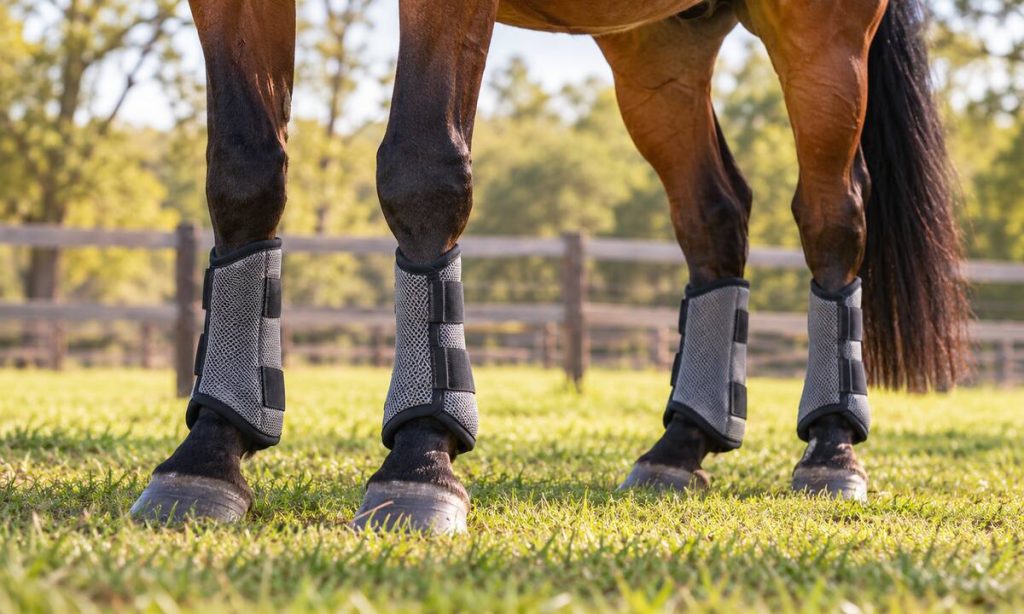
Fly boots can add a layer of mesh between biting insects and a horse’s lower legs, but poor fit can rub, twist, or interfere with movement. The best fly boots for horses depend on leg shape, turnout conditions, closure design, and how often you can inspect them. This comparison looks at seven verified products and their listed features, including pair versus four-piece sets. We do not treat marketing claims as proof of comfort or performance. Measure each leg using the product’s own size chart, supervise the first wear, and remove boots daily to inspect skin and mesh. For broader summer protection, compare our horse fly mask guide, horse fly spray roundup, and safe fly spray use guide.
Quick Picks
| Product | Best For | Key Advantage | Buy | |
|---|---|---|---|---|
| TAILNERY Fly Boots for Horses, Set of 4 | curved-edge stay-up design | Mesh coverage with fit checks | View on Amazon | Jump to Review |
| Harrison Howard Loose-Fitting Fly Boots, 4-Pack | UV-protective mesh claim | Mesh coverage with fit checks | View on Amazon | Jump to Review |
| CareMaster Fine Mesh Horse Fly Boots, Set of 4 | universal-size style | Mesh coverage with fit checks | View on Amazon | Jump to Review |
| Breathable Mesh Horse Fly Boots, Set of 4 | multiple equine-size labels | Mesh coverage with fit checks | View on Amazon | Jump to Review |
| Harrison Howard Contoured Horse Fly Boots | contoured leg coverage | Mesh coverage with fit checks | View on Amazon | Jump to Review |
| ShooFly Horse Leggins | loose-fitting plastic mesh | Mesh coverage with fit checks | View on Amazon | Jump to Review |
| Cashel Crusader Horse Leg Guard Fly Boots | two-guard set | Mesh coverage with fit checks | View on Amazon | Jump to Review |
1. TAILNERY Fly Boots for Horses, Set of 4

- Four boots in set
- Curved-edge design
- Adjustable closure
- Built-in anti-sag stays
- Fit depends on measurements
- No universal fit guarantee
TAILNERY’s set includes four fly boots and uses a curved-edge shape with built-in stays, according to its product details. The listing gives a length of 14.5 inches and a circumference range that varies from top to bottom, with an adjustable hook-and-loop closure. Those measurements can help you compare the model with your horse’s legs, but they do not replace measuring each leg and checking the brand’s size guidance. The product description also says the mesh is designed for airflow and the stays help reduce sagging. These are useful features to inspect on arrival, not promises that the boots will stay in place for every horse. Check how the boot’s top and bottom edges line up with the knee, hock, fetlock, and coronet on your horse.
Before turnout, check that each boot sits below the knee or hock as intended, clears the ground, and does not twist or rub during movement. Look for contact points around the fetlock and coronet, then remove the boots daily to inspect skin and mesh. A secure fit should not restrict normal movement or create pressure. Replace damaged gear if seams, closures, or mesh no longer hold.
The listing’s curved shape may appeal if ordinary wraps slide or bunch, while the adjustable circumference offers some flexibility. The key tradeoff is that fit depends on conformation and measurement, and the four-pack’s stated range may not suit every horse. Choose it only after comparing your horse’s measurements with the current product chart. Recheck the fit after the first turnout and inspect the lower edge for trapped material.
My Recommendation
Consider this set when its measurement range matches your horse and you want four curved-edge boots with stays. The adjustable shape is its main draw; the tradeoff is that correct fit still depends on careful measuring and daily checks. Recheck the fit after the first turnout.
2. Harrison Howard Loose-Fitting Fly Boots, 4-Pack

- Four fasteners
- Ventilated mesh
- Sewn-in support stays
- Loose-cut design
- Size-specific variation
- UV claim not independently tested
Harrison Howard’s loose-fitting four-pack is described as ventilated mesh with a UV-protection claim, sewn-in nylon stays, and four touch fasteners. The loose cut is intended to allow air movement and avoid a tight wrap-like feel. The stays are meant to help the boots remain upright, and the fasteners provide several adjustment points. Those design details make this model a candidate for owners looking for a mesh boot with a more open fit. The listing’s protection claims are not independent test results, so judge the equipment by its actual coverage, fit, and condition rather than assuming a specific level of insect or sun protection. Even an adjustable closure has a usable range, so compare the chart rather than assuming the straps solve every size mismatch.
Size and leg shape still matter, even with multiple fasteners. Check the supplied size chart and try each boot under supervision before relying on it for a full turnout period. Confirm the top edge does not pinch, the lower edge clears the ground, and the boot does not rotate as the horse walks. A loose design can shift if the fasteners are not positioned correctly, while an overtightened closure can rub.
Inspect the mesh for snags after use and clean it in line with its care directions. This four-pack may suit owners who prefer breathable, adjustable leg coverage. Its main limitation is that “stay-on” language cannot replace fit checks, especially for horses that roll, stomp, or catch equipment on fencing. Inspect each closure point after use, especially if the horse has rolled or moved through brush.
My Recommendation
This option may suit owners who want an open mesh style with several closure points. Its UV wording is a product claim, not independent testing. Prioritize the size chart and supervised fit trial, especially for horses that roll or catch equipment. Inspect closure points after each use.
3. CareMaster Fine Mesh Horse Fly Boots, Set of 4

- Four-piece coverage
- Fine mesh
- Fleece-trim edges
- Built-in stay
- Universal sizing needs checking
- Trim needs regular inspection
CareMaster’s set contains four fine-mesh leggings and is listed as a universal-size style. The product information describes a UV-proof mesh, elastic edges with fleece trim, and a built-in nylon stay intended to reduce sliding. It also describes coverage extending from the knee area toward the coronet band. These features position the set as a full-leg fly accessory for turnout, but “universal” should not be read as one-size-fits-every-horse. Compare the advertised dimensions and closure position with your horse’s conformation. A product listing is not a substitute for examining the actual boot once it arrives. Fleece trim can hold moisture or grit, which makes cleaning and drying part of routine care.
Fleece edging may be useful where a horse is prone to rubbing, but it still needs frequent inspection because dirt, moisture, or a shifted seam can irritate skin. Fit each leg separately and make sure the boots do not interfere with joint movement or touch the ground. Remove them at least daily to check for heat, dampness, damage, or pressure marks.
The set-of-four format simplifies coverage, while the universal-size claim may reduce precision for unusually small or large legs. CareMaster is worth comparing when you want a four-piece fine-mesh design with stays and soft trim. Choose a size-specific model if its measurements offer a better match or if the universal style bunches during a supervised trial. Introduce the boots during supervised turnout so you can spot shifting early.
My Recommendation
Choose it if a four-piece mesh set with fleece edging matches your horse’s measurements. The universal-size label is the main caveat. Stop using it if the boots bunch, rub, or interfere with normal movement. Use close supervision during the first trial.
4. Breathable Mesh Horse Fly Boots, Set of 4

- Set covers four legs
- Mesh construction
- Several size labels
- Fleece-edge design
- Limited measurement detail
- Monitor for shifting
This four-piece listing describes breathable mesh boots for horses, ponies, and donkeys, with contoured shaping and fleece trim. The product copy says the design is intended to reduce shifting and rubbing while allowing air circulation. It also presents the boots as suitable for several equine sizes, so check the available size variation closely before ordering. A shared category label does not prove that one set fits every animal listed; body size, leg length, and the circumference at different points all matter. Confirm the item variation and compare its chart against each leg rather than relying only on the photo. Confirm each selected variation and color before checkout because listing photos may show a different size.
Fleece trim can soften an edge, but the full boot must still stay clear of the ground and avoid constricting movement. Put the boots on while supervised and watch the horse walk, turn, and graze. Check for rotation, bunching, rubbing, or loose closures, then remove the set to inspect the skin.
The listing’s breathable and comfort wording is not a guarantee against heat or irritation, so use common-sense monitoring in warm weather and stop using a boot that causes discomfort. This model may appeal when you need a four-pack and the exact size variation matches your horse. Its main tradeoff is limited detail in the listing about measurement ranges, making fit verification especially important. Remove the boots if the horse begins stomping more or appears uncomfortable.
My Recommendation
Consider this when the selected variation truly matches your horse’s size. Its four-piece format is convenient, but the listing gives limited measurement detail. Try the boots under supervision and inspect the skin after removal. Do not treat mesh coverage as a substitute for care.
5. Harrison Howard Contoured Horse Fly Boots

- Four-boot set
- Contoured pattern
- Dense mesh fabric
- Fleece edging
- Large size variation listed
- Shaped fit may not suit all legs
Harrison Howard’s contoured set is presented as four dense-mesh leg guards with fleece edging. The listing emphasizes a shaped profile, airflow, and a fit intended to follow the leg. This differs from a loose, open-sided leggins style: it aims for more contact along the leg while still using mesh. The listing describes the product in a large size variation, so verify the selected size before checkout. The product identity and stated construction help you compare it with other mesh designs, but the listing does not supply independent durability testing or a universal fit guarantee. Mesh construction can differ in density and flexibility, so inspect the actual item before extended use.
Contoured coverage can be useful when a horse’s leg shape suits the pattern, yet it can also make sizing more exacting. Check the circumference and length chart for all four legs. After fitting, watch for rubbing at the top and bottom edges, heat, trapped debris, or a boot that rotates. Fleece trim should remain clean and intact; loose fibers or damaged seams are reasons to stop using the item.
Remove the set regularly for skin checks, especially after wet or muddy turnout. This option may suit an owner seeking a more shaped fit with padded edging. Choose a loose-fitting alternative if the contoured model presses on the leg or restricts natural movement. Stop promptly if rubbing, heat, or pressure marks appear under an edge.
My Recommendation
This model is worth comparing when a contoured shape and fleece edges suit your horse. Its fit may be less forgiving than a loose style. Use it only if each boot stays clear of joints and ground. Stop promptly if pressure marks appear.
6. ShooFly Horse Leggins

- Open plastic mesh
- Felt lower edge
- Sewn-in stays
- Pair quantity stated
- Medium size variation
- Pair rather than four
ShooFly Leggins use a loose-fitting plastic mesh design with a felt-finished lower edge and sewn-in stays, according to the product details. The stated purpose of the open structure is to let air circulate around the legs, while the felt edge is intended to reduce debris such as plant awns from entering. The product is listed as a pair in a specific blue-and-medium variation. That variation matters: this page should not be treated as evidence that another size or color has identical availability. The design is distinct from a close-fitting fabric wrap, so compare the coverage and leg shape with your horse’s needs. Patented or contoured descriptions do not guarantee that the pattern suits a particular leg shape.
A loose fit may reduce compression, but it can also shift if the horse’s legs are outside the intended range. Confirm that the closures remain secure, the boots do not catch on vegetation, and the lower edge stays clear of the ground. The felt trim should be checked for wear and packed debris. Review the current manufacturer directions for cleaning and storage, and remove the boots daily to look for rubs or damage.
ShooFly may suit a horse that tolerates a more open mesh style and an owner who wants to inspect the lower edge easily. The main limitation is the pair format and size-specific variation; confirm the quantity needed to cover the legs you intend to protect. Confirm the package quantity before ordering and plan for the legs you intend to cover.
My Recommendation
Pick ShooFly if you prefer an open plastic-mesh leggins style and the medium pair is the right size. The pair quantity is the main tradeoff. Confirm whether two or four boots are needed for your plan. Confirm the package quantity before ordering.
7. Cashel Crusader Horse Leg Guard Fly Boots

- Mesh construction
- Pair quantity stated
- Size option available
- Simple guard format
- Only two boots listed
- Check exact coverage
Cashel Crusader Fly Boots are sold as a set of two guards in the verified listing, with a durable mesh construction and a selected size. That two-piece quantity is important when comparing roundups, because some competing products include four boots. The listing also says the mesh is designed to reduce fly irritation and stomping, but the article does not treat that as a guaranteed behavioral result. Use the exact model and size chart to determine which legs the pair is intended to cover and whether you would need another set for four-leg coverage. A two-piece listing should be compared separately from four-boot sets when planning coverage.
Mesh leg guards need a careful fit check even when the material feels flexible. Confirm that the upper edge does not press into the leg, the lower edge does not drag, and the boots stay positioned during walking. Remove them daily to check for dirt, moisture, rub marks, and tears. If the horse has skin lesions or persistent irritation, ask a veterinarian before covering the area.
The set-of-two quantity may be useful if you only need to cover two legs, but it can add cost or complexity when all four require protection. Cashel is a straightforward option to compare when its size and pair configuration fit your plan. Verify the current listing before purchase, since packaging and variations can change. Measure both legs and compare them with the chart before choosing a size.
My Recommendation
Choose Cashel if you need a two-guard set and the selected size fits the intended legs. Its straightforward mesh format is the advantage; quantity is the limitation. Confirm pack contents before ordering. Measure both legs before choosing a size. Recheck the fit after the first turnout.
How to Choose Fly Boots for Horses
Start with the problem you want to address. Fly boots cover the lower legs; they do not replace turnout management, fly control around the barn, or veterinary attention for wounds and skin disease. Check your horse’s history and environment, then select a boot style suited to the expected turnout and supervision. If a horse has open sores, swelling, lameness, or persistent irritation, consult a veterinarian before covering the area.
Measure for the product’s own chart
Sizing varies between brands and patterns. Measure the length and circumference requested by the manufacturer instead of assuming “medium,” “large,” or “universal” means the same thing across products. Check whether a listing is for a pair or a set of four. A boot should stay positioned without pressing into the leg, restricting movement, or dragging at the bottom. Try one set while supervised and watch the horse walk, turn, and graze.
Compare construction and closure
Mesh allows airflow, while denser panels may feel more substantial. Fleece or felt edging can soften contact points but must remain clean and intact. Sewn-in stays, contoured shapes, and multiple hook-and-loop closures may help a boot hold its shape; they cannot compensate for the wrong size. Look for closures that stay fastened without overtightening. Avoid loose straps that could snag on fencing or vegetation, and follow the product’s care directions.
Inspect daily and respond to discomfort
Remove boots at least daily to inspect the skin, seams, mesh, closures, and any areas hidden under the edges. Check for rubbing, dampness, heat, debris, tears, and signs that a boot has twisted. Stop use if the horse shows new distress, the gear shifts repeatedly, or the skin looks sore. Replace damaged boots rather than patching a critical closure with loose material. Fly boots are one tool in seasonal management; choosing the right pair means balancing coverage with fit, airflow, safe movement, and reliable daily checks.
Take photos of the fitted boots from the front and side during the first supervised session if that helps you compare their position later. Remove them before checking skin, then clean and dry them as directed. A boot that shifts repeatedly should be replaced with a better-fitting style rather than tightened beyond its intended adjustment.
Frequently Asked Questions
Do fly boots help protect a horse’s legs?
They provide a physical mesh layer over covered areas. Fit, coverage, and condition determine whether they are suitable for an individual horse.
Should fly boots cover all four legs?
That depends on the horse and product. Check what the set includes and discuss persistent skin or insect problems with a veterinarian.
How tight should fly boots fit?
Follow the brand’s fit directions. They should remain positioned without pressure, rubbing, or interference with movement.
Can a horse wear fly boots all day?
Use the product directions and inspect the horse regularly. Remove them daily to check skin, mesh, and closures.
When should I stop using a boot?
Stop if it twists, rubs, becomes damaged, or the horse shows discomfort. Seek veterinary advice for skin injury or lameness.
Final Verdict
TAILNERY’s set has the clearest adjustable measurement details, while ShooFly offers a distinct loose-fitting plastic-mesh style. The right choice depends on the horse’s measurements and the pack quantity you need. Supervise the first wear, check for shifting, and inspect the legs daily. No feature claim can replace a safe fit and ongoing observation.
Affiliate disclosure: This article contains Amazon affiliate links. If you purchase through them, PetAdvisorPro may earn a commission. As an Amazon Associate I earn from qualifying purchases.