
Horses with Cushing’s disease, also called pituitary pars intermedia dysfunction or PPID, need more than a promising supplement label. Veterinary diagnosis, prescribed pergolide where indicated, careful feeding, and assessment of insulin status form the foundation of responsible management. The best supplements for horses with Cushing’s should address specific nutritional needs rather than promise a cure or replacement for medication. Here we compare seven identifiable products: metabolic blends, herbal mixtures, chasteberry, and concentrated vitamin E. We distinguish documented ingredients from unsupported claims about hormonal balance or laminitis prevention. Some products may suit a carefully assessed diet, while others offer little reason for use. A horse with painful feet, changing appetite, or worsening signs needs veterinary attention promptly. Use this guide as a product comparison alongside—not instead of—your veterinarian’s treatment plan.
Quick Picks
| Product | Best For | Key Advantage | Buy | |
|---|---|---|---|---|
| Formula 707 MetaStable Pellets | metabolic feed plans | leucine B6 resveratrol | View on Amazon | Jump to Review |
| Equithrive MetaCare Pellets | easy-keeper nutritional review | resveratrol flavonoids | View on Amazon | Jump to Review |
| HEIRO Equine Insulin Rescue | herbal formula comparison | magnesium vitamin E herbs | View on Amazon | Jump to Review |
| Silver Lining Herbs Pituitary Support | coat and seasonal shedding focus | barberry burdock kelp | View on Amazon | Jump to Review |
| SU-PER Chasteberry Liquid | chasteberry evidence comparison | liquid chasteberry | View on Amazon | Jump to Review |
| Kentucky Performance Elevate Maintenance | targeted vitamin E need | natural vitamin E powder | View on Amazon | Jump to Review |
| Mad Barn Natural Vitamin E | limited-ingredient antioxidant | unsweetened vitamin E powder | View on Amazon | Jump to Review |
1. Formula 707 MetaStable Pellets
What We Like
- Leucine included
- Vitamin B6 listed
- Resveratrol formula
- Pellet serving format
What We Don’t Like
- Not PPID medicine
- Metabolic claims need scrutiny
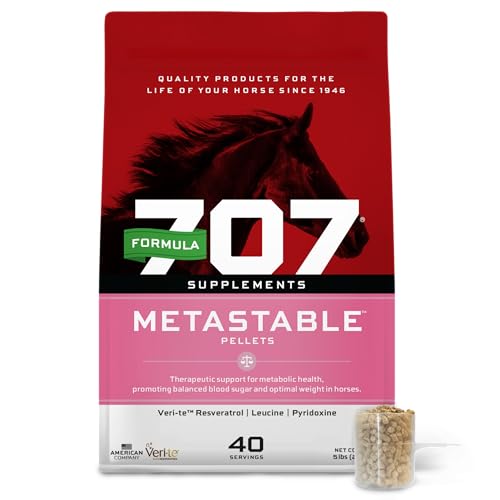
Formula 707 MetaStable Pellets is one option for owners considering metabolic feed plans. Formula 707 MetaStable is a horse pellet supplement marketed for metabolic nutrition. Its ingredient information highlights leucine, vitamin B6, and resveratrol. This is a nutritional product, so its position in the comparison rests on identifiable ingredients and feeding practicality, not proof that it corrects pituitary disease. Products bearing endocrine claims are not equivalent to prescription treatment. Compare this formula with the entire feed and the horse’s insulin results.
The pellet format fits a measured daily feeding routine. Ask your veterinarian whether this combination makes sense with the current diet, insulin results, and prescribed PPID care. Compare its current ingredient list and portion guidance with the full ration. Any supplement must be evaluated around veterinary decisions about PPID, insulin status, and safe feeding. Keep the existing medication and feeding schedule consistent during evaluation. Check sugar, starch, calories, and duplicated vitamins in the actual daily serving. Document what is fed so that total supplement amounts remain clear.
Seller statements about changes in insulin or body weight do not establish guaranteed treatment outcomes. It neither replaces pergolide nor removes laminitis risk. This is a significant limitation when deciding whether to buy. For horses with PPID, supplement selection should never interrupt prescribed care, appropriate forage management, or ongoing veterinary monitoring. Foot pain or reluctance to move calls for urgent veterinary advice. No over-the-counter feed product has been proven to cure PPID. Marketing claims about glucose and ACTH require strong independent evidence.
My Recommendation
My recommendation is to consider Formula 707 MetaStable Pellets only when metabolic feed plans is a specific, veterinarian-reviewed goal. Its leucine B6 resveratrol approach distinguishes it from the other products in this comparison. Seller statements about changes in insulin or body weight do not establish guaranteed treatment outcomes. It neither replaces pergolide nor removes laminitis risk. Review insulin measurements, the full ration, and ongoing prescription care before deciding whether a simpler nutritional addition would be preferable.
2. Equithrive MetaCare Pellets

What We Like
- Resveratrol listed
- Hesperidin and diosmin
- Amino acid ingredients
- Measured pellets
What We Don’t Like
- Not a laminitis treatment
- Complex ingredient mixture
Equithrive MetaCare Pellets is one option for owners considering easy-keeper nutritional review. Equithrive MetaCare is a pellet product whose ingredients include resveratrol, hesperidin, diosmin, and amino acids. It is positioned around carbohydrate metabolism and hoof care. This is a nutritional product, so its position in the comparison rests on identifiable ingredients and feeding practicality, not proof that it corrects pituitary disease. Compare this formula with the entire feed and the horse’s insulin results. Review the current ingredient amounts instead of choosing by a dramatic product name.
A prepared daily serving can be convenient, but compare the complete nutritional analysis with the existing ration before adding another metabolic blend. Compare its current ingredient list and portion guidance with the full ration. Any supplement must be evaluated around veterinary decisions about PPID, insulin status, and safe feeding. Check sugar, starch, calories, and duplicated vitamins in the actual daily serving. Document what is fed so that total supplement amounts remain clear. Ask the veterinarian about possible interactions with prescribed medicines.
The advertised metabolic benefits are not an alternative to testing for insulin dysregulation. It cannot be relied on to prevent laminitis or correct pituitary dysfunction. This is a significant limitation when deciding whether to buy. For horses with PPID, supplement selection should never interrupt prescribed care, appropriate forage management, or ongoing veterinary monitoring. No over-the-counter feed product has been proven to cure PPID. Marketing claims about glucose and ACTH require strong independent evidence. Chasteberry claims are especially important to evaluate against clinical guidance.
My Recommendation
My recommendation is to consider Equithrive MetaCare Pellets only when easy-keeper nutritional review is a specific, veterinarian-reviewed goal. Its resveratrol flavonoids approach distinguishes it from the other products in this comparison. The advertised metabolic benefits are not an alternative to testing for insulin dysregulation. It cannot be relied on to prevent laminitis or correct pituitary dysfunction. Review insulin measurements, the full ration, and ongoing prescription care before deciding whether a simpler nutritional addition would be preferable.
3. HEIRO Equine Insulin Rescue

What We Like
- Magnesium listed
- Vitamin E included
- Equine feed powder
- Metabolic nutritional category
What We Don’t Like
- Lengthy herbal blend
- Name overstates evidence
HEIRO Equine Insulin Rescue is one option for owners considering herbal formula comparison. HEIRO lists magnesium and vitamin E together with botanicals such as fenugreek, kelp, spirulina, and cinnamon. Its seller markets the formula as metabolic support. This is a nutritional product, so its position in the comparison rests on identifiable ingredients and feeding practicality, not proof that it corrects pituitary disease. Review the current ingredient amounts instead of choosing by a dramatic product name. PPID and insulin dysregulation need individualized veterinary management.
That combination requires a review of the horse’s current mineral intake, medical history, and medication. Product naming should not be mistaken for clinical proof. Compare its current ingredient list and portion guidance with the full ration. Any supplement must be evaluated around veterinary decisions about PPID, insulin status, and safe feeding. Document what is fed so that total supplement amounts remain clear. Ask the veterinarian about possible interactions with prescribed medicines. One change at a time makes tolerance easier to follow.
An extended herbal ingredient list may complicate identifying adverse reactions or interactions. This powder is not a replacement for veterinary insulin management or pergolide. This is a significant limitation when deciding whether to buy. For horses with PPID, supplement selection should never interrupt prescribed care, appropriate forage management, or ongoing veterinary monitoring. Marketing claims about glucose and ACTH require strong independent evidence. Chasteberry claims are especially important to evaluate against clinical guidance. Select a simpler alternative when the long ingredient panel adds uncertainty.
My Recommendation
My recommendation is to consider HEIRO Equine Insulin Rescue only when herbal formula comparison is a specific, veterinarian-reviewed goal. Its magnesium vitamin E herbs approach distinguishes it from the other products in this comparison. An extended herbal ingredient list may complicate identifying adverse reactions or interactions. This powder is not a replacement for veterinary insulin management or pergolide. Review insulin measurements, the full ration, and ongoing prescription care before deciding whether a simpler nutritional addition would be preferable.
4. Silver Lining Herbs Pituitary Support

What We Like
- Horse-focused herbal powder
- Barberry and burdock
- Kelp listed
- Feed-mix application
What We Don’t Like
- Hormone effect unproven
- Herbs require vet screening
Silver Lining Herbs Pituitary Support is one option for owners considering coat and seasonal shedding focus. Silver Lining Herbs Pituitary Support combines botanical ingredients such as barberry, burdock, and kelp. The listing refers to pituitary function, shedding, and metabolism. This is a nutritional product, so its position in the comparison rests on identifiable ingredients and feeding practicality, not proof that it corrects pituitary disease. PPID and insulin dysregulation need individualized veterinary management. The value of a nutrient addition depends on a documented diet gap.
The coat-focused message is relevant to common PPID concerns, but it does not establish that this formula improves a horse’s hormone results. Check every ingredient. Compare its current ingredient list and portion guidance with the full ration. Any supplement must be evaluated around veterinary decisions about PPID, insulin status, and safe feeding. Ask the veterinarian about possible interactions with prescribed medicines. One change at a time makes tolerance easier to follow. Keep the existing medication and feeding schedule consistent during evaluation.
Chronic shedding abnormalities should prompt veterinary monitoring. Herbal pituitary wording must not be interpreted as evidence of lower ACTH or a substitute for established treatment. This is a significant limitation when deciding whether to buy. For horses with PPID, supplement selection should never interrupt prescribed care, appropriate forage management, or ongoing veterinary monitoring. Chasteberry claims are especially important to evaluate against clinical guidance. Select a simpler alternative when the long ingredient panel adds uncertainty. Foot pain or reluctance to move calls for urgent veterinary advice.
My Recommendation
My recommendation is to consider Silver Lining Herbs Pituitary Support only when coat and seasonal shedding focus is a specific, veterinarian-reviewed goal. Its barberry burdock kelp approach distinguishes it from the other products in this comparison. Chronic shedding abnormalities should prompt veterinary monitoring. Herbal pituitary wording must not be interpreted as evidence of lower ACTH or a substitute for established treatment. Review insulin measurements, the full ration, and ongoing prescription care before deciding whether a simpler nutritional addition would be preferable.
5. SU-PER Chasteberry Liquid

What We Like
- Liquid supplement format
- Chasteberry main focus
- Sugar-free listing
- Horse-specific product
What We Don’t Like
- No proven ACTH control
- Not a pergolide alternative
SU-PER Chasteberry Liquid is one option for owners considering chasteberry evidence comparison. SU-PER Chasteberry is a liquid supplement for horses advertised around hormone and pituitary balance. The product listing describes a sugar-free formula. This is a nutritional product, so its position in the comparison rests on identifiable ingredients and feeding practicality, not proof that it corrects pituitary disease. The value of a nutrient addition depends on a documented diet gap. Products bearing endocrine claims are not equivalent to prescription treatment.
The easy-to-measure liquid format is secondary to the much more important scientific question. Veterinary guidelines do not show reliable ACTH lowering or added benefit with pergolide. Compare its current ingredient list and portion guidance with the full ration. Any supplement must be evaluated around veterinary decisions about PPID, insulin status, and safe feeding. One change at a time makes tolerance easier to follow. Keep the existing medication and feeding schedule consistent during evaluation. Check sugar, starch, calories, and duplicated vitamins in the actual daily serving.
We would not choose chasteberry to treat PPID. Discuss it with the managing veterinarian before combining it with medications or using the product for any other purpose. This is a significant limitation when deciding whether to buy. For horses with PPID, supplement selection should never interrupt prescribed care, appropriate forage management, or ongoing veterinary monitoring. Select a simpler alternative when the long ingredient panel adds uncertainty. Foot pain or reluctance to move calls for urgent veterinary advice. No over-the-counter feed product has been proven to cure PPID.
My Recommendation
My recommendation is to consider SU-PER Chasteberry Liquid only when chasteberry evidence comparison is a specific, veterinarian-reviewed goal. Its liquid chasteberry approach distinguishes it from the other products in this comparison. We would not choose chasteberry to treat PPID. Discuss it with the managing veterinarian before combining it with medications or using the product for any other purpose. Review insulin measurements, the full ration, and ongoing prescription care before deciding whether a simpler nutritional addition would be preferable.
6. Kentucky Performance Elevate Maintenance

What We Like
- Natural vitamin E
- 1,000 IU per scoop
- Powder feeding format
- Clear nutrient focus
What We Don’t Like
- Not PPID therapy
- Dosage depends on ration
Kentucky Performance Elevate Maintenance is one option for owners considering targeted vitamin E need. Elevate Maintenance Powder is a concentrated natural vitamin E supplement. The listing specifies 1,000 IU of vitamin E in a seven-gram scoop. This is a nutritional product, so its position in the comparison rests on identifiable ingredients and feeding practicality, not proof that it corrects pituitary disease. Products bearing endocrine claims are not equivalent to prescription treatment. Compare this formula with the entire feed and the horse’s insulin results.
This simpler nutrient approach may make sense if a veterinarian establishes that the ration lacks vitamin E. It is easier to assess than a complex mixed-herb product. Compare its current ingredient list and portion guidance with the full ration. Any supplement must be evaluated around veterinary decisions about PPID, insulin status, and safe feeding. Keep the existing medication and feeding schedule consistent during evaluation. Check sugar, starch, calories, and duplicated vitamins in the actual daily serving. Document what is fed so that total supplement amounts remain clear.
Extra vitamin E does not treat PPID itself. The appropriate amount depends on forage access, existing fortified feed, and the horse’s individual nutritional requirements. This is a significant limitation when deciding whether to buy. For horses with PPID, supplement selection should never interrupt prescribed care, appropriate forage management, or ongoing veterinary monitoring. Foot pain or reluctance to move calls for urgent veterinary advice. No over-the-counter feed product has been proven to cure PPID. Marketing claims about glucose and ACTH require strong independent evidence.
My Recommendation
My recommendation is to consider Kentucky Performance Elevate Maintenance only when targeted vitamin E need is a specific, veterinarian-reviewed goal. Its natural vitamin E powder approach distinguishes it from the other products in this comparison. Extra vitamin E does not treat PPID itself. The appropriate amount depends on forage access, existing fortified feed, and the horse’s individual nutritional requirements. Review insulin measurements, the full ration, and ongoing prescription care before deciding whether a simpler nutritional addition would be preferable.
7. Mad Barn Natural Vitamin E

What We Like
- 1,000 IU per scoop
- No added sugar listed
- Natural vitamin E
- Simple ingredient approach
What We Don’t Like
- Extra vitamin E may be needless
- Not an endocrine treatment
Mad Barn Natural Vitamin E is one option for owners considering limited-ingredient antioxidant. Mad Barn Natural Vitamin E contains d-alpha-tocopheryl acetate, with a listed 1,000 IU per scoop. Its product information describes no added sugars, starches, or fillers. This is a nutritional product, so its position in the comparison rests on identifiable ingredients and feeding practicality, not proof that it corrects pituitary disease. Compare this formula with the entire feed and the horse’s insulin results. Review the current ingredient amounts instead of choosing by a dramatic product name.
A limited-ingredient option may appeal when carbohydrates are being managed and extra vitamin E is indicated by the feeding assessment. Compare actual concentrations and serving instructions. Compare its current ingredient list and portion guidance with the full ration. Any supplement must be evaluated around veterinary decisions about PPID, insulin status, and safe feeding. Check sugar, starch, calories, and duplicated vitamins in the actual daily serving. Document what is fed so that total supplement amounts remain clear. Ask the veterinarian about possible interactions with prescribed medicines.
A low-additive formulation does not mean that every horse needs the nutrient. This remains nutritional support, not a treatment for pituitary disease. This is a significant limitation when deciding whether to buy. For horses with PPID, supplement selection should never interrupt prescribed care, appropriate forage management, or ongoing veterinary monitoring. No over-the-counter feed product has been proven to cure PPID. Marketing claims about glucose and ACTH require strong independent evidence. Chasteberry claims are especially important to evaluate against clinical guidance.
My Recommendation
My recommendation is to consider Mad Barn Natural Vitamin E only when limited-ingredient antioxidant is a specific, veterinarian-reviewed goal. Its unsweetened vitamin E powder approach distinguishes it from the other products in this comparison. A low-additive formulation does not mean that every horse needs the nutrient. This remains nutritional support, not a treatment for pituitary disease. Review insulin measurements, the full ration, and ongoing prescription care before deciding whether a simpler nutritional addition would be preferable.
How to choose best supplements for horses with cushing’s
Choosing the best supplements for horses with Cushing’s requires a veterinary PPID plan, not a replacement for one. Start by checking medication, insulin testing, diet composition, and whether any nutrient is actually missing. Avoid selecting a supplement because its name promises hormone or glucose control.
Separate PPID treatment from optional nutrition
Pergolide is an established veterinary treatment for many horses with PPID, while a feed supplement should not be assumed to normalize ACTH. Insulin dysregulation is related but must be evaluated separately because it may influence pasture and forage decisions. The veterinary insulin assessment guide explains how clinicians assess this issue. Discuss unusual hair shedding, drinking, muscle changes, infections, and hoof pain with your veterinarian. Don’t assume these signs indicate that another herb is needed. A product’s name can be misleading when it suggests ‘insulin rescue’ without sufficient evidence. Continue prescribed medication and follow-up testing while nutrition choices are assessed separately.
Check the carbohydrate profile and nutritional gaps
Some PPID horses need carefully managed nonstructural carbohydrates, while others may have different nutritional needs due to age, body condition, or reduced fresh pasture access. Our PPID feeding discussion guide covers topics for an appointment. Look at the entire ration, not just whether a supplement is labeled sugar-free. Vitamin E may matter if dietary intake is low, but excess supplementation does not treat PPID. Also consider sugar, starch, total calories, magnesium, selenium, and overlapping fortified products. Choose products with clearly stated nutrient concentrations when possible. Do not use metabolic marketing as a substitute for clinical insulin tests or a safe feeding plan.
Evaluate evidence, interactions, and follow-up
A multi-herb blend requires extra care because precise ingredient concentrations and medication interactions may be unclear. Chasteberry has not shown a proven benefit for ACTH control or added value with pergolide in veterinary guidelines. Check whether a supplement’s claims come from independent equine studies or only its own marketing. Maintain a written record of all medications and nutritional products. Watch body condition consistently using our horse body-condition monitoring guide. Any new foot pain, reluctance to walk, or other signs of laminitis require urgent veterinary evaluation. Buying another supplement is not an appropriate first response to those symptoms. Ask how each nutritional decision will be assessed and when it should be reviewed.
Frequently Asked Questions
Can supplements replace pergolide for PPID?
No. Supplements do not replace a veterinary diagnosis and prescribed medical treatment. Pergolide is an established treatment for many horses with PPID.
Does chasteberry lower ACTH in horses?
Clinical guidelines do not show a proven ACTH-lowering effect, or an established benefit from adding chasteberry to pergolide treatment.
Does every PPID horse need additional vitamin E?
No. Vitamin E needs vary with forage, pasture access, existing fortified feeds, and individual health. Seek a complete ration assessment.
Are PPID and insulin resistance the same condition?
No. They may coexist, but insulin dysregulation needs a separate veterinary assessment and often changes feeding choices.
What signs should prompt urgent veterinary attention?
New foot pain, reluctance to move, or other signs of laminitis need prompt attention. Do not delay care to try a supplement.
Final Verdict
If your veterinarian identifies a vitamin E gap, a clearly labeled, single-nutrient product may be easier to evaluate than a complicated herbal mixture. Formula 707 and Equithrive offer broader metabolic formulas, but they do not substitute for PPID treatment. We would not use chasteberry as a pergolide replacement. Keep insulin testing, feeding choices, and laminitis surveillance central to care. Our hay guide for insulin-resistant horses helps with another related decision.
Affiliate disclosure: This article contains Amazon affiliate links. If you purchase through them, PetAdvisorPro may earn a commission. As an Amazon Associate I earn from qualifying purchases.









