
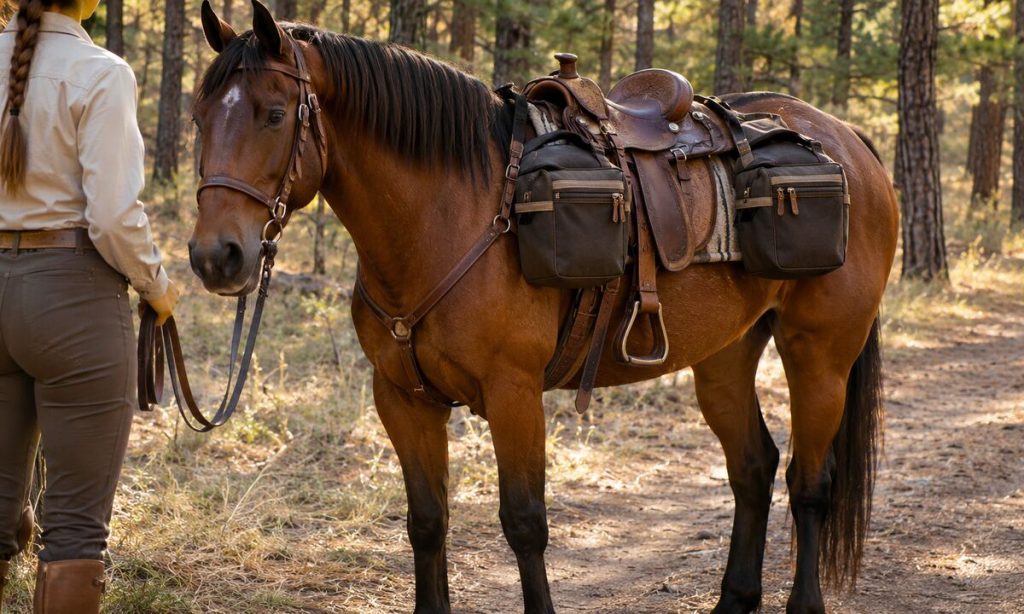
Packing cool drinks and food for a long trail ride takes more thought than choosing a roomy pouch. The best insulated saddle bags for horses balance cooling space with secure saddle attachment, even weight, and easy access. Some use padded side coolers, while others protect a smaller lunch or bottle behind the saddle. Insulation alone cannot replace a safe load or food-temperature precautions. This guide compares seven verified saddle-mounted options, from full-size rear coolers to compact cantle and pommel bags. You’ll see where each design works, what its listing actually supports, and what to measure before buying. If you mainly need dry gear storage, our general horse saddle bag guide covers non-insulated alternatives too.
Quick Picks
These seven choices solve different carrying problems. Compare the cooling location, attachment style, and practical tradeoffs before jumping to a product.
| Product | Best For | Key Advantage | Buy | |
|---|---|---|---|---|
| Reinsman Insulated Leakproof Cooler Saddle Bag | Balanced rear cooler storage | Two insulated 550-cubic-inch side bags | View on Amazon | Jump to Review |
| Reinsman Deluxe Insulated Cooler Saddle Bag | Longer organized trail trips | Removable coolers and extra pockets | View on Amazon | Jump to Review |
| Tough 1 Insulated Saddle Bag with Pockets | Basic insulated trail storage | Denier nylon and multiple pockets | View on Amazon | Jump to Review |
| Weaver Equine Trail Gear Saddle Bags | Organized mixed gear and snacks | One insulated insert plus gear compartment | View on Amazon | Jump to Review |
| Reinsman Circle Y Pommel Cooler Bag | Quick front access to drinks | Compact insulated pommel design | View on Amazon | Jump to Review |
| Majestic Ally Insulated Horse Saddle Bag | Value-minded leakproof-style coolers | Bright lined side cooler pockets | View on Amazon | Jump to Review |
| TrailMax 500 Insulated Padded Cantle Bag | Compact cantle-space trail gear | Insulated and padded rear compartment | View on Amazon | Jump to Review |
What Makes an Insulated Horse Saddle Bag Worth Carrying?
A cooler attached to a moving saddle behaves differently from a lunch bag in a vehicle. It must stay stable, avoid pressure points, and allow safe mounting. The length of your planned ride determines how much you truly need to carry. Treat any seller’s cooling-duration claim as product-specific, not as a guarantee in summer heat.
1. Reinsman Insulated Leakproof Cooler Saddle Bag

- Paired insulated side compartments
- Separate non-insulated cantle storage
- Bright interior lining
- Multiple Western saddle attachment options
- Bedroll or rain-gear straps
- Cantle compartment lacks insulation
- Requires suitable rear saddle tie points
The Reinsman Insulated Cooler Saddle Bag is a full rear-carrying setup for riders who want chilled food beside ordinary trail gear. Its product listing describes an insulated side bag on each side of the saddle. Each cooler is rated at 550 cubic inches, with room the seller compares to thirteen cans. A separate center cantle compartment handles items that do not need cooling. This distinction matters: only the side compartments are insulated. It helps you plan where food belongs instead of assuming the entire package works as a cooler.
The bag uses SRB buckle attachments and is marketed for Western saddles with suitable rear rings, cinch slots, or saddle strings. That gives riders several possible attachment methods, but it is not a universal-fit promise. Measure your tie points and check the available clearance behind your seat. The listing also describes a bright blue interior and both top-zip access and a larger opening for filling. Those details are handy when you stop briefly without completely unpacking. Separate straps can carry a rolled layer or lightweight rain gear.
For longer day rides, the combination of cooler pockets and a distinct center storage area is the main advantage. It also creates a temptation to pack too much. Keep the two sides similarly loaded, secure every loose strap, and walk the horse before riding to spot bounce or rubbing. Ice packs may help keep food cooler, but check food safety independently. A saddle bag cannot guarantee perishable meals remain at a safe temperature during a hot trail ride. The bulky layout may be unnecessary for short rides with minimal gear.
My Recommendation
Choose this Reinsman setup if you want a familiar paired cooler configuration on a compatible Western saddle. It separates snacks from ordinary gear and offers several carrying points. Its main drawback is bulk when fully packed. For a small drink supply and front access, the Reinsman Pommel Cooler is easier to manage.
2. Reinsman Deluxe Insulated Cooler Saddle Bag

- Detachable insulated side coolers
- Two listed bottle holders
- Additional interior storage pockets
- Quick-release buckle attachment
- Padded carrying handle
- More hardware to check before departure
- Higher bulk than compact saddle pouches
The Deluxe Reinsman Cooler builds on the standard insulated rear-bag idea by adding more organization. According to its current listing, it includes two insulated, leakproof side compartments. Each side is described as holding 550 cubic inches. The center cantle space and rain-gear straps stay useful for non-chilled belongings. The deluxe design also provides extra interior pockets and bottle holders, making it easier to separate a phone, small tools, snacks, and routine riding necessities. It suits a rider who dislikes digging through one shared compartment at every stop.
A key difference is that the side coolers can be removed and carried using a padded handle. That may simplify loading at the trailer or taking food to a picnic table. It does not mean you should detach bags while the horse is moving. The seller describes compatibility with different Western saddle shapes, including round and square skirts. Still, exact positioning depends on the saddle’s rear hardware and the horse’s build. Check the current bag measurements and attachment diagrams instead of trusting a generalized fit claim.
Extra storage is useful only when you maintain good weight distribution. A bottle, ice pack, and food container can create a surprisingly uneven load. Pack one side, compare it with the other, and adjust before tightening the straps. Check that the bags do not press against the horse’s back or interfere with reins and rider movement. The Deluxe version offers more flexibility than a basic cooler pair, but that flexibility brings more buckles and pockets to inspect. Riders seeking a simpler setup may prefer a compact cantle bag.
My Recommendation
This is my pick for riders who value separate pockets and removable cooler sections. The additional organization can make full-day trail stops less awkward. Expect a more involved fitting and packing process. If you rarely need extra pockets, the simpler Reinsman insulated pair provides much of the cooling layout with fewer features to manage.
3. Tough 1 Insulated Saddle Bag with Pockets

- Insulated model named in listing
- Heavy-denier nylon shell
- Multi-pocket arrangement
- Protective pocket flaps
- Sparse insulation specification
- Check actual measurements before ordering
The Tough 1 Insulated Saddle Bag with Pockets is a practical candidate for riders who want a conventional tack shape without an elaborate modular system. The verified item title identifies it as an insulated saddle bag. Its short feature list confirms heavy-denier nylon, several pockets, and a flap designed to help keep items contained. Those are useful details for a trail day when drinks must share space with small accessories. However, the listing information reviewed here does not establish an insulation thickness, tested hold time, or exact capacity.
That evidence gap should shape your decision. Do not assume the bag performs like a dedicated soft-sided camping cooler simply because its title says insulated. Confirm with the current listing which sections have insulation and whether seams and closures resist leaks. Also check whether the bag attaches to rear saddle hardware, a cantle tie, or another specific point. A neat pocket arrangement is convenient, yet unsecured compartments can still swing or open under motion. Put heavier items close to the saddle and avoid hanging bottles far away from the horse.
This option is most attractive when your priority is modest cold-item carrying with extra space for everyday equipment. It may suit casual riders who already know the Tough 1 style and want fewer specialized features. Plan to carry temperature-sensitive food in a suitable inner container and check its temperature at stops. Neither a nylon fabric description nor an insulation label proves waterproofing. If you need documented side capacity and a clearly separated cooler area, the Reinsman products provide more specific listing details. Verify the exact color and configuration before purchase.
My Recommendation
Consider Tough 1 for straightforward storage when you can verify the fit and insulated pocket construction on the current listing. Its simple pocket layout may be all a casual rider needs. Documentation is thinner than for some alternatives, so I would not choose it for an important long-duration cooling requirement without additional confirmation.
4. Weaver Equine Trail Gear Saddle Bags

- Dedicated insulated insert in one side
- Separate pocket-rich gear compartment
- Weather-resistant coated outer shell
- Reflective piping details
- Quick-release covered pockets
- Only one main side gets insulated insert
- Outer weather resistance is not immersion proof
Weaver’s Trail Gear Saddle Bags take a different approach to temperature management. The verified listing describes two padded main compartments, but only one contains an insulated insert for food and drinks. The other is organized for ordinary supplies. This asymmetric arrangement may be especially useful when you need a lunch and a few tools, rather than two full coolers. Separate smaller pockets help assign a place to keys or grooming accessories. The design also uses reflective piping, a useful visibility detail, although it does not replace proper lighting or reflective riding equipment.
The exterior is described as coated polyester with weather-resistant zippers and quick-release buckle closures. Those details may help with splashes and a brief light shower. They do not establish that every seam is fully waterproof. The listing’s denier description is inconsistent across its title and feature wording, so verify the exact material specification before relying on it. The most important practical point is how the insulated insert fits inside the padded compartment. Check its dimensions against your preferred lunch container rather than selecting by an overall bag-volume estimate.
Because one side carries the cooler insert, balanced packing deserves extra attention. Water and ice packs can weigh much more than light tools in the opposite compartment. Adjust the non-insulated side to keep the load even, without adding unnecessary weight. Confirm each bag sits clear of the horse’s back and does not rub during turns. This is a versatile choice for mixed gear on a longer ride, especially if you prefer organization over maximum chilled volume. Riders carrying only cold refreshments may favor a two-sided insulated option instead.
My Recommendation
Pick Weaver if you want one insulated section alongside a well-organized gear compartment. It offers a useful compromise between cooling and everyday trail storage. The tradeoff is its uneven internal layout, which requires deliberate packing. If you expect drinks and food on both sides, a matched insulated cooler pair is a more natural fit.
5. Reinsman Circle Y Pommel Cooler Bag

- Fits at the saddle pommel
- Listing specifies bottle and can capacity
- Top lid and quick-access zipper
- Additional stabilizing attachments
- Separate center pocket
- Less storage than a rear cooler pair
- Front placement needs rein clearance
The Reinsman Circle Y Pommel Cooler is a front-mounted option for riders who want a drink within reach without unpacking rear saddlebags. Its listing describes a nylon cooler that holds four 16-ounce bottles or eight 12-ounce cans with ice. The bag has a top zipper and another quick-access opening. A separate center pocket provides space for small essentials. This focused design makes sense for short-to-medium rides when carrying a complete lunch is unnecessary. Capacity claims describe a packed configuration, not a promise that drinks remain cold for a fixed time.
For attachment, the maker describes an adjustable strap around the saddle swell and extra points to help keep the cooler steady. This matters because anything at the pommel must avoid the rider’s hands, reins, and normal emergency movements. Before departure, confirm the strap arrangement works with your specific saddle. Make sure the cooler does not interfere with horn use or snag on other tack. The seller makes a heat-test claim about ice retention, but outdoor temperature, starting food temperature, and opening frequency change the result considerably. Treat it as a marketing claim to evaluate.
Unlike rear double coolers, this pommel bag concentrates its weight toward the front. That can be convenient for occasional sips, yet it still changes the carrying setup. Use reasonable loads, keep contents secure, and check the horse’s response at a walk. The product is best when you need limited chilled storage and frequent access. If your trip requires sandwiches, layers, and first-aid equipment, this alone will not provide the organizational capacity of a complete rear saddlebag system. Consider pairing separate gear storage only after verifying safe saddle balance.
My Recommendation
I would choose this for easy access to a modest number of drinks on a compatible saddle. Its shorter reach can be convenient during rest stops. It does not substitute for generous rear storage, and front tack clearance is critical. Choose a paired rear cooler if you need substantial food capacity or already carry equipment near the pommel.
6. Majestic Ally Insulated Horse Saddle Bag

- Insulated side pockets in listing
- High-visibility blue liners
- Reflective and padded design details
- Convenient padded carrying handle
- External water-bottle carrying point
- Inspect leakproof claim carefully
- Strap fit varies by saddle setup
The Majestic Ally Insulated Saddle Bag offers a traditional paired design at a different price position from the more elaborate established coolers. Its listing describes insulated and leakproof side pockets, a nylon outer body, and a light blue liner that makes contents easier to see. The named features also include pockets, a bottle carrier, and padding. If you often stop to find one small item, the contrast inside the compartment may be more helpful than it sounds. Still, treat the leakproof description as a seller claim until you inspect construction and care instructions.
The seller describes straps with easy snap closures and a padded handle for carrying the loaded bag off the saddle. Those could simplify packing at home, then installing the bags when the horse is standing calmly. The convenience depends on how the straps align with your saddle’s existing tie points. Check whether loose ends can flap against the horse, and avoid placement that creates pressure beneath the saddle or blocks movement. A reflective element improves the bag’s visual profile, but it should be only one part of a safe visibility plan.
This is a sensible option for a rider who prefers simple coolers and practical exterior details. It may also appeal to someone comparing cost with the Reinsman systems. Verify the particular size and color on the product page, since variations may use different photographs or packaging. You will still need balanced packing, careful cleaning, and temperature management for food. Even an advertised leakproof pocket should be tested with a harmless amount of water away from the horse before you trust it with melting ice. Extra protection is wise for moisture-sensitive belongings.
My Recommendation
Majestic Ally is worth comparing when you want insulated side pockets and a straightforward carrying handle. The bright liner and external storage are useful everyday details. I would closely inspect seams and straps before depending on its leakproof wording. Reinsman’s larger specification set may suit riders who need clearer capacities, but fit decides either purchase.
7. TrailMax 500 Insulated Padded Cantle Bag

- Insulated padded cantle construction
- Ripstop nylon outer material
- Reinforced seams and stress points
- Adjustable attachment straps
- Brass grommets for saddle strings
- Not a two-sided beverage cooler
- Confirm cooling-pocket size for your items
The TrailMax 500 Series Cantle Bag is for riders who want insulation without carrying a pair of full rear coolers. Its product title identifies a padded and insulated cantle design. The current listing also specifies 1680-denier ripstop nylon, reinforced stress points, double-stitched seams, and a nylon lining. Those construction features focus on resilience during repeated trail use. Instead of balancing two large side compartments, you get a more compact space positioned behind the saddle. That makes it especially relevant for day rides with a small supply of snacks and essential gear.
The cantle shape is marketed for Western and endurance saddles. Adjustable straps connect to the saddle rigging, while brass grommets offer saddle-string attachment. You still must check the exact saddle geometry. A bag that fits one cantle may ride too high, press into the seat, or swing on another. Its listed uses include ordinary trail items such as a lead rope, hoof pick, and water bottle. That versatility is useful, but mixing wet cooling packs with tools is rarely ideal without separate protective pouches. Verify any internal divisions before planning your load.
This option is strongest for a rider seeking a compact insulated compartment and durable attachment details. It is less suitable when you need two sides of fully separated cold storage. Keep a cantle bag relatively light so it does not bounce against the horse during gait changes. Check fasteners at walking pace before heading onto a longer trail. The nylon liner offers an additional barrier, but do not interpret it as a certified waterproof seal. For more food and beverage space, move up to an insulated side-bag system with clearly listed cooling compartments.
My Recommendation
TrailMax is my compact rear-cantle choice for modest gear loads and a simple trail silhouette. The attachment details are more specific than those of many basic pouches. You trade away the large cooling capacity of paired bags. For longer outings or several cold drinks, the Reinsman or Weaver designs offer more appropriate internal organization.
How to choose best insulated saddle bags for horses
Start with the saddle and the ride, not the advertised cooling claim. The best insulated saddle bags for horses must remain secure under motion while holding only the food and gear you truly need.
Match insulated space to what you actually pack
A single bottle is different from a full lunch for two riders. Decide what must stay cool and what can travel in ordinary pockets. Paired side coolers separate weight across the saddle, but they can become bulky. A cantle or pommel cooler favors lighter, shorter rides. Confirm whether a product insulates every pocket, only one insert, or only two side containers. Check dimensions for the shape of your food box, not just a cubic-inch capacity claim. Allow room for ice packs without compressing everything. Start with cold food and follow standard food-safety precautions. Insulation slows warming; it does not refrigerate indefinitely. If your main goal is dry storage, the broader saddle bag comparison offers alternatives.
Prioritize saddle attachment and balanced loading
Inspect the saddle’s rings, strings, pommel, and rear straps before shopping. Do not assume that Western or endurance labeling means a bag fits every model. Measure clearance behind the seat and near the horse’s flanks. Choose multiple secure attachment points rather than one swinging strap. Place dense items close to the saddle and distribute their weight thoughtfully. You should not solve a lopsided cooler by adding unnecessary heavy objects. Check that bags do not rub the horse or obstruct mounting, reins, or the rider’s position. An unfamiliar horse may need gradual introduction to the sight and movement of loaded bags. For related saddle-contact concerns, see how to compare saddle pads by fit.
Check weather, cleaning, and trail access
A coated exterior can shed some moisture without being waterproof under sustained rain. Review zipper construction, liners, leakproof claims, and washing directions separately. Choose a design you can empty and clean after carrying food. Transparent capacity claims are more useful than vague promises about staying cold all day. Consider how often you stop: a top zipper can be convenient, but you should never reach awkwardly around unsafe tack while the horse moves. Carry emergency and horse-care equipment where it remains accessible. Build your packing list around the pace and distance of the planned ride, then reassess the load before departure. Replace worn straps or damaged buckles before carrying supplies on a moving horse.
Frequently Asked Questions
These practical questions help you narrow the choice and pack conservatively before the next trail ride.
Will insulated saddle bags keep food cold all day?
Not reliably. Cooling depends on starting temperature, ambient heat, insulation, ice packs, and opening frequency. Check perishable food temperatures and use a dedicated food-safe cooler when necessary.
Are insulated saddlebags safe for any Western saddle?
No. Confirm available attachment hardware, bag clearance, and horse comfort. An unsafe fit can bounce, rub, or interfere with the rider even when the product description says Western compatible.
Is a cantle cooler as useful as paired coolers?
A cantle bag is easier to manage for a light load. Paired coolers usually offer more separate capacity. Pick the layout that fits the actual food and gear you carry.
Should both sides weigh exactly the same?
Aim for reasonable, stable balance without overloading. Account for a heavy ice pack or water bottle. Check the horse and saddle after a short walk and adjust if anything shifts.
Can I put melting ice directly into the bag?
Only if the exact product instructions support that use. Even leakproof claims deserve careful verification. Sealed cold packs often reduce mess and protect small valuables.
Final Verdict
For dedicated cold storage, the Reinsman standard cooler offers clear side-compartment information. The Deluxe model adds more removable organization. Weaver is better when you want one cooler section beside organized dry gear. Pick TrailMax for a compact cantle setup or the Reinsman pommel bag for quick drink access. Above all, test the fit and keep your horse comfortable before riding.
Affiliate disclosure: This article contains Amazon affiliate links. If you purchase through them, PetAdvisorPro may earn a commission. As an Amazon Associate I earn from qualifying purchases.









