
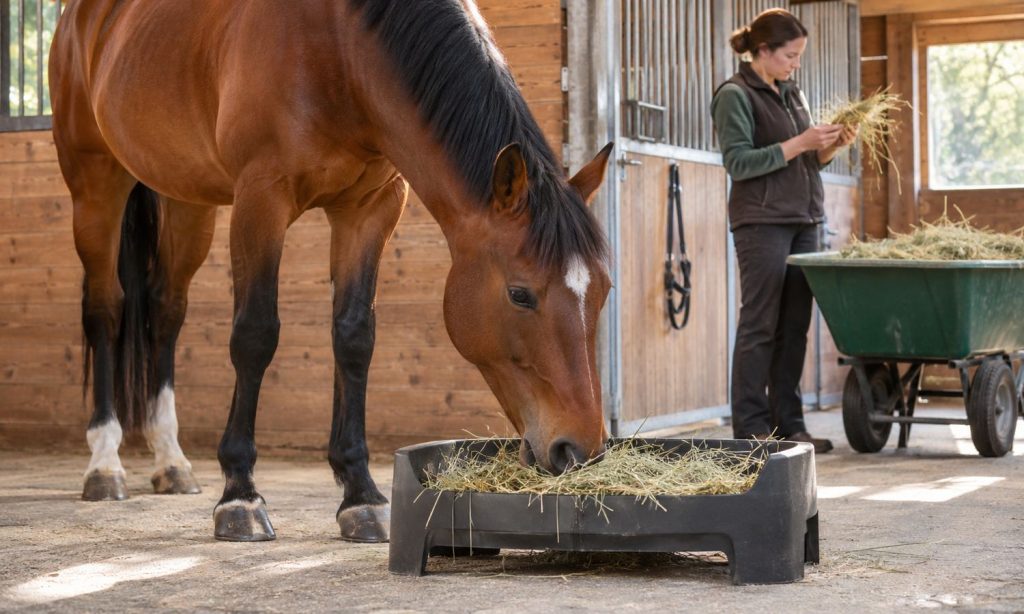
Laminitis is a painful disorder affecting the tissues that support the hoof. Feeding can be part of long-term management, especially when insulin dysregulation or obesity is involved. What features matter most in a hay for laminitic horses? The most useful starting points are a reliable forage analysis, appropriate sugar and starch content, good hygienic quality, and a ration matched to the horse's medical needs. Hay type or color alone cannot confirm suitability.
This guide explains how to interpret hay testing, assess quality, discuss soaking, and manage portions without compromising forage access. Our best hay for laminitic horses guide provides related category context, but the final diet should be agreed with an equine veterinarian and nutritionist. A horse with suspected new laminitis needs urgent veterinary assessment, not just a different bale.
Use a Forage Test, Not Guesswork About Hay Species
Hay from the same grass species can differ substantially in sugar, starch, protein, and energy depending on maturity, growing conditions, harvest, and storage. A late-cut hay is not automatically safe, and a visually green bale is not automatically high in sugar. Ask for a representative forage analysis from a qualified laboratory. A veterinary nutritionist can explain which values matter for the individual horse. Testing is more dependable than relying on descriptions such as 'low sugar' without supporting data.
Nonstructural carbohydrates, commonly abbreviated NSC, are especially important to discuss for horses with insulin dysregulation and laminitis risk. Laboratories may report starch, water-soluble carbohydrates, ethanol-soluble carbohydrates, and related measurements in different ways. Clarify the calculation and whether results are on a dry-matter or as-fed basis before comparing reports. Our guide to reading hay analyses helps explain those terms. What features matter most in a hay for laminitic horses begins with verified numbers that a professional can interpret in context.
Match Sugar and Starch Targets to the Veterinary Plan
University of Minnesota Extension describes lower-NSC forage as important for horses prone to laminitis and metabolic disease. Some guidance uses a threshold around 12% NSC for selected conditions, but the appropriate target depends on testing method and the horse's diagnosis. Do not treat one number as a universal prescription. The veterinarian may also recommend assessing insulin regulation, weight, and other endocrine factors that influence how the horse responds to dietary carbohydrates.
Review the entire ration, including grain, pasture, treats, supplements, and hay. A low-NSC hay can still be part of an overly calorie-dense feeding plan if the quantity is not controlled appropriately. Conversely, reducing forage too severely may create other welfare and digestive problems. Consult our guide to discussing laminitis feeding with a veterinarian for useful questions. The goal is safe nutrition across the day, not merely a favorable number on the hay report.
Assess Hygiene, Mold, Dust, and Storage Condition
Even hay with suitable nutrient values should be clean and wholesome. Inspect bales for visible mold, musty odor, excessive dust, weeds, foreign objects, and water damage. Do not feed spoiled hay to a horse with laminitis—or to any horse. Hay quality can deteriorate during storage if it becomes wet or is exposed to pests. Good ventilation and protection from leaks are important. Keep hay off damp floors and separate it from chemicals and waste.
Check new batches even when they come from the same supplier. Different fields or cutting dates can have different nutrient profiles. Store analyses with batch identifiers, so the reported values match the hay currently being fed. Make gradual changes when a new batch differs from the old one, under veterinary guidance when necessary. What features matter most in a hay for laminitic horses includes reliable traceability and storage, not simply the species printed on an invoice.
Understand When Soaking May Help and Its Limits
Soaking hay can reduce water-soluble carbohydrates, but the result varies with hay type, temperature, water volume, time, and handling. It can also remove other nutrients. A fixed soaking time does not guarantee that every batch meets a specific sugar target. The University of Minnesota Extension recommends using forage tests before and after soaking when managing certain conditions. Work with your veterinarian or nutritionist to decide whether soaking is appropriate and how to evaluate the result.
Prepare soaked hay hygienically and feed it promptly according to professional guidance. Do not let wet forage sit for prolonged periods in warm conditions or reuse dirty soaking water. Dispose of runoff appropriately and prevent slippery barn areas. Soaking does not make moldy hay safe. For some horses, obtaining suitable tested hay may be more practical than relying on repeated soaking. A feeding method should be realistic enough that all caregivers can perform it consistently and safely.
Calculate Appropriate Portions Without Starving the Horse
Daily hay quantity should account for body weight, body condition, other feed, metabolic status, and the minimum forage intake recommended by the veterinary team. A horse with obesity may need controlled energy intake, but overly aggressive restriction is not the answer. Weigh forage rather than estimating by flakes because bale density and flake size vary. Keep a written record of the actual amount offered and eaten. Balance feeding frequency and safe access to fiber with the horse's treatment plan.
Our guide to estimating daily hay portions offers general weighing principles, but a laminitic horse requires individualized targets. Separate horses during feeding when one animal receives a restricted or special ration. Do not allow unrestricted access to another horse's concentrates or treats. Discuss use of feeders or grazing restrictions with the veterinarian, especially for an animal with active hoof pain. What features matter most in a hay for laminitic horses includes how it fits into a safe daily schedule.
Pay Attention to Endocrine Disease and Body Condition
Laminitis has several causes, and insulin dysregulation is an important factor in many cases. Signs of endocrine or metabolic disease may include regional fat deposits, changing body condition, or a history of recurrent laminitis. These signs require professional evaluation; appearance alone cannot diagnose insulin problems. A veterinarian may recommend testing and management beyond the diet. Forage changes support care but do not replace pain management, hoof support, or treatment of the underlying condition.
Regularly record weight-tape trends, body condition, appetite, hoof comfort, and exercise instructions. Do not increase exercise for a horse with active laminitis until the veterinarian confirms that movement is appropriate. Our guide to recognizing laminitis signs in horses emphasizes urgent warning signs. If the horse suddenly becomes reluctant to move, stands unusually, or has painful feet, call the veterinarian. Switching hay alone will not relieve an acute hoof crisis.
Avoid Simplistic Hay Rules and Marketing Claims
One mistake is assuming that all timothy hay is low in sugar or all alfalfa is unsuitable. Different hays have varying analyses, and a carefully selected mixture may be appropriate for some horses. Another is trusting unverified 'laminitis-safe' descriptions without a test. Hay color and smell help identify hygiene problems but cannot determine NSC content. Likewise, a soaking routine should not be treated as proof that carbohydrates have reached a target unless testing supports it.
Avoid abrupt ration changes, uncontrolled treats, and unmeasured access to pasture when a veterinary plan restricts them. Do not reduce feeding so aggressively that the horse experiences long periods without suitable forage. Ask the team how to handle changes in hay supply, winter conditions, and travel. What features matter most in a hay for laminitic horses can be summarized as analysis, appropriate ration design, hygienic quality, and reliable implementation. The best-looking bale is not necessarily the best match.
Frequently Asked Questions
These answers address common hay-selection questions, but they cannot determine the correct diet for a specific horse. Laminitis is a serious condition with multiple possible causes. A veterinarian and equine nutritionist should guide forage targets, especially during active pain or when insulin dysregulation is suspected.
Use a consistent system for weighing hay, identifying tested batches, and recording the horse's condition. When a new delivery arrives, check its analysis and quality before treating it as interchangeable with the previous supply. Small feeding errors can accumulate over weeks.
Is timothy hay always safest for a laminitic horse?
No. Nutrient content varies by harvest and storage. A forage analysis and the horse's specific medical plan are more informative than the species name alone.
Does soaking always make high-sugar hay safe?
No. Sugar reduction varies and soaking can remove other nutrients. Testing before and after soaking helps determine the result. Soaking never makes moldy hay safe.
Should a laminitic horse stop eating hay during a flare?
Do not improvise fasting. Seek urgent veterinary care and follow the specific feeding and hoof-support plan. Adequate appropriate forage remains an important consideration.
Can I judge NSC content by hay color?
No. Color and odor may suggest storage quality, but sugar and starch content require analysis. Hay that looks attractive can still be unsuitable for a particular ration.
Are grain and pasture part of the calculation?
Yes. The complete ration includes all forage, concentrates, treats, and grazing. A suitable hay does not compensate for excessive carbohydrate intake elsewhere.
Final Words
What features matter most in a hay for laminitic horses? Reliable forage analysis, appropriate sugar and starch levels, clean storage, and a ration matched to the horse's condition. Discuss soaking and portion control with the veterinary team, and keep records that connect each test to the hay actually fed. Never let a feed change delay urgent care for new hoof pain.
The best hay for laminitic horses article offers related category context. Use that information alongside professional advice and the horse's current tests, not as a replacement for individualized care. Forage quality and consistency are practical tools for long-term support, while the underlying cause of laminitis still needs medical attention.
Reference
These university extension references explain forage carbohydrate testing, hay quality, and soaking considerations relevant to horses with laminitis or metabolic risk. They do not establish a universal NSC cutoff for every laboratory method or individual horse. Veterinary interpretation remains essential for treatment decisions and acute illness.
Use the cited resources to prepare questions about a particular hay test, ration, and storage method. The appropriate plan also depends on hoof status, pain, endocrine findings, and body condition. The clinical team should coordinate dietary, medical, and hoof-management advice.









