
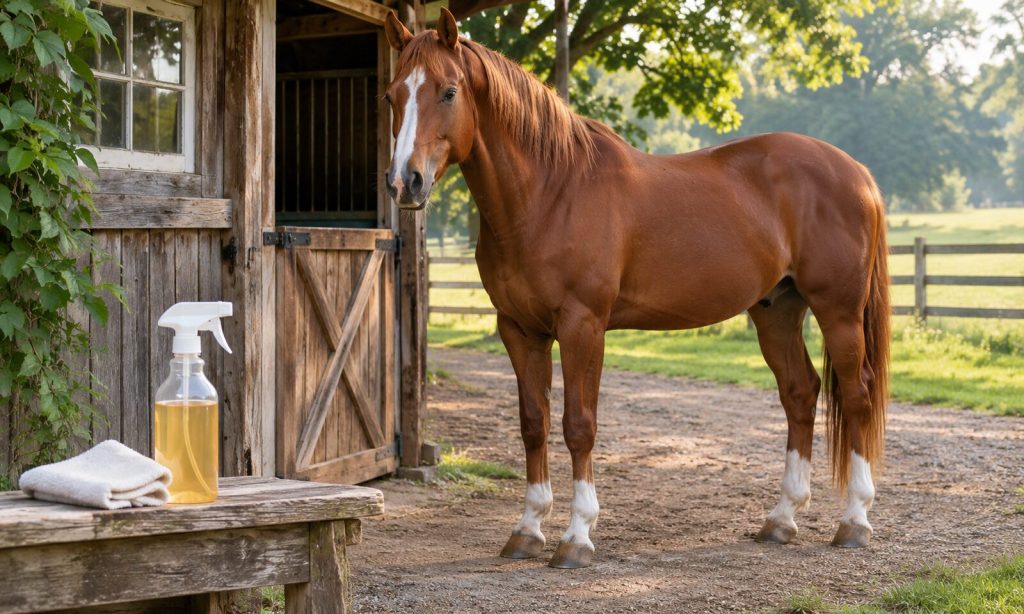
Homemade fly spray for horses can look appealing when biting insects crowd a pasture or barn. But an ingredient that smells pleasant to people is not automatically safe for equine skin. Knowing how to use and care for a homemade fly spray for horses means understanding its limits, avoiding irritating mixtures, and keeping bottles clean. A horse’s comfort matters more than a dramatic homemade recipe.
The safest starting point is to identify the flies, protect sensitive areas, and use routine barn management. Untested oils, household cleaners, and alcohol-heavy recipes can irritate eyes or skin. This guide explains how to assess a mixture, how to handle and store equipment, when to discard a batch, and when a proven label-directed approach is more sensible.
Understand What Homemade Spray Can and Cannot Do
A homemade spray is usually intended as a temporary deterrent, not a treatment for insect-borne disease or an alternative to good stable sanitation. Extension research from the University of Minnesota notes that some plant-based ingredients may repel certain insects, yet homemade recipes can irritate sensitive horses. Results depend on fly species, weather, the horse, and the mixture. Claims that a kitchen formula lasts all day are not well established.
Before deciding how to use and care for a homemade fly spray for horses, observe the problem. Stable flies often trigger stamping and tail swishing around the lower legs. Houseflies favor manure and damp bedding, while horse and deer flies behave differently. A single bottle is unlikely to solve all these problems. Our guide to using fly spray safely with horses covers broader application decisions.
Check Every Ingredient Before Considering Application
Do not assume that vinegar, essential oils, mouthwash, soap, or bathing products are harmless because they are common household items. Concentrated oils can cause skin reactions, and mixtures have not necessarily been tested for equine exposure. Ingredients may separate, change strength, or react with container materials. Avoid applying anything containing disinfectants, automotive products, bleach, or ingredients of uncertain identity. Never improvise a pesticide concentration.
A veterinarian should review any questionable formulation, especially for foals, pregnant mares, horses with allergies, or animals with damaged skin. If the mixture lacks a validated safety profile, the prudent decision is not to apply it. EPA-registered repellents provide label directions and safety review that household formulas generally lack. Choosing fly spray for sensitive horses offers additional context on irritation risks.
Prepare a Clean, Clearly Identified Container
Use a dedicated, intact spray bottle that has never held a cleaner or chemical pesticide. Wash and dry the sprayer according to the bottle maker’s instructions. A reused bottle with unknown residue is unsuitable, even after a quick rinse. Choose a secure cap and nozzle that does not leak. Mark the bottle clearly with the contents and preparation date so nobody mistakes it for water or a grooming aid.
Prepare only a small amount if a veterinarian has confirmed that a particular mixture is appropriate. Keep preparation tools separate from food equipment, and protect feed and drinking water from splashes. Do not decant an EPA-registered product into an unlabeled container; keep those products in their original packaging. Proper identification makes how to use and care for a homemade fly spray for horses a safer routine for everyone who shares the barn.
Assess Skin and Apply With Restraint
Before any topical use, check the horse for sores, dermatitis, eye discharge, swelling, and unusually reactive skin. Do not apply an untested mixture to damaged areas. Avoid the eyes, nostrils, mouth, udder, genital area, and mucous membranes. Never spray directly toward the face or allow the horse to inhale a mist. Do not restrain a frightened horse simply to finish spraying; stop and regain calm handling.
If a veterinarian has explicitly cleared the mixture, follow that professional’s directions rather than guessing a full-body amount or reapplication interval. Watch for rubbing, hives, coughing, head shaking, or worsening agitation. Remove a suspected irritant with appropriate gentle rinsing and contact the veterinarian for guidance. Our article about cleaning and inspecting fly-spray equipment explains practical sprayer checks.
Build Fly Control Around the Barn, Not Just the Bottle
The most dependable strategy tackles breeding areas as well as adult insects. Remove manure and wet bedding routinely; address spoiled feed, standing water, and poorly drained watering points. Clean feeders without spreading residues into forage. Fly pressure can remain high if damp organic matter accumulates behind a barn, regardless of how often the horse is sprayed. Check areas around stalls, fences, and paddock gates.
Physical barriers can reduce exposure without coating the animal. Properly fitted fly sheets, masks, screens, and leg protection may help, provided they do not rub and are inspected daily. Adjust turnout patterns to local insect activity when feasible. The horse fly mask storage guide is useful when seasonal equipment comes off. Understanding how to use and care for a homemade fly spray for horses includes recognizing when other controls do more.
Store, Clean, and Replace Safely
Keep any veterinarian-approved mixture out of direct sunlight and extreme heat, away from children, pets, feed, and medications. Do not assume a homemade spray has a predictable shelf life. Without stability or microbial testing, a long storage period cannot be justified. If the ingredients separate, develop an unusual odor, cloud, or leave residue, discard the mixture rather than trying to rescue it by vigorous shaking.
Empty the bottle when the approved period of use ends, then wash and thoroughly dry the parts that can be safely cleaned. Follow local disposal rules and avoid pouring concentrated oils or chemicals into a trough, drain, or pasture. Replace a leaking nozzle or cracked plastic bottle. Add the date of each cleaning to a small barn log. These habits make how to use and care for a homemade fly spray for horses easier to track.
Recognize When a Different Approach Is Needed
If a horse develops persistent itching, open sores, crusting, repeated stamping, or significant swelling, ask the veterinarian to assess the cause. Not all skin irritation is caused by flies. Allergic reactions, infections, or other conditions may require different treatment. A repellent cannot diagnose the problem. Seek prompt help for breathing difficulty, facial swelling, collapse, or severe distress after any topical exposure.
Compare changes in insect activity with weather, pasture hygiene, and turnout conditions. A simple daily log of bite locations and behaviors gives better information than assuming the latest mixture worked. When planning seasonal protection, selecting fly spray for trail riding can help identify practical label-based questions. How to use and care for a homemade fly spray for horses is ultimately a risk-management question, not a contest to make the strongest scent.
Frequently Asked Questions
Owners often want one exact recipe or a fixed application schedule. Neither can be established safely for every horse or homemade formula. Concentration, skin condition, weather, and the insects involved can all change what is appropriate.
Use these answers as a screening checklist, not as a prescription for an untested mixture. When ingredients or exposure are uncertain, discuss the formula with your veterinarian before it touches your horse.
Is vinegar alone a proven horse fly repellent?
No reliable general rule establishes vinegar alone as a safe, effective repellent for all fly species. It can irritate sensitive skin. Ask your veterinarian before use.
Can I spray homemade mixtures near a horse’s eyes?
No. Avoid the eyes, nostrils, mouth, and other sensitive tissues. Face protection and any approved application method need a separate safety assessment.
How long does homemade fly spray stay fresh?
There is no universal shelf-life for untested homemade mixtures. Do not store a batch indefinitely. Use only under veterinary guidance and discard questionable liquid.
Does a stronger essential-oil scent work better?
Not necessarily. Higher concentrations may increase irritation without improving control. Do not experiment with concentrated essential oils on a horse.
What if my horse rubs or develops hives after spraying?
Stop using the mixture, prevent further exposure, and call your veterinarian. Seek urgent veterinary help for severe swelling, breathing changes, or collapse.
Final Words
How to use and care for a homemade fly spray for horses starts with honest limits: identify ingredients, question untested claims, protect sensitive skin, keep equipment clearly labeled, and discard unstable mixtures. Healthy barn hygiene and physical barriers often reduce the need for frequent spraying. A horse that shows irritation deserves a change of plan, not another coat.
For practical next steps, review fly spray safety around horses and keep your veterinarian involved whenever skin disease or reactions are possible. Homemade fly spray for horses should never be treated as automatically safer simply because it is made at home.









