
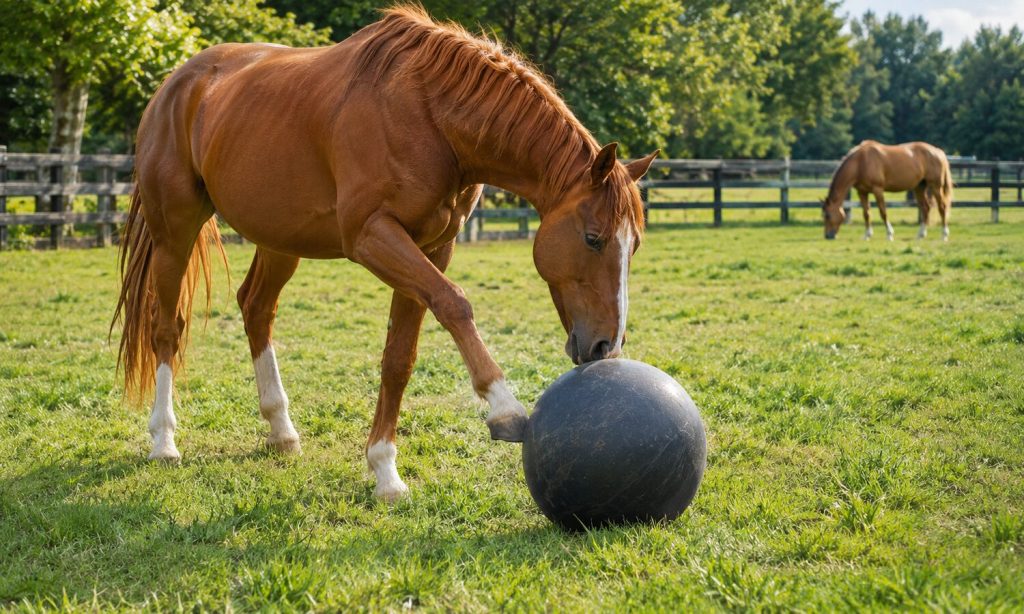
What features matter most in a toys for horses? Safety, appropriate size, durability, and the opportunity for normal behavior come before novelty. Horses may push, nose, kick, chew, or investigate unfamiliar objects. An enrichment toy should be suitable for the animal and its environment, with no sharp edges, swallowable parts, or places where hooves and jaws can get trapped. A cheerful-looking ball is not useful if it creates avoidable hazards.
Toys can add variety for a stalled or paddocked horse, but they should complement turnout, forage, social contact, and veterinary care. Our guide to toys for horses explains different enrichment categories. Here, we focus on features to assess before introducing an object, including safe materials, stable placement, play style, supervision, cleaning, and signs of stress. The best setup suits the horse, not just the stable’s décor.
Start With Safety and Appropriate Size
A safe enrichment object should be large enough that the horse cannot swallow it and should not break into small hard fragments. Its material should tolerate the intended level of pushing, nosing, or chewing. Avoid exposed metal edges, sharp seams, dangling strings, loose fittings, and hollow spaces that can trap a hoof or lower jaw. A horse’s size and strength make ordinary household toys unsuitable.
What features matter most in a toys for horses will also depend on where the item is used. A loose paddock ball needs room to move without rolling into roads, fences, or water troughs. A hanging item must be positioned so it cannot wrap around a leg or neck. Follow the manufacturer’s animal-specific safety guidance and inspect the whole area before play.
Consider Individual Risk
A young curious horse may chew aggressively, while another horse may panic when an object swings. Older horses with limited movement may prefer gentle investigation. Match the toy to temperament, mobility, and prior experience. If the horse is recovering from injury or has a medical restriction, ask the veterinarian before adding physical play.
Choose Durable, Easy-to-Clean Materials
Inspect surfaces for cracks, brittle areas, loose caps, protruding fasteners, and degraded rubber. Outdoor sunlight, weather, and repeated contact with teeth or hooves can wear down a toy. A material that was safe when new may become risky after months in a paddock. Replace damaged items before pieces detach or jagged edges appear.
What features matter most in a toys for horses includes maintenance, not just strength. A smooth washable surface is easier to keep free of manure, mud, and feed residue. Clean according to its material directions, rinse away detergents, and dry as appropriate before returning it to the enclosure. Avoid chemicals or paint that could be ingested during play.
Set a Regular Inspection Routine
Check a toy daily during active use and more thoroughly after storms or heavy play. Watch for splitting, frayed attachments, missing plugs, or trapped debris. Record why an item was removed. If a horse has started chewing off parts, do not keep offering the same damaged object. Choose a safer activity rather than improvising repairs with tape or wire.
Match the Toy to the Horse’s Natural Behavior
Horses spend substantial time grazing, exploring, moving, and interacting socially. A useful enrichment object may invite nosing or gentle movement without causing frustration. Some horses enjoy pushing a large ball, while others prefer a simple safe object to investigate. Food-related puzzles require careful planning to avoid disrupting forage intake or encouraging competition between animals.
What features matter most in a toys for horses is whether the horse voluntarily interacts with it and remains relaxed. A toy that is ignored is not necessarily defective; it may simply not suit the individual. Do not force contact or chase a frightened horse toward it. Introduce new items at a distance and let the horse choose whether to investigate.
Keep Social Needs in View
Toys are not replacements for appropriate equine companionship and turnout. A horse that weaves, paws, or displays another repetitive behavior may need a broader welfare assessment. The UC Davis Center for Equine Health notes that stall enrichment can be one part of managing certain repetitive behaviors, but environmental factors matter too. Seek professional support when behavior becomes persistent or concerning.
Evaluate Setup and Supervision
Place an item where the horse has a clear escape route and is not likely to collide with gates or troughs. Introduce one object at a time under supervision. Watch whether the horse paws, kicks, bites, or pushes it in a safe way. Remove the object if play becomes frantic, another horse guards it, or the toy repeatedly lodges under fencing.
What features matter most in a toys for horses also includes the design of attachment points. Hanging enrichment should not create loops that can tighten around body parts. Inspect ties, clips, and structural supports, using only the placement specified for equine use. For shared turnout, consider whether one horse could corner another around a valued item.
Introduce New Objects Gradually
Allow the horse to see and sniff the object from a comfortable distance. Avoid sudden loud movement or rolling something directly at the horse. Positive curiosity is a good sign; pinned ears, fleeing, or repeated startle responses suggest the setup needs to change. A slow introduction is safer than a dramatic surprise.
Check Whether It Truly Adds Enrichment
An enrichment item should offer meaningful choice or stimulation. Observe play over multiple days rather than judging only the first encounter. A toy can be rotated out when interest fades, provided each reintroduction remains safe. Keep regular exercise, forage, clean water, and social access as primary needs. A bright accessory cannot repair a poor housing environment.
What features matter most in a toys for horses is also a question about the horse’s daily life. Consider what the animal lacks: safe exploration, time outside, or predictable companionship. A toy may be useful in one setting and unnecessary in another. Consult the veterinarian or equine behavior professional if unusual chewing, aggression, or repetitive behaviors arise.
Avoid Treating Every Behavior as Boredom
Kicking, weaving, cribbing, or sudden irritability can have multiple causes, including discomfort. Do not assume a toy will correct a medical issue or chronic stress. Assess feeding, housing, exercise, and health. For a horse that repeatedly chews stall fixtures, seek a veterinary and management assessment before relying on a distracting object.
Common Mistakes When Choosing Horse Toys
Do not select by color, novelty, or a photograph alone. Check dimensions, materials, safe intended use, attachment design, and maintenance. Avoid household items that can splinter, shatter, or become tangled. Do not introduce several unfamiliar objects at once, especially in a shared paddock where horses may compete or become anxious.
What features matter most in a toys for horses becomes easier to answer after observing one horse’s play style. If the animal likes to nose a safe object, choose activities that permit that motion. If it ignores balls, consider appropriate exploration or forage-based enrichment under professional guidance. The goal is welfare, not a stable filled with accessories.
Know When to Remove the Toy
Remove an object immediately if it breaks, develops sharp edges, traps a hoof, causes guarding, or provokes dangerous behavior. Never wait for an accident to prove a concern. Clean and store usable toys according to directions, and discard items that cannot be repaired safely. A boring but safe paddock beats a hazardous novelty.
Frequently Asked Questions
Equine enrichment is individual. These questions cover safety checks, shared turnout, and the limits of toys in horse welfare.
Consult a veterinarian before adding enrichment to a horse recovering from injury or displaying new behavior changes. Every object should remain voluntary and safe.
Are large balls safe for every horse?
No. Size, material, space, and individual behavior matter. A horse that kicks dangerously or panics around a ball may need a different activity.
Can a toy stop cribbing or weaving?
Not reliably. Repetitive behaviors can reflect complex welfare and medical factors. Seek appropriate management and veterinary advice.
How often should horse toys be inspected?
Inspect during daily care, and remove any item with damage or risky attachments. Check more closely after rough play or severe weather.
Can two horses share one enrichment toy?
Only if interactions remain calm and safe. Some horses guard resources or push others away. Provide space and supervise introductions.
Is a homemade toy a good alternative?
Only if its materials, size, attachments, and behavior risks can be evaluated as safe. Avoid improvised parts that break, tangle, or may be swallowed.
Final Words
What features matter most in a toys for horses are safe dimensions, durable construction, easy cleaning, secure placement, and a genuine fit with the horse’s behavior. Inspect each object regularly and introduce it without pressure. Never let a toy replace proper forage, movement, companionship, or clinical care.
When exploring toys for horses, treat enrichment as a way to offer healthy choices rather than a guaranteed fix for boredom. The most valuable feature may be an uncomplicated design that stays safe under real use. Observe the horse, adjust the environment, and remove hazards promptly.









