
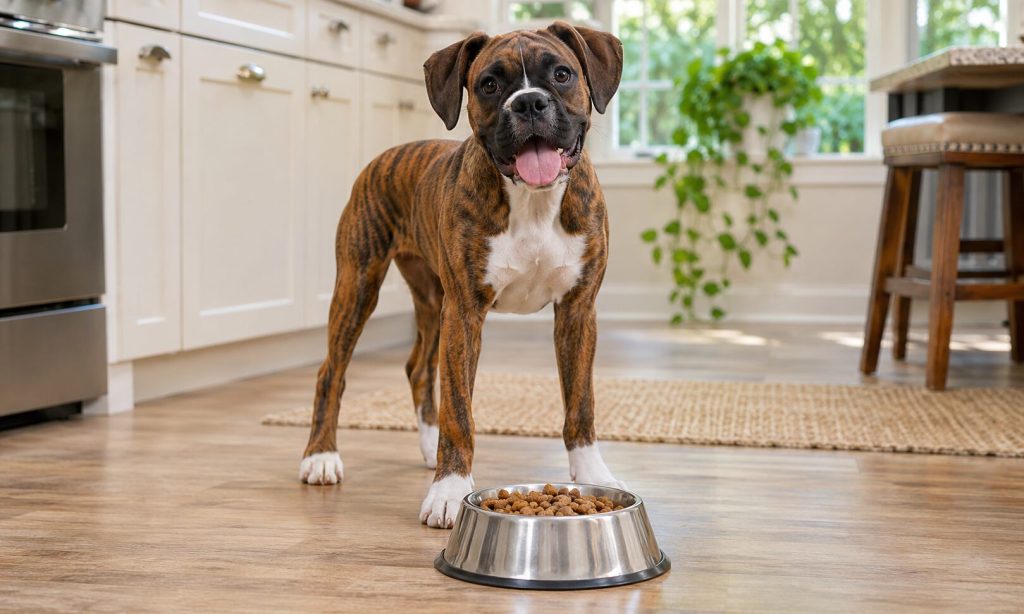
Boxer puppies are energetic, fast-growing dogs, and their food needs more thought than an appealing ingredient list. The best dog food for boxer puppy households should support steady growth, healthy body condition, and an easy feeding routine. Breed-specific kibble is one option, but carefully formulated large-breed puppy diets also deserve attention. The right choice depends on your pup’s expected adult size, age, appetite, digestion, and your veterinarian’s guidance.
This guide compares seven identifiable puppy foods, including dry and wet options. We explain where each formula fits, what its tradeoffs mean in daily life, and how to check nutritional adequacy before buying. Treat each product as a candidate, not a guaranteed match for every Boxer. If your puppy has persistent diarrhea, poor weight gain, or a medical condition, ask your veterinary team to review the diet before changing it.
Quick Picks
Choose for age, expected size, and daily feeding practicality. Compare feeding routines for large-breed dogs before setting portions.
| Product | Best For | Key Advantage | Buy | |
|---|---|---|---|---|
| Royal Canin Boxer Puppy Dry Dog Food | Breed-specific kibble | Boxer-shaped kibble | View on Amazon | Jump to Review |
| Hill’s Science Diet Large Breed Puppy Chicken & Brown Rice | Balanced large-breed growth | Balanced minerals with DHA | View on Amazon | Jump to Review |
| Purina Pro Plan Large Breed Puppy Sensitive Skin & Stomach Salmon & Rice | Skin and digestion concerns | Salmon, oatmeal and probiotics | View on Amazon | Jump to Review |
| Diamond Naturals Large Breed Puppy Lamb & Rice | Lamb-led dry option | Large-breed mineral planning | View on Amazon | Jump to Review |
| Eukanuba Large Breed Puppy Chicken Formula | Active large puppies | Protein and calcium-phosphorus balance | View on Amazon | Jump to Review |
| IAMS Proactive Health Large Breed Puppy Chicken | Straightforward large-breed feeding | DHA, calcium and vitamin E | View on Amazon | Jump to Review |
| Royal Canin Large Puppy Wet Food in Gravy | Moist-texture meals | Soft slices with prebiotics | View on Amazon | Jump to Review |
Royal Canin Boxer Puppy Dry Dog Food

- Designed for Boxer puppies
- Specialized easy-grip kibble shape
- Prebiotics for digestive support
- Vitamin E antioxidant complex
- Protein profile for developing muscle
- Breed-specific formula limits flexibility
- Large bag requires careful storage
Royal Canin Boxer Puppy is the only breed-specific choice in this comparison. Its stated target is purebred Boxers from eight weeks through fifteen months. The kibble has an unusual shape intended to make it easier for a Boxer to pick up and chew. That detail matters because a deep-chested puppy with a distinctive muzzle may approach a bowl differently from a smaller, narrow-jawed dog. Still, shape is a convenience feature, not a reason to ignore the nutrient statement or feeding guidance on the actual bag.
The manufacturer describes precise protein content with L-carnitine for muscle support, plus high-quality proteins and prebiotics for digestive function. Antioxidants that include vitamin E are also part of its growth-focused formulation. Those are relevant design choices for a busy puppy, but they should not be interpreted as a promise of stronger immunity or perfect stool. Monitor your own puppy’s appetite, bowel habits, body condition, and energy. If anything changes sharply, discuss it with a veterinarian instead of assuming a formula will solve the problem.
One practical appeal is straightforward decision-making: you buy a product created specifically for this breed and age bracket. The other side of that simplicity is less flexibility when your puppy dislikes the texture or needs a special therapeutic plan. The listed 30-pound bag may be convenient for a household feeding one growing dog, but food freshness still matters. Keep the original bag inside a clean, sealed container, follow storage instructions, and check the best-by date. Transition gradually from the current food while measuring portions rather than free-feeding.
My Recommendation
I would shortlist this for a healthy purebred Boxer puppy whose owner wants breed-focused kibble and a simple age-based feeding plan. The mouth-friendly shape and growth formula are clear advantages. It is less suitable when a vet recommends a therapeutic diet or your dog does poorly on the recipe. Compare the nutrition statement and your puppy’s growth curve before committing.
Hill’s Science Diet Large Breed Puppy Chicken & Brown Rice

- Large-breed puppy formulation
- Balanced mineral approach
- DHA from fish oil
- High-quality protein emphasis
- Chicken-and-rice recipe
- Dry-only texture
- Not Boxer-specific
Hill’s Science Diet Large Breed Puppy takes a broader approach than a breed-labeled food. This chicken-and-brown-rice recipe is marketed for large-breed growth, with balanced minerals intended to support developing bones and teeth. That is especially relevant when a Boxer puppy is expected to grow into a substantial adult. Large-breed diets focus on controlled development rather than simply delivering the highest calorie count. Before selecting it, verify the current package’s AAFCO nutritional adequacy statement and whether it fits your puppy’s expected adult weight.
The product listing also identifies DHA sourced from fish oil, antioxidant ingredients, and protein intended to support developing muscle. These points reflect the manufacturer’s formulation claims, not findings from a head-to-head trial of the seven foods in this article. What matters at home is whether your puppy grows steadily, maintains a healthy waist, and tolerates the food. A good-looking ingredient panel does not replace observing your dog. Your veterinarian can help distinguish normal puppy appetite shifts from problems that need assessment.
A 27.5-pound dry bag can suit owners who prefer consistent scoops and measured meals. It also means the food must be protected from heat, moisture, and long periods after opening. Because this is not a Boxer-specific shape, watch how your puppy handles each piece, especially if meals are eaten too quickly. A slow feeder may help some dogs, but it should never replace a medical assessment when regurgitation or gagging occurs. Compare calories per cup with your present food before changing portions, and make the transition over several days.
My Recommendation
This is a sensible comparison point for a Boxer puppy whose expected adult size calls for large-breed growth nutrition. I like its attention to mineral balance and DHA. The tradeoff is an ordinary dry-kibble format rather than specialized Boxer-shaped pieces. Use your puppy’s measured body condition and the label’s growth statement to decide whether it fits.
Purina Pro Plan Large Breed Puppy Sensitive Skin & Stomach Salmon & Rice

- Salmon-led puppy recipe
- Large-breed growth positioning
- Oatmeal and rice ingredients
- Probiotic and prebiotic blend
- DHA plus omega-6 oils
- No guarantee for food allergies
- May not suit fish-sensitive pups
Some Boxer puppies struggle with loose stools or itchy skin while their owners are searching for a consistent feeding routine. Purina Pro Plan’s Large Breed Puppy Sensitive Skin & Stomach recipe offers a salmon-first approach rather than a standard chicken-led formula. Its listing names rice and oatmeal alongside prebiotic fiber and live probiotics. These features make the product worth comparing for general digestive tolerance. They do not prove that the food treats an allergy, and they cannot replace a veterinarian-directed elimination diet when a true food reaction is suspected.
According to the listing, this large-puppy recipe includes DHA for developing vision and brain function. Sunflower oil supplies omega-6 fatty acids, while vitamin A is described as part of skin and coat support. Each ingredient plays a role within a broader complete diet; none is a stand-alone treatment. For an active Boxer puppy, the more useful measures are steady growth, normal stool, an appropriate body condition, and consistent eating. Give a new food enough time during transition to assess tolerance, unless your veterinarian advises a different plan.
The 24-pound dry format is practical for repeatable portions and predictable feeding times. Salmon-based food can be an appealing alternative when an owner prefers to avoid a particular poultry-led recipe, but switching proteins randomly may complicate a future veterinary diet trial. If ear inflammation, vomiting, severe itching, or recurring diarrhea is present, get the underlying cause checked. Compare the actual label to your puppy’s expected adult weight and life stage. Keep treats controlled so they do not mask whether the main diet is agreeing with your dog.
My Recommendation
I would consider this when an otherwise healthy Boxer puppy needs a large-breed formula and its owner wants a salmon-based recipe with digestive-support features. Its practical advantage is combining those features in one food. It is not a treatment for allergy or chronic gastrointestinal disease. Seek veterinary advice before using food changes to manage persistent symptoms.
Diamond Naturals Large Breed Puppy Lamb & Rice

- Lamb listed first
- Large-breed puppy positioning
- Rice-based dry formula
- DHA noted in listing
- Large 40-pound package
- Very large bag to store
- Limited detail in API feature list
Diamond Naturals Large Breed Puppy Lamb & Rice is a distinct alternative to the chicken-forward formulas in this group. The current listing identifies lamb as the first ingredient and describes the food as formulated with protein and mineral levels for larger growing dogs. That gives owners a useful starting point, especially when they want to compare a lamb-led dry diet. It does not mean lamb is inherently safer, more digestible, or better for every Boxer. Read the full ingredient panel and nutritional adequacy statement on the package instead of relying only on the front label.
The listing also references DHA for brain and vision development. For a growing puppy, the bigger nutritional picture is the right balance of calories, protein, minerals, and essential fats over time. Avoid the common mistake of increasing portions just because your Boxer seems eager to eat. A healthy puppy may act hungry even when receiving enough calories. Track body condition and growth rather than feeding solely by enthusiasm. When changing from another puppy food, calculate portions using the new product’s energy density, not the size of the old scoop.
A 40-pound bag can appear convenient, but its size is also the principal drawback for a single small puppy household. Food can lose freshness if stored poorly or used too slowly. Preserve the original packaging information, protect the kibble from moisture, and clean storage containers between bags. If the puppy has a known medical need, a lamb-based retail formula may still be unsuitable. Ask the vet for a plan rather than improvising a restriction. Think of this as a practical lamb option within a broader large-breed feeding decision, not a miracle ingredient.
My Recommendation
Choose this for comparison if you want a lamb-first large-breed puppy kibble and can use a substantial bag while it remains fresh. I appreciate the clearly identified growth-oriented positioning. The main limitation is package size, especially for one young dog. Confirm the current label’s nutrient adequacy and feeding amounts before deciding it offers the right value.
Eukanuba Large Breed Puppy Chicken Formula

- Chicken first ingredient
- Protein-focused growth formula
- Calcium-phosphorus planning
- DHA included for puppies
- Large-breed age guidance
- Expected-size threshold matters
- Chicken recipe may not fit sensitivities
Eukanuba Large Breed Puppy targets dogs expected to exceed 55 pounds as adults, according to its current listing. The product is presented as a complete and balanced growth food for large puppies up to 15 months. That expected-size language is important for Boxers because individual adult weights vary. Your veterinarian can help decide whether a large-breed growth formulation or another puppy diet makes more sense for a particular dog. Do not select by breed label alone when your puppy’s growth pattern or medical history points elsewhere.
Chicken is listed as the first ingredient, and the maker highlights animal protein alongside planned calcium and phosphorus levels. DHA is also included for developing brain function. These are practical nutrition elements, but more is not automatically better for a growing skeleton. In fact, adding calcium supplements without medical direction can be counterproductive. A complete puppy diet is designed as a package, so avoid modifying it casually with large amounts of toppers, minerals, or high-calorie extras. The goal is steady, healthy development and a lean outline as your Boxer matures.
The 40-pound bag may be useful for owners feeding a larger, quickly growing puppy, particularly if storage space is available. Measure portions with a scale or accurate cup, and check whether exercise levels justify gradual calorie adjustments. Do not increase servings sharply just because a puppy has a very energetic day. Since the formula uses chicken, it may not match a vet-prescribed food trial excluding that protein. As with every option here, introduce it gradually and monitor how well the puppy eats, chews, and passes stool.
My Recommendation
This is a strong candidate for a Boxer puppy expected to reach the product’s large-breed weight range. The formula’s emphasis on protein and mineral planning fits the growing-dog decision. Its tradeoffs are the large package and chicken-based recipe. I would confirm adult-size expectations with the vet before choosing it over a medium-growth option.
IAMS Proactive Health Large Breed Puppy Chicken

- Chicken-based large-puppy recipe
- DHA for early development
- Calcium planned for growth
- Vitamin E and selenium
- Dry food with feeding guidance
- No breed-specific kibble
- Ingredient preference may differ
IAMS Proactive Health Large Breed Puppy offers another chicken-led option for owners comparing standard growth foods. The current listing names real chicken as the first ingredient and describes omega-3 DHA, planned calcium levels, vitamin E, and selenium. It is positioned for growing larger dogs rather than for Boxers alone. That distinction can be positive if you prefer to compare nutrition by size and life stage, but it also means you should evaluate the actual feeding directions against your puppy’s expected adult size and activity.
The manufacturer connects DHA with cognitive and visual development, calcium with bones and joints, and the antioxidant ingredients with normal immune function. These are formulation goals, not evidence that this product prevents disease. Boxer puppies do best when meals are predictable and body condition is checked repeatedly. Ask your veterinarian what a healthy weight gain pattern looks like for your individual dog. If the puppy is unusually thin, heavily potbellied, vomiting, or not thriving, do not try to correct those signs simply by switching brands or increasing food.
At home, this is a dry-kibble choice that can be weighed and divided into regular meals. Using a food scale can make a bigger difference to portion consistency than using different scoops. Factor treats into the daily calorie budget, particularly during training when a puppy may receive rewards throughout the day. Check freshness and storage guidance after opening the bag. Its ordinary kibble format may be less compelling to an owner seeking a Boxer-specific shape or a wet-food option, but straightforward routines are often an advantage.
My Recommendation
I would compare IAMS against the other large-breed puppy formulas when the priority is an uncomplicated chicken-based dry food. DHA, calcium planning, and clearly identified antioxidant nutrients make its purpose easy to understand. The limitation is that it offers neither Boxer-specific kibble nor a wet texture. Check the complete label and your pup’s individual growth needs first.
Royal Canin Large Puppy Wet Food in Gravy

- Soft slices in gravy
- Designed for larger puppies
- Prebiotics in formula
- DHA included
- Useful alternative texture
- Cans need refrigeration after opening
- Serving cost differs from kibble
Not every Boxer puppy prefers dry kibble all the time. Royal Canin Large Puppy Wet Food provides thin slices in gravy and is labeled for larger puppies from two through fifteen months, with an expected adult weight of 56 to 100 pounds. Its moist texture can be helpful when comparing feeding formats, though it should never be used to hide difficulty chewing or swallowing that needs veterinary attention. The formula is listed as a large-breed puppy option, so check the current package’s life-stage and feeding statement before serving it as a main meal.
The maker highlights easily digested proteins, prebiotics, antioxidant vitamins E and C, and DHA. These reflect routine nutritional support within a formulated food, not treatment claims. Wet food also contains more moisture by weight than kibble, which changes how calories per serving are calculated. A cup of dry food cannot simply be swapped for a cup of gravy without checking the energy figures. This matters for a rapidly developing Boxer because accidental overfeeding can happen when owners mix formats without measuring both components.
The listing describes a pack of twelve 13-ounce cans. That packaging creates different practical demands from a dry bag: you need fridge space after opening, clean utensils, and attention to the manufacturer’s storage window. Discard food that has sat out too long, especially in warm weather. The soft pieces may work well as a complete feeding option or a planned component of a mixed routine when the labels permit. If you combine foods, calculate total calories and preserve nutritional balance. Ask your vet to help establish amounts during the transition.
My Recommendation
I would shortlist this for a Boxer puppy that benefits from a soft feeding format or for owners who want to compare wet and dry options. The large-puppy positioning and moist texture are useful differences. The chief tradeoff is extra handling and portion math. Confirm the growth statement, refrigeration instructions, and total daily calories before buying in bulk.
How to choose best dog food for boxer puppy
A good puppy food decision starts with a label and a growth plan, not a list of fashionable ingredients. Compare nutrient adequacy, expected adult size, calorie density, feeding practicality, and your Boxer’s tolerance before deciding which formula belongs in the bowl.
Match the growth statement to your Boxer’s expected adult size
Look for a nutritional adequacy statement that supports growth, not adult maintenance alone. Large-breed puppy formulas may be appropriate when the dog is expected to reach the maker’s specified adult size. Because Boxer weights vary, confirm this with your veterinarian. Read the complete label, not only the recipe name or a marketing phrase. Check the intended age range and ask when your puppy should transition to adult food. Different products use different age thresholds. A growth diet should help maintain a lean body condition, not push the fastest possible weight gain. If a formula lists calories per cup or per can, use that number to plan real portions. Avoid adding calcium or vitamin D supplements to a complete growth diet without professional direction. Excessive mineral intake can be harmful in growing larger dogs. You can also compare common mistakes when selecting a large puppy diet.
Consider digestion, ingredient needs, and the feeding format
A salmon-and-rice recipe may suit a household that prefers fish-based puppy food. A lamb-led option changes the primary protein source. Neither is automatically hypoallergenic or a treatment for itchy skin. Repeated ear problems, persistent loose stools, and intense scratching need veterinary assessment before a restrictive diet trial. Texture also matters. Some puppies eat carefully from regular kibble, while others gulp meals or prefer moist pieces. A breed-shaped kibble or planned wet-food meal can change your routine, but the nutrient statement remains the foundation. Transition diets gradually and monitor stool, appetite, and body condition. If your puppy refuses food repeatedly, loses weight, vomits often, or seems lethargic, contact the veterinarian rather than continuing to experiment with flavors.
Measure portions, plan storage, and revisit the choice
Start with the product’s feeding chart, but regard it as an opening estimate. Your Boxer’s age, current weight, expected adult weight, exercise, treats, and body condition determine what happens next. Weigh or measure meals consistently. For busy training days, reserve part of the daily ration for rewards instead of adding unlimited treats. Compare dry-food cups with wet-food calories before combining them, since moisture changes serving volume. Store dry food in its original bag within a sealed container, and follow the maker’s instructions for opened canned food. Check your puppy’s outline and weight regularly with your veterinary team. A diet that works well at ten weeks may need a different portion or transition plan months later. Do not use ingredient claims, price, or package size as a substitute for that ongoing check. For practical measuring tips, explore how to measure puppy food portions.
Frequently Asked Questions
These answers address common Boxer puppy food questions. Your veterinarian can tailor them to your dog’s growth and health.
Does a Boxer puppy need breed-specific food?
Not necessarily. A complete puppy diet matched to your dog’s expected adult size and health needs can also be appropriate. Breed-specific kibble is one format option, not an absolute requirement.
Should I choose large-breed puppy food for my Boxer?
It depends on your puppy’s expected adult weight and the product’s defined size range. Ask your veterinarian to confirm the growth diet that fits your dog.
How often should I feed a Boxer puppy?
Young puppies usually need meals split across the day. The exact schedule changes with age and medical needs, so follow your veterinarian’s advice and the food label.
Can I mix wet and dry puppy food?
Yes, when both products fit your puppy’s life stage and the combined portions meet calorie and nutrient needs. Calculate calories from each; do not swap equal volumes.
What if my Boxer puppy has itchy ears or loose stool?
A new food may not address the underlying cause. Persistent itching, ear inflammation, vomiting, or diarrhea warrants veterinary assessment before using elimination diets or supplements.
Final Verdict
For the closest Boxer-specific format, Royal Canin Boxer Puppy stands out because the shape and age range are explicitly designed for this breed. Hill’s Science Diet Large Breed Puppy and Eukanuba offer alternative growth-focused approaches. Purina Pro Plan Sensitive Skin & Stomach gives owners a salmon-led option, while Royal Canin’s wet food changes the texture. There is no universal winner: the best dog food for boxer puppy feeding depends on expected adult size, healthy growth, tolerance, and a plan you can follow. Review the current label with your veterinarian when anything about your puppy’s health is uncertain.
Affiliate disclosure: This article contains Amazon affiliate links. If you purchase through them, PetAdvisorPro may earn a commission. As an Amazon Associate I earn from qualifying purchases.









