
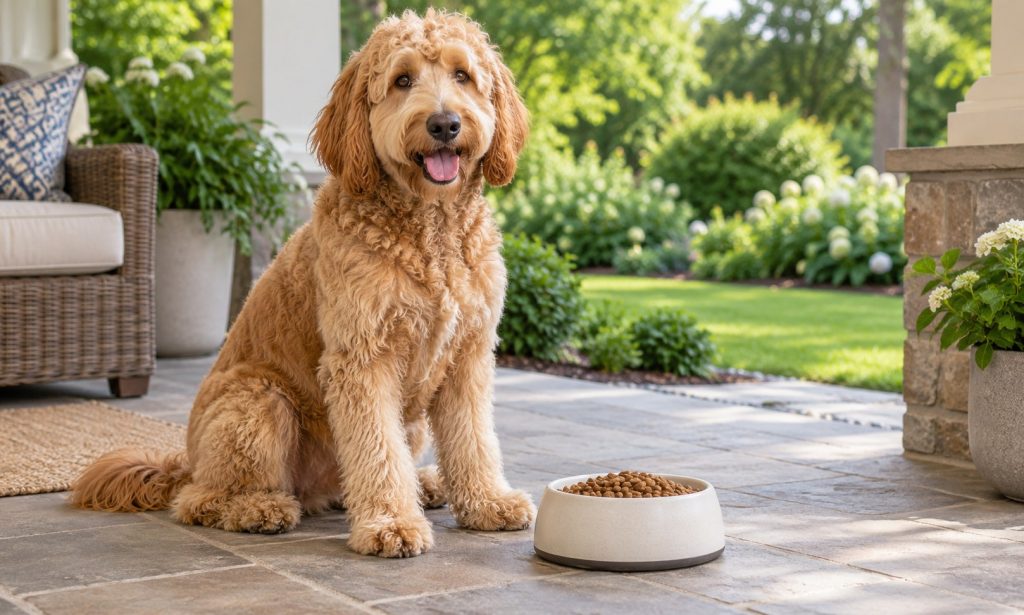
Goldendoodles vary from small companions to much larger dogs, so the right puppy food depends on the size the individual puppy is likely to reach as an adult. The best dog food for goldendoodle puppy growth should be complete and balanced for the correct life stage, provide suitable energy, and avoid uncontrolled weight gain. We compared seven Amazon-verified puppy foods, mostly large-breed formulas, plus a small-breed choice for miniature Goldendoodles. They differ in protein source, digestibility features, kibble size, and growth-focused nutrient profiles. For puppies expected to become large dogs, confirm that the nutritional adequacy statement supports growth of large-size dogs. The puppy’s breeder and veterinarian can help estimate mature weight and adjust the feeding plan. Do not choose adult food simply because the puppy is growing quickly. Track body condition, stools, and energy, use measured portions rather than free feeding, and change foods gradually when your veterinarian agrees.
Quick Picks
| Product | Best For | Key Advantage | Buy | |
|---|---|---|---|---|
| Hill’s Science Diet Large Breed Puppy | Balanced large-breed growth | chicken and brown rice with mineral balance and DHA for large puppies | View on Amazon | Jump to Review |
| Purina Pro Plan Large Breed Puppy | Large puppies needing DHA | chicken and rice large-puppy nutrition with DHA and calcium | View on Amazon | Jump to Review |
| Fromm Large Breed Puppy Gold | Large puppies on a chicken formula | a premium large-breed puppy chicken recipe formulated for growth | View on Amazon | Jump to Review |
| Diamond Naturals Large Breed Puppy | Lamb-and-rice large-breed option | a large-breed puppy diet with lamb, rice, and DHA | View on Amazon | Jump to Review |
| IAMS Large Breed Puppy | Chicken-based growth feeding | a chicken large-puppy recipe with DHA and minerals | View on Amazon | Jump to Review |
| Purina Pro Plan Sensitive Skin & Stomach Puppy | Large puppies with digestive sensitivity | a salmon-and-rice large-breed puppy diet with prebiotic fiber | View on Amazon | Jump to Review |
| Purina Pro Plan Small Breed Puppy | Miniature Goldendoodle growth | a small-breed chicken-and-rice puppy recipe with DHA | View on Amazon | Jump to Review |
1. Hill’s Science Diet Large Breed Puppy

- Large-breed growth formula
- Chicken and brown rice
- Balanced minerals positioning
- DHA and fish oil
- Large-breed nutrient targets may not fit a miniature Goldendoodle
Hill’s Science Diet Large Breed Puppy is designed for growing puppies expected to become larger adults. The verified listing identifies a chicken-and-brown-rice formula with DHA and a growth-oriented mineral balance. Those details make it a useful comparison for a standard Goldendoodle that may mature at a substantial size. A miniature Goldendoodle is a different feeding decision. Adult size should be estimated with the breeder and veterinarian before selecting a puppy diet simply because the dog has the word Doodle in its name.
The nutritional adequacy statement is more important than the illustration on the bag. Ask whether this exact formulation supports growth of large-size dogs if the puppy is expected to reach that category. Check calcium-related guidance, calories per cup, and the feeding table for the puppy’s current age and weight. Hill’s mineral-balance positioning is relevant to controlled growth, but it cannot guarantee prevention of developmental bone problems. Compare the kibble size and the total feeding cost against other large-breed puppy foods in the guide.
I would consider this product for a Goldendoodle puppy with an expected large adult build and no medical reason to use a specialized diet. Measure meals rather than free-feeding and record weight and body condition over time. Treats used in training count toward daily energy, which can add up quickly with an enthusiastic puppy. Adjust the amount as the puppy develops under veterinary guidance rather than trying to accelerate growth. If stools become persistently loose or the puppy refuses food, investigate the issue instead of repeatedly changing brands.
My Recommendation
Hill’s Science Diet Large Breed Puppy is a sensible starting comparison if your Goldendoodle is projected to grow into a large adult. The large-breed growth formulation matters more than the curly coat or breed mix alone, and the chicken-and-brown-rice recipe provides a familiar format for routine puppy meals. I would check the precise growth adequacy statement and use a measured feeding schedule as body condition changes. If your puppy is expected to remain small, a small-breed growth formula may be the better fit. Avoid adding calcium supplements unless your veterinarian recommends them.
2. Purina Pro Plan Large Breed Puppy

- Large-breed puppy category
- Chicken and rice recipe
- DHA included
- Calcium for growth
- The large-breed formula should match expected mature size
Purina Pro Plan Large Breed Puppy is a chicken-and-rice growth formula whose verified listing mentions DHA and calcium for developing puppies. Its central selling point for a Goldendoodle is its large-breed purpose, not the particular mix of parent breeds. A puppy that is likely to become a large adult needs an appropriate overall nutrient profile and energy intake during growth. If the puppy will remain small, a different growth formula may be more convenient. The current adequacy statement should resolve that decision rather than a guess based on coat size.
Compare Purina’s recipe with Hill’s Large Breed Puppy by reading calories per cup, protein source, and the feeding directions for the actual puppy. Both are chicken-centered choices, so neither is an obvious answer for a puppy with an established chicken-related food reaction. The presence of DHA supports the product’s growth positioning but does not distinguish it as a proven best performer for every Goldendoodle. Feeding trials and veterinary advice should inform the selection when there are concerns about digestion, body condition, or a rapid change in growth rate.
I would shortlist Purina Pro Plan for a growing Goldendoodle whose predicted adult size makes a large-breed formula appropriate. Start from the feeding chart, split the day’s ration into age-appropriate meals, and reassess portions as exercise changes. Keep the puppy lean rather than aiming for the highest possible weight on a growth chart. A gradual transition may help the digestive system adapt when switching from the breeder’s food. Confirm the current package’s life-stage statement before buying; formulations and labeled variations can change.
My Recommendation
Purina Pro Plan Large Breed Puppy appeals to me for an active, rapidly growing Goldendoodle whose expected adult size supports large-breed feeding. The chicken-and-rice recipe and DHA inclusion are relevant, but neither is a reason to overfeed for faster growth. Follow the puppy’s body condition and veterinary growth guidance rather than the upper end of a package chart by default. Compare it with Hill’s large-breed puppy food if your puppy prefers a different kibble or ingredient profile. I would not choose this formula solely because the puppy currently looks unusually tall or heavy.
3. Fromm Large Breed Puppy Gold

- Large-breed growth focus
- Chicken recipe
- Puppy life-stage formula
- Dry-food feeding format
- Confirm product availability and exact growth statement
Fromm Large Breed Puppy Gold is marketed as a premium chicken-based dry diet for growing large dogs. Its verified listing identifies a formula intended for large-breed puppy growth, which may interest a household expecting a standard Goldendoodle. Unlike a general adult kibble, the category is designed around the needs of developing dogs. However, the manufacturer’s label and the precise Amazon variation should still be checked for life-stage suitability. A familiar brand name is no substitute for reading the adequacy statement and feeding guidance.
This option may appeal to an owner interested in a different manufacturer, but it should not be judged by price or premium marketing alone. Compare the calories delivered per cup, current ingredient list, and actual puppy growth statement with Hill’s, Purina, or Diamond Naturals. If the dog has recurrent diarrhea, do not assume that a more expensive formula will automatically resolve the problem. Veterinary evaluation may be needed, and a consistent, nutritionally complete diet often provides a clearer starting point than rapid changes among similar chicken recipes.
I would evaluate Fromm only after confirming that the exact current listing is available and that the bag’s growth adequacy matches the Goldendoodle’s expected adult size. Monitor the puppy’s waist, rib coverage, and appetite as the daily ration is adjusted. Keep a record of new treats and training snacks if digestive signs appear. A puppy diet should support steady development over months, not a sudden increase in body mass. If the dog is likely to stay miniature, a small-breed growth formula may be a better fit.
My Recommendation
Fromm Large Breed Puppy Gold is worth examining when you want a chicken-centered growth recipe formulated for larger puppies and your dog tolerates that ingredient profile. I would verify the specific bag’s life-stage adequacy statement, feeding directions, and energy density rather than assuming every Fromm Gold formula is equivalent. Gradual growth and a lean body condition are the priorities for a future large adult dog. Compare a lamb-based large-breed puppy option if a different protein profile is needed for routine preference. For persistent digestive problems, consult your veterinarian before repeatedly changing recipes.
4. Diamond Naturals Large Breed Puppy

- Lamb protein recipe
- Rice-based formula
- Large-breed puppy focus
- DHA listed
- A large bag size may not be convenient for a small household
Diamond Naturals Large Breed Puppy offers a lamb-and-rice alternative to the chicken-centered large-breed foods in this guide. The verified listing includes DHA and identifies the recipe for developing larger dogs. That protein difference can be meaningful when an owner is comparing ingredient preferences, although lamb should not be treated as automatically hypoallergenic. The formula’s large-breed orientation is relevant to a Goldendoodle with a substantial expected adult weight. A miniature puppy may not need the same kibble size or serving approach.
The label’s growth statement and calcium-related nutrient information deserve more attention than a single ingredient on the front of the bag. Compare calorie density and bag size with the dog’s current weight and expected rate of use. A larger package can be economical, but kibble needs appropriate dry storage and should remain fresh before it is finished. If the puppy has a confirmed food sensitivity, the veterinarian should guide ingredient selection; merely exchanging chicken for lamb is not an accurate diagnostic process.
I would consider Diamond Naturals when lamb-and-rice is a practical preference and the veterinarian agrees that the puppy needs a large-breed growth formula. Feed measured amounts, watch for a gradual development pattern, and reevaluate the ration at regular weight checks. The dog’s activity can change markedly between early puppyhood and adolescence, making fixed portions unreliable. Do not add calcium supplements unless specifically prescribed. If appetite or stool quality changes persist after a careful food transition, investigate those signs rather than assuming more food is required.
My Recommendation
Diamond Naturals Large Breed Puppy would make my shortlist when an owner prefers a lamb-and-rice formula for a Goldendoodle expected to reach a larger adult size. The DHA inclusion is relevant for a growing puppy, but portion control and documented large-breed growth suitability are still essential. I would transition slowly and monitor stool quality, appetite, and weight rather than judging the food from a few meals. Compare a chicken-based large-breed formula when lamb does not offer a clear advantage for your puppy. Food changes alone cannot diagnose an allergy or intolerance.
5. IAMS Large Breed Puppy

- Chicken first positioning
- Large-breed puppy format
- Omega-3 DHA
- Growth mineral focus
- Check digestibility and portion response in the individual puppy
IAMS Large Breed Puppy is another growth formula with chicken-oriented ingredients and DHA, according to the verified listing. It is designed for large puppies, which can be appropriate for some standard Goldendoodles but not every Doodle-sized dog. The main comparison is whether the whole nutrient profile and feeding amounts match the puppy’s likely mature weight. IAMS includes a different recipe and kibble format from the other brands, but those distinctions do not by themselves establish better skeletal development or a more suitable calorie plan.
Check the actual package for an appropriate AAFCO growth statement, then compare the feeding table with the puppy’s measured weight and age. Puppy calorie needs change quickly, and an apparently small difference in cups per day can matter over weeks. DHA is a familiar growth-oriented nutrient, yet no one supplement or ingredient compensates for overfeeding. If the dog tends to gulp meals, consider feeding management instead of choosing a formula based only on kibble shape. Digestibility must be judged by the individual dog’s response.
I would put IAMS on the shortlist for a family seeking a conventional chicken-based large-breed puppy diet at an appropriate price and package size. Start with a slow transition if changing foods, and avoid mixing several unfamiliar treats during the same week. Keep the puppy’s body condition lean enough that the ribs can be assessed without heavy fat coverage. Ask the veterinarian to revisit portion size during growth spurts. A formula that fits today may require rechecking as the Goldendoodle’s adult size becomes clearer.
My Recommendation
IAMS Large Breed Puppy is a practical comparison for an owner seeking a chicken-based growth diet without choosing a specialized sensitive-stomach recipe. I would focus on the exact large-breed puppy label, growth adequacy, meal consistency, and the puppy’s developing body condition. The listed DHA is a useful formulation feature, but it does not settle the choice between similar complete puppy foods. If your Goldendoodle is a miniature variety, check whether a small-breed puppy food better matches the likely adult size. Keep treats modest so the complete food supplies most daily nutrition.
6. Purina Pro Plan Sensitive Skin & Stomach Puppy

- Salmon protein recipe
- Large-breed puppy growth
- Prebiotic fiber
- DHA inclusion
- Sensitivity claims do not establish a food-allergy diagnosis
Purina Pro Plan Sensitive Skin and Stomach Puppy is a salmon-and-rice formula that the verified listing describes for large-breed puppy growth. It includes prebiotic fiber and DHA, making it a distinct comparison for owners whose puppy has digestive sensitivity concerns. The phrase sensitive skin does not prove that the puppy has a food allergy, and salmon is not a universal solution to itching. A veterinarian should evaluate recurrent vomiting, diarrhea, or skin inflammation rather than letting a marketing label stand in for diagnosis.
The large-breed growth designation still matters even when the recipe emphasizes digestion. Confirm that the exact variant is suitable for the expected adult size and compare the calorie density with the puppy’s activity and current weight. Prebiotic fiber may be included in a formula to support digestion, but individual tolerance differs. If the puppy has an established adverse food reaction, read every ingredient and ask whether an ordinary retail food is suitable. A diagnostic elimination trial requires a more controlled feeding plan than simply choosing fish instead of chicken.
I would consider this Pro Plan option when a clinician agrees that a salmon-based large-breed puppy diet is appropriate and the dog has a reason to prefer this ingredient profile. Observe stools during a gradual transition and track any changes in ear or paw symptoms separately from digestive changes. Keep daily food and treat portions consistent enough to make observations useful. A puppy should not be put through repeated food switches merely to chase a sensitive claim. Ongoing illness, poor growth, or persistent itching warrants professional assessment.
My Recommendation
Purina Pro Plan Sensitive Skin & Stomach Puppy may suit a large Goldendoodle puppy that does better with a salmon-and-rice recipe after a veterinarian reviews persistent digestive or skin complaints. I would first verify that the specific bag matches the puppy’s expected adult size and growth stage. The sensitive-skin positioning is not a food-allergy diagnosis and does not replace an elimination diet when one is medically indicated. Compare a standard large-breed puppy option if there is no clear need for the alternative ingredient profile. Track stools, itching, and weight during any carefully managed transition.
7. Purina Pro Plan Small Breed Puppy

- Small-breed kibble
- Chicken and rice
- DHA for puppies
- Probiotics listed
- It is not intended as a substitute for large-size puppy growth formulas
Purina Pro Plan Small Breed Puppy is the deliberate exception among these mostly large-breed growth options. Its verified listing describes a chicken-and-rice recipe with small-breed kibble, DHA, and probiotics. It may better match a miniature Goldendoodle whose adult size is expected to remain relatively small. Kibble size can influence feeding convenience for a young, small-mouthed dog, but ease of chewing is not the same as nutritional adequacy. The breeder and veterinarian should help estimate the puppy’s likely mature size before selecting this format.
A dog expected to become a large adult may need a different growth nutrient profile, so this small-breed recipe should not be used as a blanket recommendation for every Goldendoodle. Read the precise adequacy statement and compare energy density, meal portions, and the puppy’s current body condition. Probiotics are a formulation feature rather than a guarantee against loose stool. If a miniature puppy has dental difficulty or repeatedly leaves hard kibble, discuss appropriate texture and feeding strategies with the veterinarian instead of assuming the brand is the problem.
I would choose the small-breed version for comparison when the puppy is genuinely on a miniature growth trajectory and a small kibble format is practical. Feed in measured meals, keep treats modest, and adjust portions as weight and activity change. A growing puppy needs adequate energy, but deliberately pushing rapid weight gain is not beneficial. Monitor behavior and stool quality through any transition. If the adult-size estimate remains uncertain, ask the veterinarian which puppy growth category offers the safest nutritional fit rather than alternating between bags.
My Recommendation
Purina Pro Plan Small Breed Puppy is the important exception in this list: I would reserve it for a miniature or genuinely small Goldendoodle puppy, not one expected to become a large adult. The smaller kibble and growth-focused formula may be convenient for a small mouth, provided the label meets that puppy’s nutritional needs. I would use the projected adult weight, not current puppy size alone, to choose between small- and large-breed options. For a standard-size Goldendoodle, compare one of the large-breed growth formulas instead and avoid unnecessary calorie or calcium additions.
How to choose best dog food for goldendoodle puppy
Goldendoodle puppies are not one uniform size, so adult-size predictions affect the appropriate growth diet. Before comparing brands, check the large-size growth statement when relevant, measure servings, and watch body condition. The right food supports steady development without forcing faster growth.
Estimate the puppy’s adult size
Goldendoodles can have very different mature weights because the Poodle parent may be miniature, medium, or standard. Ask the breeder or veterinarian to estimate your puppy’s adult size, then review whether a large-breed growth formula is appropriate. Labels for large-size puppy growth address a different need from small-breed puppy diets. Don’t select food only because a Goldendoodle looks tall at eight weeks. Review the nutritional adequacy statement and avoid switching prematurely to adult maintenance food. Balanced growth and measured portions are more important than trying to make a young dog reach maximum size quickly.
Check the nutrition statement and feeding format
Look for a complete and balanced puppy diet suited to the dog’s expected adult size. For puppies expected to reach a large body weight, check that the food is appropriate for growth of large-size dogs. Compare listed calcium and phosphorus information, calories, kibble shape, and any sensitive-digestion features. DHA may be included in puppy diets, but a marketing claim cannot substitute for the overall nutrient profile. Ask the veterinarian how to adjust portions as the puppy’s growth rate changes. Ingredients and protein sources also matter when there is a medically confirmed intolerance.
Measure meals and track development
Puppies need reliable meals and consistent access to water. Measure servings rather than guessing by the bowl’s appearance, then reassess portions as growth progresses. Watch the puppy’s waist, ribs, stool consistency, activity, and appetite. Feeding charts are starting points, not fixed instructions for every Goldendoodle. Avoid unnecessary calorie-dense extras or numerous supplements, particularly calcium supplements, without veterinary advice. A food transition should be gradual when medically appropriate. If digestive symptoms or inadequate growth persist, investigate rather than endlessly changing brands.
Consider the puppy’s age and chewing ability when choosing kibble size. A miniature Goldendoodle may handle a smaller nugget better than a large-puppy formula designed for big jaws. On the other hand, a projected large adult dog needs the correct growth nutrient balance even if it is currently small. Keep portion records during training because treats contribute to the total daily energy intake. Body-condition monitoring is more useful than chasing a certain number on the scale. Consistency is essential: avoid changing multiple diet variables at once, and write down the puppy’s growth and meal intake. Ask the veterinarian to interpret the trend rather than comparing it with another Doodle’s size.
Related PetAdvisorPro Guides
You can also compare food choices for adult Doodles; and large-breed feeding routines; and daily dog food portion estimates; and large puppy nutrition alternatives for practical feeding guidance.
Frequently Asked Questions
Do all Goldendoodle puppies need large-breed puppy food?
No. The choice depends on their projected adult size. Ask the breeder and veterinarian to help assess it.
Is adult dog food suitable for a Goldendoodle puppy?
Generally choose a complete and balanced diet for growth until the veterinarian recommends a life-stage transition.
Does grain-free food prevent puppy allergies?
No. Grain-free is not a reliable test or treatment for food allergy. Ask a veterinarian about suspected reactions.
Should I add calcium supplements?
Not without veterinary advice. Incorrect mineral supplementation can unbalance a growing puppy’s diet.
How often should I adjust feeding portions?
Review portions as the puppy grows, using body condition and veterinary guidance rather than a fixed chart alone.
Final Verdict
For Goldendoodles likely to mature into large dogs, compare Hill’s Large Breed Puppy, Purina Pro Plan Large Breed Puppy, and Fromm Large Breed Puppy Gold. The Purina small-breed puppy option may suit a miniature Goldendoodle with a very different adult size. Check the growth adequacy statement, watch body condition, and use the veterinarian’s estimate of mature weight instead of treating one formula as correct for every Doodle.
Affiliate disclosure: This article contains Amazon affiliate links. If you purchase through them, PetAdvisorPro may earn a commission. As an Amazon Associate I earn from qualifying purchases.









