
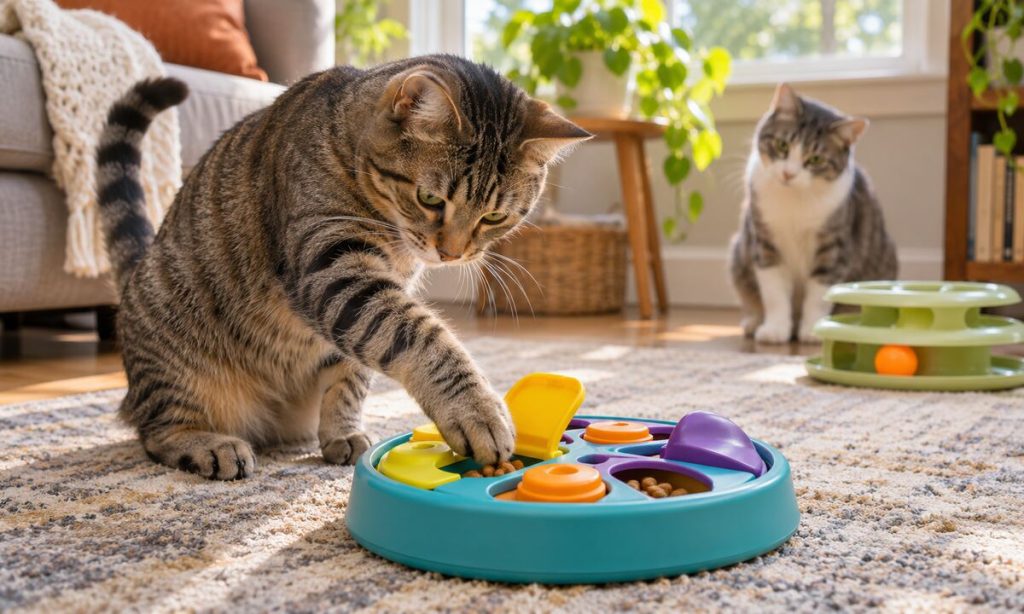
Indoor cats need more than a comfortable window seat. Hunting, investigating, chasing, and solving small problems are natural parts of feline behavior, yet a predictable indoor routine can leave little opportunity for those activities. The best enrichment toys for cats introduce manageable challenges and give curious paws a satisfying job throughout the day.
Different cats prefer different rewards. Some work eagerly for a few pieces of kibble, while others are captivated by rolling balls or fluttering feathers. We compared seven distinct toys across food puzzles, physical play, and automated motion. The right choice should suit your cat’s age, confidence, mobility, and supervision needs—not simply promise endless entertainment.
Quick Picks
These seven enrichment options address different play styles. Start with the activity your cat already seeks, then add a second type of challenge for variety.
| Product | Best For | Key Advantage | Buy | |
|---|---|---|---|---|
| Catstages Nina Ottosson Buggin’ Out Puzzle & Play | Adjustable treat puzzles | Multiple hidden treat cups | View on Amazon | Jump to Review |
| TRIXIE 5-in-1 Fun Board | Varied foraging activities | Five distinct puzzle modules | View on Amazon | Jump to Review |
| Catit Senses 2.0 Food Tree | Pawing for dry kibble | Multi-level feeding challenge | View on Amazon | Jump to Review |
| Catit Senses 2.0 Super Circuit | Customizable rolling-ball chase | Reconfigurable enclosed track | View on Amazon | Jump to Review |
| Catstages Tower of Tracks | Compact batting play | Three tiers with captive balls | View on Amazon | Jump to Review |
| Catstages Snuffle Mat Interactive Treat Dispenser | Gentle sniff-and-find games | Hidden rewards in soft mat | View on Amazon | Jump to Review |
| Oxawo Automatic Moving Feather Wand | Supervised moving-prey play | Rechargeable wobbling feather motion | View on Amazon | Jump to Review |
Catstages Nina Ottosson Buggin’ Out Puzzle & Play

- Adjustable challenge level
- Many separate treat spaces
- Encourages exploratory pawing
- Uses measured food portions
- Engaging for puzzle-loving cats
- Takes time to set up
- Needs careful hand cleaning
The Nina Ottosson Buggin’ Out gives a food-motivated cat something to investigate instead of a bowl they can empty in seconds. Small treat cups and sliding pieces hide rewards across the board, encouraging sniffing and deliberate paw movements. The layout suits cats that already show curiosity about opening drawers, reaching into boxes, or working treats out of corners. The multiple compartments allow you to spread a measured portion around the toy rather than concentrating everything in one obvious spot.
Adjustable difficulty is the strongest selling point. Begin with uncovered or easily reached food, let your cat discover success, then close more compartments after they understand the movement. For a cat new to puzzles, an advanced setup can be frustrating; the toy works best when the challenge rises gradually. The broad board also gives an owner a clear view of which tasks the cat finds easy. Use appropriately sized dry food or treats and inspect the sliding pieces for wear after enthusiastic play.
This is not a substitute for chasing and climbing, but it creates a satisfying quiet activity for evenings or measured feeding time. Food-contact surfaces require consistent cleaning, especially if you use oily treats. Introduce the puzzle in a calm room where the cat can explore without a second pet stealing rewards. Owners who appreciate a structured progression will find more long-term versatility here than in a single-action dispenser. The best results come from short, successful sessions followed by a break.
My Recommendation
I recommend Buggin’ Out for curious cats that finish simpler food games too quickly. Start with a few accessible rewards, then vary the covered compartments. Its food-puzzle format pairs well with a separate movement toy. Skip it if your cat strongly dislikes working for food or cannot comfortably manipulate the pieces.
TRIXIE 5-in-1 Fun Board

- Five challenge styles
- Non-slip rubber feet
- Supports slow feeding
- Good challenge variety
- No batteries required
- Some wells need patience
- Not ideal for wet food
The TRIXIE Fun Board presents five different ways to reach small food rewards on one feeding station. Rather than moving an identical lid repeatedly, your cat must investigate shapes, channels, and paw-access points that demand slightly different techniques. This variety helps a persistent food hunter stay interested, especially when one module becomes familiar. The relatively low platform also allows many cats to work at their own pace without jumping or balancing on an elevated structure.
Rubber feet are useful because a determined cat may push hard while fishing for a treat. A stable platform makes it easier to focus on the task instead of chasing the entire toy across the floor. Some sections take practice, so introduce only one or two at first, then populate more modules as your cat gains confidence. The board is designed for dry food or small treats. Check that the pieces you choose are neither too large to reach nor so small that they scatter everywhere.
For indoor cats that enjoy exploring multiple textures and openings, this can turn a short feeding portion into a series of little discoveries. It also works for households that prefer passive, battery-free stimulation. Cleaning requires attention to narrow spaces, and it may not be the most convenient option for owners who use exclusively wet food. Put it away between sessions if the cat begins to solve every module automatically. Its real value is variety in the same compact footprint.
My Recommendation
Choose the TRIXIE Fun Board when your cat enjoys working through different tasks rather than opening identical compartments. Its stationary, non-electric format suits a quiet household. Introduce the easier modules first and clean food recesses thoroughly. Add a chase toy to balance mental foraging with more vigorous physical activity.
Catit Senses 2.0 Food Tree

- Layered paw-access design
- Stable broad base
- Whisker-friendly lower tray
- Easy to disassemble
- Works with dry kibble
- Limited to dry food
- Some cats tip or scatter kibble
The Catit Senses 2.0 Food Tree invites a cat to reach into a vertical feeder and guide pieces of dry food downward. Its layered openings encourage the natural batting motion many cats already use to investigate objects. Food collects in a lower tray, letting the cat experience a simple cause-and-effect reward. For a kibble-fed pet that normally rushes through meals, this format can add useful activity to an existing feeding routine without needing batteries or constant owner involvement.
The tree’s broad base is intended to help prevent tipping, and the collector tray gives food a defined landing place. However, energetic paws can still send pieces outside the feeder, so use it on an easy-to-clean surface. Start with a small amount of familiar kibble and watch how your cat reaches through the openings. Some cats understand the mechanism quickly; others need a demonstration with kibble placed near an accessible edge. The design is especially appealing to cats that like scooping things from cups or containers.
One advantage is that the components can be taken apart for cleaning, an important consideration when a feeder is used daily. It is not a suitable choice for moist diets or cats that cannot comfortably reach upward. The tree also provides less fast-paced exercise than a chasing toy. Treat it as a meal-time enrichment tool, not as a complete activity program. Pairing it with a supervised hunting game can provide a broader mix of feline experiences.
My Recommendation
The Catit Food Tree is my pick for kibble eaters that enjoy reaching and batting. It turns part of an ordinary meal into a gentle activity without requiring treats in addition to dinner. Check the cat’s comfort with the height and keep the base on a level, washable surface.
Catit Senses 2.0 Super Circuit

- Multiple layout possibilities
- Ball stays in track
- Stimulates chasing and batting
- Connects with Senses system
- No food needed
- Requires floor space
- Some cats lose interest without rotation
The Catit Senses 2.0 Super Circuit is a track-based toy for cats fascinated by movement rather than food. A ball travels through a partially covered channel, allowing a cat to bat it forward and watch it reappear through openings. The 12-piece set supports many layouts, which is helpful when you want to refresh play without buying an entirely new toy. It gives an indoor cat a repeatable stalking and swatting opportunity in an ordinary living room.
The channel keeps the ball largely contained, which may reduce the familiar problem of toys disappearing beneath furniture. Layout matters: an extended path can be interesting for an energetic cat but may crowd a small apartment. Assemble the sections securely and test that the ball moves freely before introducing your pet. Some cats are drawn in immediately by the motion; others respond better when you nudge the ball for them. Changing the curve and track shape periodically can renew attention.
This product can remain entertaining without edible rewards, making it useful for pets on carefully managed diets. Nevertheless, not all cats enjoy repetitive ball movement; a dedicated prey chaser may prefer a wand controlled by a person. Inspect joints and the ball for wear, and follow assembly directions so pieces cannot separate during rough play. Combine the circuit with resting places, climbing options, and personal playtime rather than expecting one gadget to meet every behavioral need.
My Recommendation
I like the Super Circuit for cats that repeatedly chase bottle caps or loose balls across the floor. The enclosed path helps keep play in one area, and changing layouts adds novelty. Give it enough floor space and test secure connections before leaving it accessible under normal supervision guidelines.
Catstages Tower of Tracks

- Compact vertical footprint
- Three chase levels
- Six moving balls
- Non-slip base
- No setup complexity
- Repetitive action for some cats
- Not for kittens under 12 weeks
The Catstages Tower of Tracks stacks three circular tracks vertically and provides six balls for swatting, chasing, and tracking with the eyes. It is a straightforward activity station: the cat touches a ball, the ball circles a tier, and the resulting movement invites another paw strike. Unlike elaborate puzzle feeders, this toy requires little training or food motivation. A curious cat can approach, test one ball, and immediately understand the outcome.
Because the toy rises vertically rather than spreading along the floor, it fits well beside a sofa or in a smaller indoor play corner. A non-slip base helps prevent drifting, and the manufacturer includes a safety bar in the design. Inspect all parts before play and follow age guidance; this specific toy is not recommended for kittens younger than twelve weeks. Multi-cat households may find that two cats can watch or interact from different sides, but individual preferences still determine how much use it gets.
The tower is especially practical as a secondary toy that stays available between supervised wand sessions. It offers a little physical movement and a clear visual target, but it does not supply the complex problem solving of a food puzzle. A cat may also tire of the same circular motion if no other activities rotate in. Move the tower occasionally, give the balls a nudge, and observe whether interest returns. Its simplicity is a strength when your cat likes quick bouts of batting.
My Recommendation
Pick the Tower of Tracks for cats that enjoy batting a moving object but are uninterested in complicated food puzzles. It offers immediate, low-effort play in a compact space. Check the age recommendation and ball security, and alternate with a more challenging toy to maintain variety.
Catstages Snuffle Mat Interactive Treat Dispenser

- Encourages food searching
- Compact play area
- Non-slip backing
- Adjustable hiding spots
- Quiet indoor activity
- Requires close supervision
- Spot-clean care only
The Catstages Snuffle Mat is a quieter enrichment option that encourages a cat to search for hidden dry treats within a textured play surface. Instead of chasing a rolling ball or solving a rigid sliding mechanism, the cat explores with its nose and paws. The small footprint suits an apartment or a designated feeding corner. Hook-and-loop attachable elements change how accessible rewards are, so you can introduce straightforward hiding spots before trying a more challenging arrangement.
Sniffing and foraging can be a rewarding activity for cats that are cautious around noisy gadgets or prefer calm play. Place only a few familiar treats in easy-to-find areas on the first attempt, then increase hiding difficulty if the cat remains engaged. The non-slip backing helps the mat stay where you place it, although determined tugging may still move it. Supervise use, particularly if your cat tends to chew fabric, pull at attached sections, or swallow nonfood materials.
Fabric-based toys require a different maintenance routine from hard plastic puzzle boards. Follow the maker’s spot-clean instructions and allow the mat to dry completely before storing it. Avoid hiding messy wet food in textile crevices. This design is not meant to replace vigorous activity, but it can be useful during a rainy day, recovery from a busy outing, or a low-key evening at home. Count treats toward daily calories and take the mat away when the session ends.
My Recommendation
This snuffle mat suits a food-curious cat that prefers gentle searching to loud moving toys. I recommend short, supervised sessions and a modest number of treats. If your cat pulls or chews loose fabric components, remove the mat and choose a sturdier hard-surface puzzle instead.
Oxawo Automatic Moving Feather Wand

- Motion attracts chase interest
- Rechargeable operation
- Self-righting wobble base
- Offers feather movement
- Distinct from food puzzles
- Feathers need supervision
- Some cats dislike motor noise
The Oxawo automatic feather wand creates moving-prey stimulation using a motorized, wobbling base and attached feather-style wand. Its motion can attract cats that ignore stationary objects but spring to attention when something flutters unpredictably. This is the most action-focused pick in the group, offering a contrast to puzzles that depend on food rewards. The rechargeable design avoids repeated disposable-battery replacement, although actual interest will depend heavily on your cat’s tolerance of movement and sound.
The base is intended to right itself when nudged, making the play pattern less predictable than a fixed spinning attachment. Introduce the toy while you are present, let your cat inspect it switched off, and then try a brief motion cycle. Cats that become anxious around motors may need a gentler, human-operated wand instead. Because feathers and attachments can detach or be chewed, treat this as an interactive supervised toy; do not rely on marketing language about hands-free play as a guarantee of unsupervised safety.
Active cats may enjoy short bursts of stalking and pouncing, especially when you end the session with a chance to catch and release the moving target. Check the wand connection and feather condition every time you use it, and store loose attachments securely afterward. This toy also cannot substitute for the responsive pacing of playing directly with a cat. Use it as one additional form of stimulation alongside manual play, scratching surfaces, and predictable rest.
My Recommendation
The Oxawo wand is worth considering for movement-focused cats that need a new chase pattern. I recommend supervising every session, inspecting feathers for damage, and stopping if the motor sound worries your pet. For unsupervised use, a sturdy captive-ball toy is a more appropriate category.
How to choose best enrichment toys for cats
Before buying the best enrichment toys for cats, observe what your cat enjoys and how quickly they lose interest. A safe, rewarding challenge should encourage repeat play without causing frustration. Consider these three practical factors.
Match the toy to your cat’s preferred reward and ability
Food-motivated cats may enjoy treat-dispensing puzzles, snuffle surfaces, or layered feeders. Those who stalk moving objects may prefer tracks and wand-style toys. Start with a simple challenge: leave puzzle cups partly open, use a familiar food, or let your cat watch you demonstrate the toy. Increase difficulty only after the cat succeeds comfortably. Senior cats and those with joint discomfort may need low, accessible designs rather than toys requiring prolonged reaching. Timid cats often benefit from quiet, predictable motion; sudden sounds can discourage investigation. Your cat’s response is more informative than a manufacturer’s suggested difficulty level. If your pet walks away repeatedly, reduce the challenge rather than forcing participation. Keep enrichment voluntary, upbeat, and adapted to the individual.
Prioritize safe parts, stability, and cleaning
Check construction before every play session. The base should resist tipping, track balls should remain captive, and removable components must be too large to swallow. Feathers, strings, elastic pieces, and worn attachments deserve direct supervision; store them out of reach afterward. Wash food-contact surfaces according to the maker’s directions and dry fully before refilling. Consider whether a puzzle has corners that trap oily residue or a fabric mat that is difficult to sanitize. Place toys on a level surface away from stairs, water bowls, and clutter. Observe a first session before leaving a sturdy, non-string toy available while you are away. Even products marketed as automatic or independent-play require regular checks for damage.
Rotate activities and use treats thoughtfully
Novelty matters, but you do not need a room full of gadgets. Rotate two or three toy types across the week: a food puzzle one day, a ball track the next, and a short supervised feather game later. Put a toy away occasionally so it feels interesting when reintroduced. For food puzzles, measure the kibble or treats and deduct them from the daily ration rather than adding uncounted calories. Cats with special diets should use their veterinarian-approved food. Pair active play with predictable rest and social contact. You can also create an engaging environment using scratchers, viewing perches, and safe hiding spots. Enrichment supports well-being, but a sudden change in activity, appetite, or behavior warrants veterinary attention rather than a new toy alone.
Frequently Asked Questions
Here are practical answers to the questions owners often ask before choosing.
How long should my cat use an enrichment toy each day?
Several brief sessions often work better than one long session. Start with five to ten minutes, observe enthusiasm and fatigue, and adjust. Food puzzles can form part of a measured meal.
Are food puzzles suitable for kittens?
Some are, provided the manufacturer’s age guidance, part sizes, and difficulty are appropriate. Introduce food slowly, supervise, and choose simpler designs for young or inexperienced kittens.
Can I leave cat enrichment toys out while I am away?
Only sturdy toys without loose strings, feathers, or swallowable parts should be considered for unsupervised access. Inspect frequently and follow each product’s safety instructions.
Do automated feather toys replace playing with my cat?
No. They can add variety, but supervised interactive play offers pacing, bonding, and control over potentially detachable feather parts.
What if my cat ignores a puzzle feeder?
Try a familiar, aromatic treat; lower the difficulty; and reward a first successful paw movement. If interest remains low, switch to a moving-ball or wand-style activity.
Final Verdict
The best enrichment toys for cats are the ones your particular cat returns to willingly. For cats motivated by food and problem-solving, the Nina Ottosson Buggin’ Out puzzle offers adjustable challenges. The TRIXIE Fun Board supplies several contrasting foraging tasks, while the Catit Food Tree encourages pawing around feeding time.
If your cat prefers movement, the Catit Super Circuit and Catstages Tower of Tracks offer distinct ball-chasing experiences. The Catstages Snuffle Mat invites quieter sniffing, while the Oxawo feather wand adds supervised moving-prey play. Rotate styles, check parts regularly, and keep treats within daily feeding allowances.
Affiliate disclosure: This article contains Amazon affiliate links. If you purchase through them, PetAdvisorPro may earn a commission. As an Amazon Associate I earn from qualifying purchases.









