
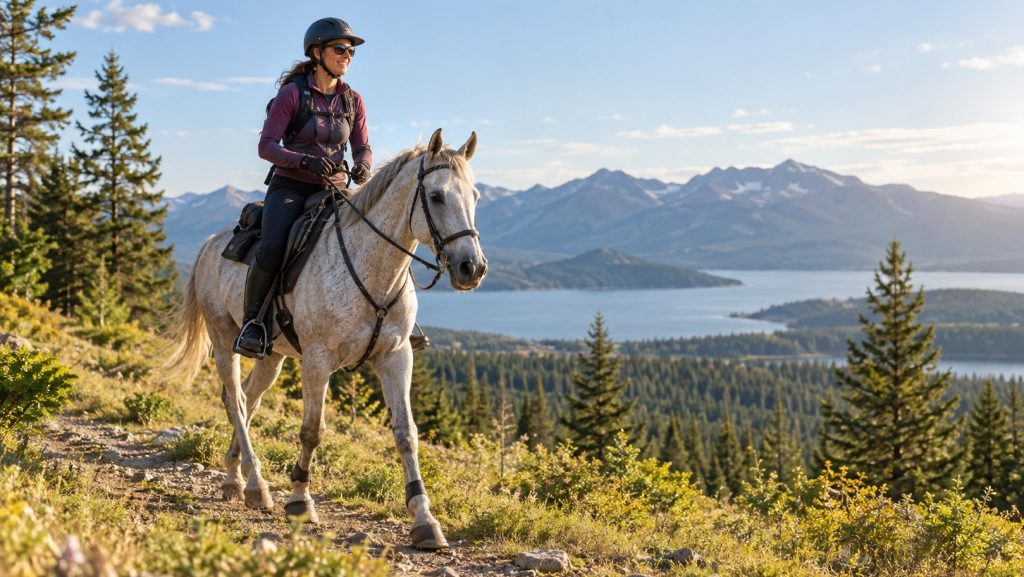
If your idea of a relaxing weekend involves waking up at 4:00 AM in the freezing fog to check a horse’s heart rate while covered in dirt, congratulations—you have the endurance riding bug.
Long-distance trail riding is equal parts art, science, and sheer willpower. While casual riders might think a five-mile walk around the paddock is an achievement, competitive trail riders view that as a warm-up. Understanding Endurance Horse Distance is essential whether you are aiming for your first Limited Distance (LD) 25-mile event or dreaming of tackling the legendary 100-mile Tevis Cup.
Understanding how far a horse can travel with a rider isn’t just about pushing limits; it’s about safety, metabolic health, and preserving your equine partner for years to come.
What is Endurance Horse Distance? Defining the Limits
When we discuss Endurance Horse Distance, we are referring to sanctioned competitive events and structured long-distance trail rides ranging anywhere from 25 to 100 miles in a single day.
Unlike sprint racing or arena sports, endurance riding measures a horse’s aerobic capacity, structural soundness, and recovery speed over vast stretches of natural terrain.
Standard Competitive Distances
-
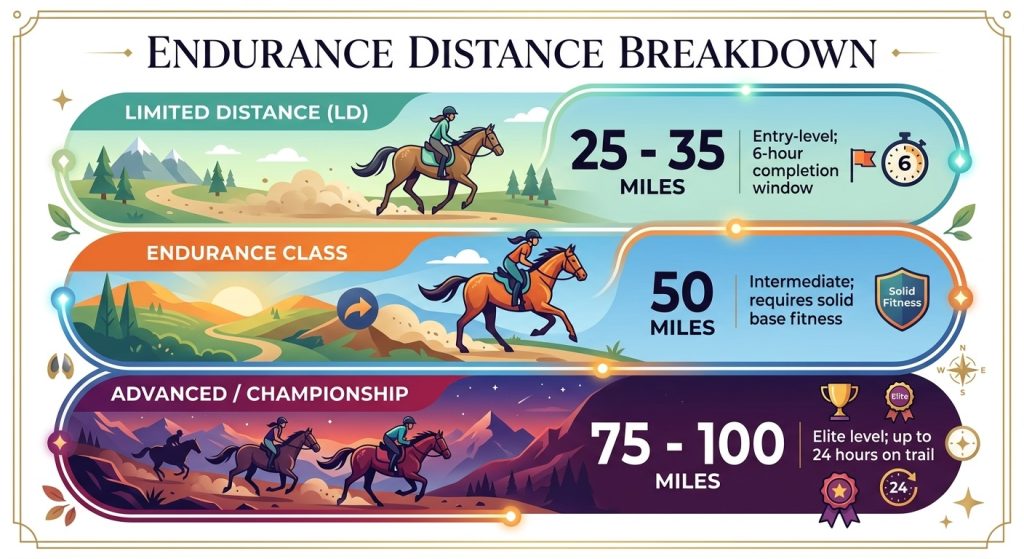
Limited Distance (25–35 Miles): Designed as an introduction to the sport. While called “limited,” riding 30 miles across uneven elevation is no small feat for rider or horse.
-
Fifty-Mile Rides: The benchmark distance for true endurance performance.
-
One-Hundred-Mile Rides: The pinnacle of the sport. Completing a 100-mile Endurance Horse Distance within 24 hours requires a horse with elite genetics, meticulous conditioning, and an attentive rider.
The Science Behind Horse Daily Mileage
A healthy, unconditioned horse pasture-grazing covers roughly 3 to 5 miles per day on its own. Add a saddle, a 160-pound human, and challenging topography, and the dynamic changes drastically.
Under conditioned circumstances, a fit trail horse can comfortably sustain a horse daily mileage of 20 to 30 miles at an easy trot and walk without metabolic distress. In competitive scenarios, well-conditioned horses cover up to 100 miles in a single calendar day, provided they pass mandatory veterinary checks along the way.
Key Factors Affecting Endurance Horse Distance
Not every horse is built to cover vast distances. If you expect a stocky draft cross to cruise through a desert 50-miler at a brisk trot, you are going to have a long, frustrating day.
Genetics and Breed Capabilities
Arabians and Arabian crosses dominate the long-distance trail world. Their high proportion of slow-twitch muscle fibers, efficient cardiovascular systems, and natural heat dissipation give them a massive advantage.
That said, Mustang, Morgan, and Grade horses often excel at moderate distances. The key lies in structural conformation: short backs, strong bone density, and well-balanced hooves.
Terrain, Climate, and Trail Conditions
Fifty miles on a smooth, shaded dirt road in Oregon feels vastly different than 50 miles over rocky canyon paths in Arizona.
-
Elevation Gain/Loss: Climbing taxes the cardiovascular system; steep descents strain joints and tendons.
-
Ambient Temperature & Humidity: High heat combined with humidity severely impairs a horse’s ability to cool itself through sweating.
-
Footing: Deep sand or slick clay cuts safe speed and distance in half.
Rider Weight and Tack Ergonomics
When calculating how far a horse can travel with a rider, the total carried weight (rider plus tack) should ideally remain under 20% of the horse’s lean body weight.
Equally critical is tack fit. An ill-fitting saddle creates pressure points that turn into painful muscle spasms within 10 miles. IMO, spending extra money on a custom-fitted saddle pad and an ergonomically balanced saddle is the single best investment an endurance rider can make.
Conditioning and Training: Building Up Endurance for Horse Distance
You cannot take a horse off winter pasture and expect it to complete a 25-mile ride next Saturday. Building safe, long-term conditioning takes months—sometimes years—of gradual preparation.
Base Conditioning: The Slow and Steady Phase
The primary objective of base conditioning is strengthening bones, tendons, and ligaments. Muscles adapt to work quickly, but connective tissue adapts very slowly.
-
Duration: 3 to 6 months of low-intensity work.
-
Pace: Primarily long, active walking interspersed with short trots.
-
Target: Establishing a reliable horse daily mileage of 8 to 12 miles, 3 times a week.
Aerobic Interval Training
Once a solid structural base is established, introduce interval workouts to elevate cardiovascular efficiency.
-
Warm-Up: 15 minutes of purposeful walking.
-
Work Sets: Alternately trot at 8–10 mph for 15 minutes, then walk for 5 minutes.
-
Cool-Down: 20 minutes of relaxed walking until the heart rate drops below 55 bpm.
Heart Rate Monitoring on the Trail
An onboard heart rate monitor is an endurance rider’s best friend. It provides unbiased, real-time data on your horse’s exertion levels.
Key Metrics to Watch
-
Target Trotting Pulse: 120–140 beats per minute (BPM).
-
Recovery Threshold: Pulse should drop below 64 BPM within 10 minutes of stopping. If it stays elevated, your horse is telling you to back off the pace.
Nutrition, Hydration, and Metabolic Health
Fueling an endurance horse is a science. You are operating an athletic engine that consumes massive quantities of calories, water, and electrolytes over extended periods.
Electrolyte Management and Gut Motility
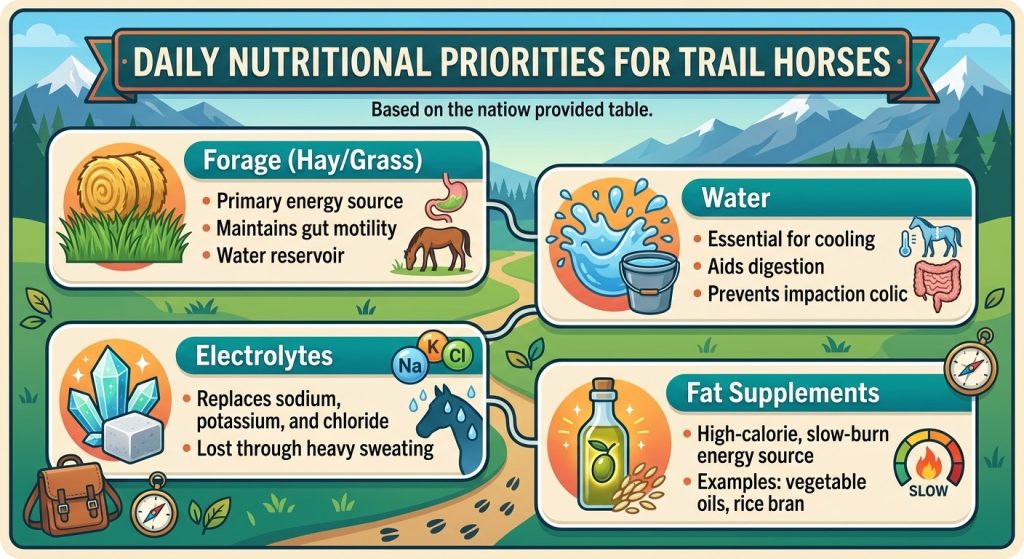
Sweat consists of water and vital minerals: sodium, potassium, chloride, and calcium.
When horses lose excess electrolytes, they run the risk of synchronous diaphragmatic flutter (“thumps”), muscle cramps, and colic. Offer balanced electrolyte pastes before, during, and after long rides—but only after ensuring the horse is already drinking water consistently. FYI, dosing an unhydrated horse with concentrated salts can severely damage its stomach lining.
Caloric Requirements for High Horse Daily Mileage
Working horses covering extended distances require dense, slow-burning energy. High-fat, high-fiber feeds work far better than high-starch grain mixes, which can trigger metabolic ties-up.
-
Free-Choice Forage: High-quality grass hay provides a constant digestive buffer.
-
Fats: Rice bran, beet pulp, and vegetable oils offer sustainable calories without making the horse overly hot or anxious.
Vet Checks, Gate Rules, and “Fit to Continue”
Official endurance riding is uniquely self-policing because of one core concept: the veterinary check. You can be the fastest rider on the trail, but if your horse fails a vet check, you are instantly disqualified.
Heart Rate Parameters
Upon arriving at a ride check station, the clock runs until your horse’s heart rate drops to the event standard (typically 64 BPM or lower). The faster your horse recovers, the sooner your rest period begins.
Metabolic Signs and Lameness Scores
Veterinarians check several critical health indicators:
-
Capillary Refill Time (CRT): Gums should return to a healthy pink color within 2 seconds of being pressed.
-
Skin Turgor: Pinching the skin on the shoulder should result in an immediate snap back; delayed flattening signals dehydration.
-
Gut Sounds: Active gut sounds in all four quadrants are mandatory. A quiet gut is a red flag for impending colic.
-
Gait Evaluation (Trot-Out): The horse is trotted in a straight line on a loose lead. Any sign of lameness—no matter how subtle—results in a “Pull” from the ride.
Essential Gear to Maximize Endurance Horse Distance
The right equipment prevents girth sores, sore backs, and split hooves long before they become career-ending injuries.
Saddle Fit and Padding
An endurance saddle must distribute rider weight over a wide surface area while keeping the spine completely free of pressure.
-
High-Density Foam Pads: Help absorb repeated shock over long distances.
-
Neoprene vs. Fleece Girths: Soft, breathable synthetic girths prevent chafing in sweat-heavy areas.
Hoof Boots vs. Traditional Shoes
Barefoot horses covering high horse daily mileage over sharp rock usually require hoof protection.
-
Steel/Aluminum Shoes: Traditional and reliable, often paired with pads and pour-in silicone for sole protection.
-
Flexible Hoof Boots: Exceptional for shock absorption and ground feel. Ensure they are fitted precisely to prevent rubs around the pasterns.
Post-Ride Recovery and Injury Prevention
What you do in the 48 hours following a long trail effort determines how quickly your horse returns to peak condition.
-
Immediate Cooling: On hot days, sponge cold water over large surface blood vessels (neck, chest, inner thighs) and scrape it off immediately.
-
Hand Walking: Keep the horse moving gently for 10–15 minutes every hour following a ride to clear lactic acid from muscles.
-
Leg Care: Check tendons and ligaments thoroughly for heat, windpuffs, or pain. Cold hosing or applying cooling clay poultices reduces soft-tissue inflammation effectively.
-
Rest: Allow at least one full week of pasture turnout for every 25 miles completed before resuming structured workouts.
Frequently Asked Questions About Endurance Horse Distance
How far can a horse travel with a rider in a single day safely?
For a well-conditioned endurance horse on moderate terrain, a distance of 25 to 50 miles per day is safe and standard during events. Elite endurance horses can cover up to 100 miles within 24 hours under strict veterinary oversight. For an unconditioned leisure horse, safe daily distances should not exceed 10 to 15 miles at a walking and trotting pace.
What is the ideal horse daily mileage during a regular training week?
During an active conditioning phase, a target horse daily mileage ranges from 5 to 15 miles per session, 3 to 4 days a week. It is critical to build in full rest days so bones and soft tissues can repair themselves. Quality of movement and cardiovascular control matter far more than piling on mindless miles.
Which horse breeds excel at endurance horse distance rides?
Arabians and Arabian crosses dominate the sport due to their high concentration of slow-twitch muscle fibers, efficient heat dissipation, and exceptional recovery rates. However, breeds like Mustangs, Morgans, Appaloosas, and Grade horses frequently complete Limited Distance (LD) and 50-mile events successfully.
How do I know if my horse is getting exhausted on the trail?
Signs of severe fatigue include a lagging pace, tripping, elevated respiration that fails to drop when stopped, dry/tacky gums, lack of gut sounds, and disinterest in eating or drinking. If your horse displays these signs, dismount immediately, offer water, cool the horse down, and seek veterinary assistance. 🙂
What gear is mandatory for an official endurance competition?
While rules vary slightly depending on the sanctioning body (such as AERC in the USA), mandatory items always include an approved helmet for the rider, a well-fitted saddle, and a secure bridle or halter/bridle combination. Additionally, gear like heart rate monitors, sponge buckets, and hoof boots are highly recommended for rider efficiency and horse comfort.
Final Words: Hitting the Trail with Confidence
Mastering the nuances of Endurance Horse Distance takes patience, acute observation, and deep respect for your animal’s physical limits. There are no shortcuts on the trail. Every mile you complete successfully is a direct result of the preparation, proper nutrition, and careful conditioning you put in at home.
Listen to your horse, respect the veterinary checks, and enjoy the journey across the miles. The bond forged over hours on the open trail is like nothing else in the equestrian world.









