
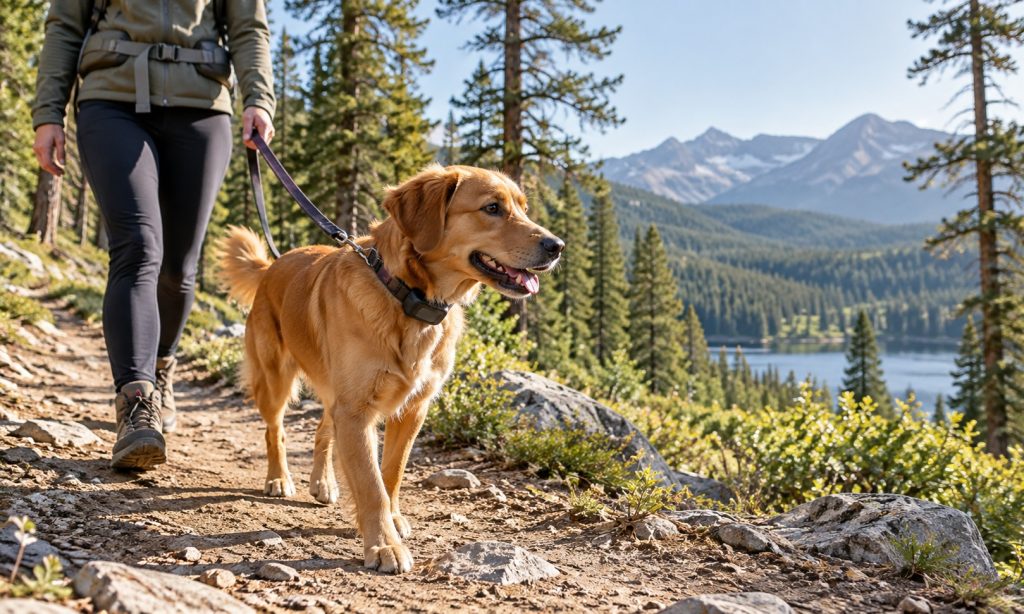
A dog can slip a collar, pull free when wildlife appears, or disappear around a bend before you have time to react. A GPS tracker can help you find a dog’s location, but the right choice depends on where you hike, whether cellular service reaches the trail, and how long the device can keep working away from a charger. If you are comparing options for the best GPS dog collar for hiking, start with those practical limits—not a long feature list.
A tracker is a backup layer of safety. It does not replace a leash, a well-fitted collar or harness, reliable identification, or recall practice. And no device can promise a precise location in every landscape. Trees, cliffs, and other obstructions can interfere with GPS reception, while some trackers also need cellular coverage to send location updates to your phone.
First, understand what the tracker needs to work
GPS satellites help a tracker calculate its location. The device must then get that information to you—often through a cellular network and a phone app, or through a compatible handheld receiver in some tracking systems.
That distinction matters on a hike. A tracker that relies on cellular service may work well on a local trail with coverage but struggle in a remote valley without it. Manufacturer guidance for one cellular tracker, for example, says it needs cellular coverage to transmit a pet’s position; poor coverage can also shorten battery life because the device works harder to connect.
Other systems pair a dog’s tracking collar with a separate handheld unit. That setup may suit remote activities where phone service is unreliable, but it can involve additional equipment and a different learning curve. Check the system’s coverage and equipment requirements for the trails you actually visit.
A tracker can show delayed, approximate, or missing updates when signals are blocked. GPS research has found that location accuracy can worsen under forest canopy compared with open, unobstructed conditions. Think of location tracking as useful information—not a guarantee that the dot on your screen is the dog’s exact position.
What to look for in a GPS dog collar for hiking
Coverage that matches your routes
Before comparing apps or colors, check how the tracker communicates and where it works. Review the service map for your regular hikes, nearby wilderness areas, and any planned trips. A map that shows broad national coverage does not necessarily mean dependable signal on a specific trail.
For cellular models, ask:
- Does the tracker need a mobile connection to send location updates?
- Which networks does it use?
- Does it need a subscription?
- Can it store location data when service is unavailable?
- What will happen when it reconnects?
For a system using a handheld receiver, confirm what equipment is required and whether you can use it without a phone signal. Do not assume that a feature called “live tracking” will work everywhere.
Battery life under real hiking conditions
Advertised battery life is a starting point, not a trip plan. Frequent location updates, weak cellular service, cold conditions, and prolonged searching can affect how long a device lasts. A tracker’s power-saving mode may help during everyday use but may not reflect continuous or high-frequency tracking on a hike.
Look for separate battery estimates for ordinary tracking and active tracking if the maker provides them. Before leaving, charge the tracker and your phone, carry a power bank if appropriate, and check whether you can change the update interval. If you take long or multi-day hikes, consider whether the system’s battery capacity and charging method fit that schedule.
A best GPS dog collar for hiking should have enough reserve for the entire outing, with a margin for delays. Do not set out assuming the device will last exactly as long as the maximum advertised estimate.
Update frequency and alerts
A location update every few minutes may be adequate for checking where a dog is walking beside you. It may be too slow if the dog has bolted and is moving quickly. See whether you can switch to a more frequent update mode and whether doing so affects battery life.
Useful alerts may include a low-battery warning, a lost-connection notification, or an alert when a dog leaves a defined area. Learn how those alerts behave before you rely on them: a phone with notifications muted, no signal, or a depleted battery may not receive them in time.
A secure, comfortable fit
The device should stay attached without bouncing, twisting, or rubbing. Check the manufacturer’s minimum dog weight and neck-size range, and consider the combined weight of the tracker and collar. A bulky unit can be uncomfortable for a small dog or interfere with a harness.
Fit matters during movement. Check for chafing after the first short walk, especially under the neck and around the attachment point. Make sure the dog can move, breathe, and swallow normally, and remove the device if it causes irritation. If your dog uses a harness on the trail, make sure the tracker’s position will not snag or press uncomfortably against the dog.
Weather and water protection
Hiking can mean rain, mud, stream crossings, and a dog who treats every puddle as an invitation. Check the exact device’s water-resistance rating and the maker’s instructions for swimming, cleaning, and charging. “Water-resistant” does not automatically mean suitable for extended submersion.
Also check the charging port, clip, and collar material. Mud and grit can interfere with a mount, and a tracker that detaches is no help. After each hike, inspect the attachment and clean the unit as directed.
Map and app usability
An app can be feature-rich and still be difficult to use when you are worried and standing on a trail. Before buying, see whether the map is readable, the location history is easy to access, and the app clearly distinguishes a current position from an old one. Check whether maps can be saved for offline use and whether the tracker itself continues recording locations without a phone connection.
Try the app at home. Set up the account, enable alerts, learn how to start active tracking, and confirm that location sharing works with the people who hike with you. If the system requires a separate receiver, practice using it before taking it into the backcountry.
Total cost and service requirements
Compare the full cost, including the device, required service plan, replacement bands or mounts, and any compatible handheld equipment. A lower purchase price may come with a recurring fee. A tracker that does not require cellular service may still need a receiver or other equipment.
Read the service terms before relying on location history, live updates, or sharing features. Some features may depend on an active plan. Make sure you understand what continues to work if you pause or cancel service.
Match the tracker to your kind of hike
For short hikes near town, a cellular tracker may be a straightforward option if you have reliable coverage on the route. For remote trails, coverage gaps should shape your decision. A system with a separate receiver or a clear offline mode may be more suitable, depending on the trail and your equipment.
For long hikes, prioritize battery reserve, practical charging, and an update mode you can adjust. For wet or muddy routes, focus on secure mounting and the device’s stated water protection. For a small dog, pay extra attention to weight and fit. The best GPS dog collar for hiking is the one whose limitations suit your real conditions.
Do not choose based only on a advertised “range.” A cellular system’s range depends on network availability; a receiver-based system’s effective distance may depend on terrain and line of sight. Ask what the stated number measures and under what conditions it was tested.
How often should you use or replace a GPS dog collar for hiking?
Use the tracker on hikes when its added location information is useful, but check it before every outing. Confirm the battery, fit, attachment, app connection, and alert settings. If you have not used it recently, test it on a familiar walk before taking it somewhere remote.
There is no universal replacement schedule. Replace a collar or mount when it is cracked, stretched, frayed, or no longer holds the device securely. Replace or service the tracker according to its manufacturer’s guidance if the battery no longer holds a dependable charge, the casing is damaged, or it fails repeated connection tests. A software update, service change, or new phone can also affect setup, so periodically confirm that the system still works as expected.
Hiking safety still starts with the basics
Check the rules for the specific trail. Rules vary by park and public land area; some require dogs to stay leashed, and some do not allow dogs on particular trails. The National Park Service advises hikers to keep pets on a leash when enjoying the outdoors.
Before leaving:
- Use a secure leash and a well-fitted collar or harness.
- Keep current identification on your dog.
- Practice recall in safe, controlled settings.
- Carry water and supplies appropriate to the route and weather.
- Tell someone your route and expected return time.
- Keep your phone and tracker charged.
- Know how to start active tracking and share a location.
- Do not rely on the tracker to prevent an escape.
The American Kennel Club also notes that hikers should keep dogs leashed in many hiking areas for safety and to reduce their impact on the environment.
Frequently asked questions
Does a GPS dog collar work without cell service?
It depends on the system. A cellular tracker may still determine a GPS position but be unable to send it to your phone until it reconnects. A tracker paired with a compatible handheld unit may work differently. Check the specific model’s requirements and test it before a remote trip.
Is a GPS tracker more reliable than Bluetooth?
They serve different purposes. A pet-specific GPS tracker is designed to report location over GPS and another communication method, such as cellular service or a receiver. Bluetooth item trackers depend on nearby compatible devices or a short-range connection. The American Kennel Club cautions that Bluetooth item trackers may not be a reliable substitute for pet-specific GPS tracking.
Will a tracker work under trees or between mountains?
It may, but performance can be affected by terrain and blocked satellite views. USGS research describes less precise GPS positions under forest canopy than in open conditions. Check whether the tracker keeps a history or can reconnect and send saved locations later.
Should my dog wear a GPS tracker instead of an ID tag?
No. Keep identification on your dog even if you use a tracker. A tracker can lose power, detach, or fail to connect; an ID tag can help someone contact you if they find your dog.
How do I choose the best GPS dog collar for hiking?
Start with your routes and likely signal conditions. Then compare battery life during active tracking, update frequency, fit, water protection, app or receiver usability, offline options, and recurring costs. The best GPS dog collar for hiking is one you have tested, can operate under stress, and can use where you actually hike.
Final Words
A tracker can make it easier to respond if your dog gets separated, but it cannot remove the risks of hiking. Choose a system that fits your dog and the terrain, learn its limits, and test it before relying on it outdoors. If you are looking for the best GPS dog collar for hiking, prioritize dependable fit, useful battery reserve, and a location system that matches the coverage and conditions on your usual trails.









