
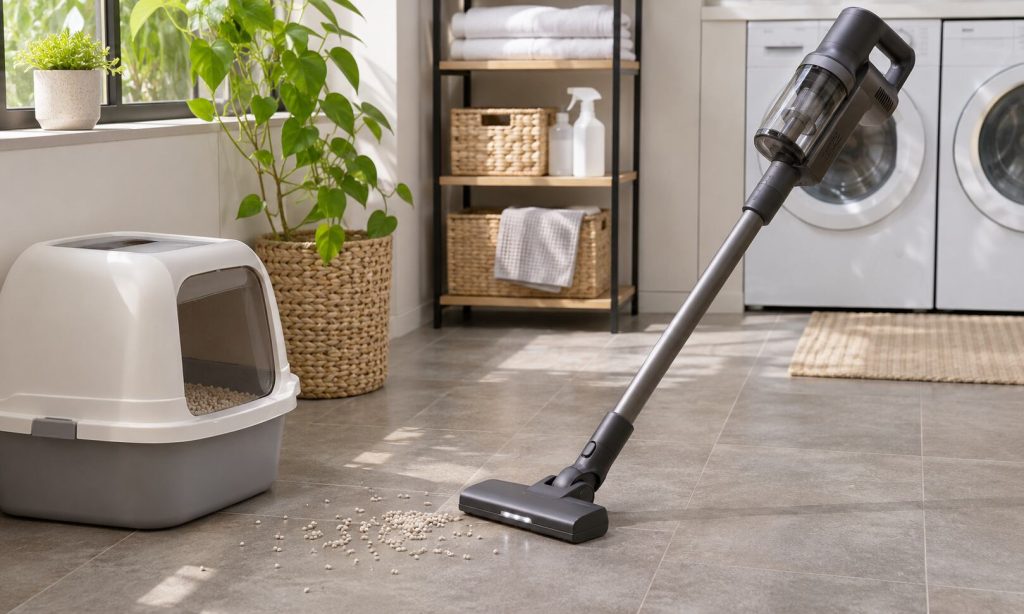
Sizing a cordless vacuum for cat litter is about matching the cleaning job to bin capacity, floor head, battery runtime, weight, and storage space. A handheld model may cope with a few scattered pellets beside one box, while a larger stick vacuum may be easier for several boxes across hard flooring. Bigger is not always better: a heavy machine can be awkward beneath furniture, and strong airflow with a poorly designed head may scatter granules rather than collect them.
This guide explains how to size a cordless vacuum for cat litter around daily debris volume and the surfaces in your home. It also covers filtration, cleaning attachments, safe disposal, and basic maintenance. If you are looking for the best cordless vacuum for cat litter, use the sizing method before comparing features; our hard-floor cat-litter vacuum guide offers a related comparison of floor-cleaning needs.
Estimate the Amount of Litter You Actually Clean
Before sizing a cordless vacuum for cat litter, observe the cleanup area for several days. Note whether you remove a small ring of granules around the tray, a trail down the hallway, or debris from multiple boxes. Different cats track different amounts depending on litter texture, paw fur, and mat placement. This determines whether a compact handheld dust cup is enough or whether a larger collector saves repeated trips to the bin.
Do not use a household vacuum to remove full loads of used litter from inside the box unless its manufacturer explicitly permits that task. Clumps can be heavy, wet, abrasive, or unsanitary. A scoop and designated disposal method remain appropriate for soiled litter. The vacuum should mainly tackle dry tracked granules on suitable surfaces after ordinary litter-box maintenance.
Match Floor Head Design to Your Surface
The best way to size a cordless vacuum for cat litter depends on whether your floors are tile, laminate, wood, vinyl, or carpet. A soft roller or well-designed hard-floor head can gather loose granules without pushing them across the room. Thick carpet may require a different brush roll and more passes. Check how the head handles larger debris rather than trusting a single advertised suction number.
A narrow head reaches bathroom corners and the edge of a cabinet, but takes longer to cover a large area. A wide head cleans open floor quickly yet may not fit beside a litter box. If you need both, consider an interchangeable crevice tool or small motorized attachment. See our cat hair and litter vacuum overview for the distinct challenges of fur and granules.
Choose Dust Cup Capacity for the Job
When sizing a cordless vacuum for cat litter, compare usable dust-cup capacity, not merely the physical size of the machine. Lightweight models with tiny cups may need emptying after one gritty cleanup, while larger bins add bulk and weight. Estimate how often you are comfortable emptying the unit and inspect whether pellets bridge the opening. A bin that is easy to remove and wash can matter more than a few extra ounces.
Do not pack a cup beyond its maximum line. Overfilling can restrict airflow, reduce pickup, and force dust toward filters. Empty collected litter into an appropriate waste bag, ideally in a well-ventilated area away from pets. Avoid shaking a dusty bin indoors. The ability to release debris without putting your hands inside the cup is a useful everyday feature.
Calculate Realistic Battery Runtime
A compact cordless vacuum for cat litter needs enough runtime for the entire cleanup route, including corners, entryway mats, and a second pass under furniture. Manufacturer figures are often measured on particular settings, so high-power operation can shorten available time. Estimate minutes per room and add a margin for unexpected tracked litter. A removable battery may be useful for larger homes, but it is unnecessary for a quick daily spot clean.
Check charging location, charging time, storage temperature, and whether the model can stand or hang securely. A machine that lives near the litter area but blocks a doorway becomes inconvenient. Keep batteries and charging contacts dry, follow the maker’s charging instructions, and inspect cables for damage. Do not leave a unit charging in a location where a cat may chew wires or knock it down.
Account for Weight and Handling
To size a cordless vacuum for cat litter comfortably, consider the weight held in your hand and the balance when using an extended wand. A technically powerful stick model is not helpful if it is tiring to lift or awkward to angle around a tray. For an older owner or someone with limited grip strength, easy controls and a lightweight handheld conversion may matter more than additional attachments.
Try to visualize the motion required: lifting the head over a litter mat, tilting under a cabinet, carrying the unit upstairs, and emptying it over a bin. Handle placement and trigger design affect comfort. A short cordless handheld can be quicker for one bathroom, while a floor-standing stick model reduces bending across a larger area. Compare the actual use case before choosing a size class.
Check Sealed Filtration and Dust Control
Litter produces fine dust even when granules look clean. When sizing a cordless vacuum for cat litter, inspect the entire filtration design and whether it captures fine particles without excessive leakage. A HEPA-labeled component is useful information, but a filter alone does not prove that the whole machine is well sealed. The EPA notes that a HEPA filter can help keep some vacuumed dust from returning to indoor air.
Filters require periodic cleaning or replacement according to the manufacturer’s manual. A clogged filter can reduce pickup and increase maintenance. Avoid vacuuming potentially infectious waste or dusty material outside the machine’s intended use. For general indoor particulate guidance, read the EPA overview of indoor particles. People with respiratory sensitivities may prefer low-dust litter and careful cleanup methods in addition to filtration.
Choose Attachments for Box Edges and Mats
A cordless vacuum for cat litter usually needs a crevice tool for baseboards and under the box, plus a floor head suited to granular debris. A flexible hose may be useful behind a toilet or cabinet, but attachments create storage and cleaning work. Choose only what your space requires. A rotating brush can trap hair and may fling some pellets; check the recommended setting for each surface.
Our guide to introducing vacuum noise to cats helps minimize stress when adding a cleaning routine. Litter-trapping mats can reduce tracking, but vacuuming them requires the right tool and gentle technique so the mat is not sucked into the inlet. Shake or brush a mat according to its instructions before vacuuming when appropriate. Use a washable mat and clean edges regularly. Avoid using the vacuum on wet litter, liquids, or damp clumps unless the specific model is rated for wet pickup.
Test Pickup Without Overloading the Machine
Before committing to a cordless vacuum for cat litter, look for evidence of pickup on similarly sized granules and the exact floor types in your home. If possible, test a small quantity of unused dry litter in a safe area. Observe whether the head gathers debris in a forward pass, scatters it sideways, or leaves pellets at the edge. Do not judge performance by suction marketing claims alone.
Keep a small hand broom as a backup for large accidental spills. If a full bag bursts, sweeping up most dry granules before vacuuming can protect the cup and filters. Use a scoop for the litter box and reserve the vacuum for surrounding surfaces. A machine sized to normal daily tracking should not be treated as a workshop vacuum for heavy, wet, or abrasive cleanup.
Plan Cleaning and Long-Term Maintenance
Sizing a cordless vacuum for cat litter also means sizing the maintenance effort. Fine granules can wear seals, clog small passages, and collect around joints. Empty the cup regularly, inspect the head, and follow the manufacturer instructions for filter washing and drying. Never reinstall a damp filter in a dry-only machine. Check that replacement filters and batteries are available for the model before buying.
Wipe the exterior with an appropriate cloth rather than rinsing motorized parts. Keep attachments dry and free from hair wrapped around the roller. Store the unit where it cannot fall into a litter tray or be knocked over by a pet. If airflow drops or the unit overheats, turn it off and troubleshoot as instructed rather than forcing another pass through gritty debris.
Frequently Asked Questions
Use these questions to match the machine to the size of your cleaning area and the nature of the litter. Always follow the vacuum’s approved materials and maintenance instructions.
A cordless vacuum is for surrounding floors and mats, not a substitute for scooping and sanitizing the cat’s litter box.
Is a handheld vacuum big enough for one cat?
Often, if tracking is limited to a small area and the dust cup holds the typical daily debris. Check surface compatibility, cup emptying, and how easily it reaches the box edge.
Should I choose the highest suction rating?
Not by itself. Head design, larger-pellet pickup, filtration, weight, and usable runtime also determine real performance. Strong airflow can still scatter granules with a poorly suited nozzle.
Can a cordless vacuum remove wet clumps?
Do not vacuum wet or soiled clumps with a dry-only machine. Scoop them into the appropriate waste stream; use the vacuum for dry tracked debris only unless its manual explicitly allows otherwise.
How often should I empty the dust cup?
Before reaching the maximum fill line and whenever pickup drops. For litter, frequent emptying reduces weight and dust accumulation. Follow the maker’s instructions for bin and filter care.
Does HEPA mean no dust escapes?
No. A HEPA component describes filter performance, while whole-machine sealing, correct installation, and maintenance affect practical emissions. Inspect the filtration system and avoid shaking dusty debris inside.
Final Words
To size a cordless vacuum for cat litter, measure the amount of daily tracking, the floor area, and the effort required to reach corners. Then compare dust-cup capacity, floor head, runtime, weight, and filtration as a complete system. The best cordless vacuum for cat litter is one suited to your actual cleanup route, not necessarily the largest or most heavily advertised model. Our hard-floor litter vacuum guide provides related context.
Keep the vacuum for dry debris, scoop soiled litter separately, and maintain filters and attachments according to instructions. Small, frequent cleanups usually protect the machine and keep dust from building up. With the right size and a tidy litter area, daily care becomes more manageable for both you and your cat.









