
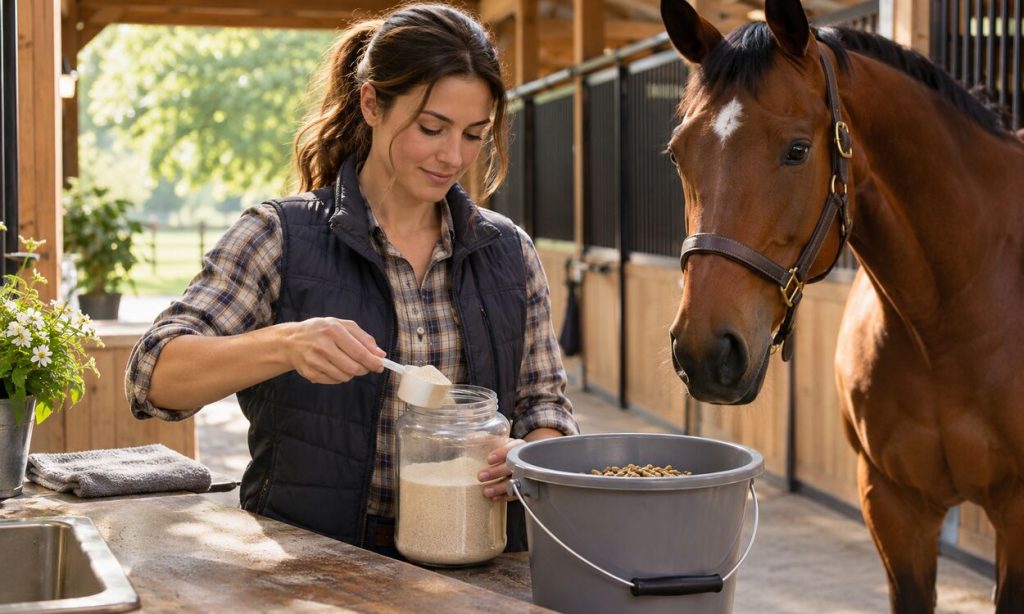
Owners often ask how to size a gastric supplement for horses, but supplements do not have a universal size that fits every animal. The practical question is how much of a particular feed supplement belongs in an individual horse’s daily ration, if it belongs there at all. That decision depends on the product’s directions, body weight, diet, medical history, and a veterinarian’s assessment. A scoop supplied with one formula cannot safely measure every other formula.
This guide explains how to read the label, measure a serving, introduce a veterinarian-approved supplement, and monitor the horse. It also distinguishes ordinary feed supplements from medicines used to treat diagnosed gastric ulcers. Horse owners concerned about discomfort should first consider the signs of equine gastric ulcers and the value of veterinary examination before changing the feed program.
What ‘Size’ Means for an Equine Gastric Supplement
On a gastric supplement label, the equivalent of sizing is the recommended serving or daily amount. A label may state a weight of powder, a measured volume, a scoop count, or a number of pellets. These measures are not interchangeable. Two powders can have different densities, so an identical-looking scoop may hold different weights. A horse’s own weight is another separate measurement. Keep the animal’s weight, the supplement’s serving weight, and the amount actually fed clearly distinguished in your records.
The phrase how to size a gastric supplement for horses is therefore best understood as how to verify an appropriate serving for a particular horse. Use the manufacturer’s species-specific instructions only as a starting point, not a medical prescription. Check whether the label addresses adult horses, growing animals, pregnant mares, or horses with medical conditions. An incomplete or confusing label is a reason to seek professional advice, not an invitation to estimate. An extra scoop is not a shortcut to healing.
Determine Whether the Horse Needs Veterinary Care First
Reduced appetite, changes in attitude, poor performance, weight loss, or signs of abdominal discomfort can have many causes. They cannot confirm an ulcer diagnosis by themselves. A veterinarian may review feeding history, exercise, medications, and physical findings, then discuss whether gastroscopy is appropriate. This matters because gastric ulcer syndromes involve different regions of the stomach and can require different clinical management. Feed supplements are not a reliable substitute for diagnosing or treating suspected gastric disease.
Ask the veterinarian how a proposed supplement fits with existing care. Mention nonsteroidal anti-inflammatory medicines, other supplements, hay access, travel, and stressful training changes. The conversation is especially important for a horse with recurrent colic, significant appetite changes, or a previous ulcer diagnosis. For additional context, our guide to feeding horses with ulcers describes questions to raise. Never postpone evaluation while testing supplements one after another.
Read the Label Without Guessing at a Dose
Find the complete product name, ingredient list, amount per serving, recommended feeding frequency, and total daily amount. Read any instructions about mixing, dividing servings, storage, or use with other products. Check whether the amount is expressed as ounces, grams, tablespoons, or a manufacturer-specific scoop. Convert units only when the directions or your veterinarian give a reliable basis. A volume measure cannot be converted to a weight measure without knowing the material’s density.
To work out how to size a gastric supplement for horses, compare the actual measured serving with the directions for that formula. Do not use a scoop left over from another container, and do not automatically double servings for a larger horse. If directions use body-weight bands, confirm the horse’s weight and the label’s units. Any question about extra servings, use in a foal, or use in a horse receiving medicine belongs with the veterinarian or manufacturer before feeding.
Weigh the Horse and Measure the Serving Accurately
A livestock scale provides the best practical body-weight measurement when accessible. A properly used horse weight tape gives an estimate, which may be sufficient for tracking trends but is less precise. Record the date and method, and avoid assuming an old stable-record weight remains correct after a change in body condition. If the feeding instructions rely on exact weight, ask the veterinarian whether the available estimate is adequate. Avoid using guesswork based on height or breed alone.
For powdered supplements, a clean digital kitchen or feed scale can help when the label specifies grams or ounces by weight. Set the scale to zero with the empty container on it, then weigh the actual serving. Use only a dry, designated utensil; moisture can cause clumping or contamination. For liquids, use an appropriate marked measuring device and follow the product’s instructions. Measuring accurately can prevent repeated small errors that become substantial over several weeks of daily feeding.
Add the Supplement to a Consistent Feeding Routine
Before introducing a new feed supplement, document the current forage, concentrate, treats, and other additives. Several products may contain overlapping ingredients. Ask a veterinarian or equine nutrition professional to review cumulative amounts where mineral or other nutrient duplication is possible. If the supplement is appropriate, follow its specific directions for gradual introduction or mixing. Do not disguise a refusal of food by repeatedly adding more powder. Maintaining adequate forage access and a stable routine deserves attention alongside any supplement discussion.
Store the package according to its label, away from heat, humidity, rodents, and curious animals. Keep the batch number and expiration date visible. Write down who is responsible for each feeding so that two caregivers do not accidentally supply the same serving. A simple feed chart can record the product, measured amount, time, and whether the horse ate it. Our overview of equine digestive supplement considerations explains why ingredients and intended functions deserve separate attention.
Monitor Response Without Treating Supplements as Medicine
Record appetite, manure consistency, weight trend, behavior, exercise tolerance, and any observed discomfort. Keep notes objective: ‘left half of evening feed’ is more useful than ‘stomach seems better.’ Changes may follow alterations in forage, workload, dental health, or weather as well as the supplement. A response does not prove a specific gastric condition, and a lack of response does not rule one out. Share the record with your veterinarian, particularly when symptoms persist or return.
Knowing how to size a gastric supplement for horses does not answer whether a supplement is clinically effective. Product claims and ingredient studies vary considerably, and treatment of confirmed equine gastric ulcers commonly involves veterinarian-directed management. Do not modify prescription medication timing, duration, or dose based on supplement marketing. If the horse develops new loose manure, feed refusal, or another adverse change after introduction, stop and contact the veterinarian for individualized advice. Avoid stacking additional formulas to ‘balance out’ a suspected reaction.
When to Recheck the Plan or Seek Urgent Help
Recheck serving instructions whenever the formulation changes, the horse gains or loses considerable weight, another medicine or supplement is added, or a health condition develops. Also review the plan before traveling or changing barns, because feeding arrangements can change unexpectedly. If the horse refuses a supplement mixed into feed, do not force a large unknown quantity into its mouth. The next step is checking suitability and palatability with the care team, rather than improvising administration.
Signs of colic, severe pain, repeated rolling, persistent inability to eat, or rapidly worsening condition warrant urgent veterinary contact. There is no safe home supplement ‘size’ that addresses an emergency. In less urgent cases, ask the veterinarian what improvement would be meaningful and when reevaluation is appropriate. Owners can read about the limits of gut supplements for ulcer concerns without confusing those products with proven medical treatment.
Frequently Asked Questions
These questions address everyday measurement errors and the situations that require professional judgment. They supplement, but do not replace, the specific directions for a veterinarian-approved formula.
A sensible serving plan uses accurate measurements, the horse’s current details, and a written record. When the label is unclear, leave the amount unresolved until it can be checked.
Can I use the scoop from another gastric supplement?
No. Scoop shapes and powder density vary. Use the device specified for the actual product or weigh the serving when the label supplies a mass. Ask the veterinarian or manufacturer how to proceed if the original scoop is missing.
Does a heavier horse always need twice as much supplement?
Not necessarily. Some feed directions use weight bands; others specify a fixed daily amount. Never invent a dose by multiplying a serving without checking the exact formula and your veterinarian’s instructions.
Can gastric supplements cure ulcers in horses?
A supplement should not be treated as a proven cure. Suspected ulcers require veterinary assessment, and confirmed disease may need prescribed treatment and management changes. Seek professional help instead of relying on marketing promises.
Should I feed the full amount the first day?
Follow the product’s instructions and veterinarian-approved feeding plan. Some feed changes benefit from gradual introduction, but timing and quantities depend on the specific formula and horse. Do not make unsupported adjustments.
What if my horse refuses feed containing the supplement?
Remove the uneaten feed, note how much was consumed, and contact your veterinarian or the manufacturer for safe handling guidance. Do not assume the remaining portion can be accurately dosed by eye.
Final Words
Learning how to size a gastric supplement for horses begins with rejecting the idea that a bigger serving produces a better result. Identify the exact product, verify the horse’s circumstances, follow a veterinarian-approved plan, and measure the amount using the units specified on the label. Keep records so everyone caring for the horse can follow the same routine.
Most importantly, distinguish nutritional support from veterinary diagnosis and ulcer treatment. If appetite, condition, or comfort changes, investigate the underlying cause promptly. The soundest plan combines reliable measurements, adequate forage, sensible management, and professional guidance rather than guessing how much gastric supplement to feed.
Reference
Authoritative equine veterinary literature describes gastric ulcer assessment and treatment, including the limitations of relying on outward signs alone. These sources informed the medical distinctions in this guide.
Supplement serving sizes are product-specific, while clinical treatment decisions require an equine veterinarian. The references below concern veterinary evaluation rather than endorsing a supplement.
- American Association of Equine Practitioners, Equine Gastric Ulcer Syndrome conference guidance (2020).
- Equine Veterinary Education, Equine Gastric Ulcer Treatment and Monitoring (2022–2023).
- AAEP convention proceedings, equine gastric disease and treatment evidence (2017).









