
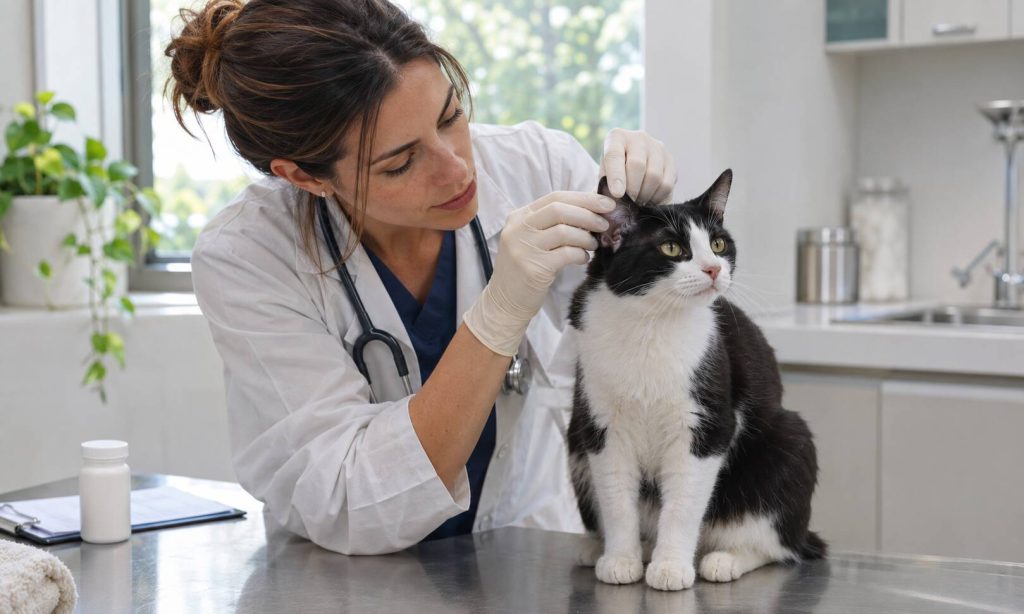
Some medicines sold without a prescription for humans are sometimes used in cats under veterinary direction. That does not make them safe to choose, dose, or combine at home. Anyone considering over-the-counter allergy medicine for cats should start with a diagnosis and the veterinarian’s explicit approval of the exact active ingredient and formulation. Itching may come from fleas, infection, parasites, or other conditions, not necessarily an allergy that responds to an antihistamine.
This guide explains how to discuss possible OTC medicines, check labels, administer only a veterinary-approved plan, store medicine safely, and recognize concerning reactions. It deliberately provides no self-prescribing dose. Before treating itching, our guide to distinguishing cat fleas and allergies provides useful background. A cat’s safety depends on accurate assessment, not the convenience of a pharmacy shelf.
Determine What Is Causing the Symptoms
Scratching, grooming excessively, ear discomfort, irritated skin, hair loss, sneezing, or coughing can arise from different problems. Flea-bite allergy, mites, skin infections, food-related reactions, and environmental allergies may require different management. A cat licking one area repeatedly could also be in pain. Do not begin medication solely because someone online called similar symptoms allergies. A veterinarian can review the history, check the skin and coat, and recommend appropriate testing or treatment. Our guide to common causes of itching in cats outlines several possibilities.
Persistent itching or skin wounds deserve timely care. Difficulty breathing, facial swelling, collapse, or other severe sudden signs require emergency veterinary attention. Even when the cat looks stable, a medication that reduces itching might mask signs without addressing fleas or infection. The proper goal is to identify and manage the underlying cause. Ask the veterinarian which observations and photos would be most useful before an appointment.
Understand Why Human OTC Labels Can Be Misleading
An over-the-counter status describes how a medicine is sold to people; it does not authorize animal use. A product can combine an antihistamine with a decongestant, pain reliever, sleep aid, alcohol, sweetener, or other ingredient that changes its risk for a cat. Extended-release and flavored liquid formulations also differ from plain tablets. Never assume two products with similar front labels contain the same components. Read the full active and inactive ingredient lists.
Cats process certain substances differently from people, and some human medications can cause serious poisoning. University veterinary guidance warns against giving cats human medicines without first consulting a veterinarian. If the veterinarian authorizes a particular medicine, confirm the exact formulation, strength, route, frequency, and intended duration. Do not substitute a different generic combination or liquid without asking. Even a familiar ingredient may be unsafe at the wrong concentration.
Agree on an Individual Veterinary Treatment Plan
The clinician should decide whether an antihistamine or another treatment fits the diagnosis. Antihistamine responses vary considerably, and some cats may not benefit. A veterinary plan may instead emphasize parasite control, environmental changes, dietary investigation, or a different medically supervised therapy. Share the cat’s age, weight, kidney or liver conditions, pregnancy status, prior reactions, and all medicines or supplements. Those details can affect risk and treatment choices.
Ask what improvement should look like, when the medicine should be reassessed, and what adverse signs require a call. Write the instructions down exactly. Do not borrow a dose from another cat, split tablets by guesswork, or increase frequency when the symptoms persist. Our questions for a veterinarian before antihistamine use may help structure the discussion. A planned review is safer than repeated unsupervised trials.
Give Only the Authorized Medicine in the Authorized Way
Before each administration, compare the package with the written veterinary instructions. Confirm the active ingredient, strength, dose unit, route, timing, and any food directions. Use an appropriate measuring device for a prescribed liquid when the veterinarian provides one. Do not use a household teaspoon or mix medicine into food without checking that the cat will consume the complete amount and that mixing is allowed. Keep a simple administration record to avoid accidental repeat doses.
Never force a pill into a struggling cat if doing so risks choking or injury; ask the clinic to demonstrate a safer method or provide an appropriate formulation. If the cat vomits after receiving medicine, do not automatically redose. Call for instructions. If a dose is missed, follow the veterinarian’s plan rather than doubling the next one. Stop and seek medical advice for unexpected behavior or possible adverse effects.
Watch for Adverse Reactions and Urgent Warning Signs
Some antihistamines can cause sleepiness, behavioral changes, dry mouth, stomach upset, or paradoxical agitation. Serious reactions or overdose can produce dangerous neurologic or cardiovascular signs. Your veterinarian should tell you what to monitor for the chosen medicine. Keep the packaging available in case an emergency clinic needs ingredient details. If the cat becomes unusually weak, disoriented, agitated, or refuses food, contact the veterinary team promptly.
Seizures, difficulty breathing, collapse, severe tremors, or suspected ingestion of a dangerous medication are emergencies. Do not wait for symptoms to resolve or attempt to induce vomiting without professional direction. Contact an emergency veterinarian or animal poison service. Our cat allergy-medicine reaction guide covers related warning signs. Safe use includes knowing when not to give another dose.
Store Medicine So Cats and People Cannot Make Mistakes
Keep medicines in their original labeled containers with child-resistant closures where appropriate. Store them in a secure cabinet beyond a cat’s reach, not beside treats, feeding bowls, or loose tablets. Follow temperature and light requirements printed on the label and provided by the veterinarian. Do not transfer pills to an unlabeled jar. Cats can swallow dropped tablets, and a visitor may mistake an animal medicine for a human product.
Separate medicines prescribed for different household pets. Use a written schedule when multiple caregivers administer doses. Check expiration dates and discard unused medicine according to pharmacy or local disposal guidance. Never leave tablets on a counter in preparation for a later dose. If the cat accidentally gets into a container, save it for the veterinarian and seek urgent guidance. Good storage is an essential part of the treatment plan.
Recheck the Diagnosis if the Cat Does Not Improve
If symptoms continue, do not simply increase medication or try several OTC products in succession. A poor response may mean the cause is not histamine-mediated, the diagnosis needs refinement, or the treatment is not appropriate. Revisit flea prevention, environmental conditions, skin infection signs, and the veterinary history. Keep notes about itch frequency, affected areas, appetite, and any new lesions. Photographs taken at consistent intervals may help the clinician assess changes.
Follow-up matters even when the cat seems more comfortable. Some conditions recur or need longer-term environmental management. Do not stop a prescribed plan or switch formulas without checking the instructions. If the veterinarian recommends a controlled food trial or another investigation, follow it consistently. Medicine is one possible tool, not a substitute for knowing why the cat is itchy.
Frequently Asked Questions
These questions focus on common household errors with nonprescription medicines and feline allergy symptoms. The answers intentionally avoid dosing details because those must come from a veterinarian.
Never use a human medicine label as the sole instruction for treating a cat. The full formulation and the animal’s medical history determine whether a plan is appropriate.
Can I give my cat a human OTC antihistamine?
Only when a veterinarian specifically authorizes the exact medicine and formulation for that cat. Do not choose or dose it independently.
Are all antihistamines safe for cats?
No. Ingredients, combinations, strengths, and formulations vary. Some human medications are toxic to cats, and even approved drugs can cause adverse effects.
Can I double the dose if my cat is still scratching?
No. Contact the veterinarian. Continued itching may mean the medicine is ineffective or the cause needs different treatment.
What if my cat spits out or vomits a dose?
Do not automatically repeat it. Ask the veterinarian whether a replacement dose is appropriate and how to administer the medicine safely.
When is an allergic reaction an emergency?
Seek emergency veterinary care for breathing difficulty, collapse, seizures, severe swelling, or other rapidly progressing serious signs.
Final Words
Using OTC allergy medicine for cats safely starts with veterinary evaluation, explicit approval of the exact formulation, and careful observation. Do not use human package directions to calculate feline doses or treat unknown itching. Keep medicine labeled, secure, and separate from other pets’ prescriptions.
If signs persist or adverse reactions appear, contact the veterinarian instead of adjusting the treatment yourself. The most helpful decision is often identifying the real cause of the cat’s symptoms before any medicine is given.
Reference
These university veterinary, professional, and veterinary manual sources informed the guidance on feline allergies, antihistamine limitations, and household medication risks. They reinforce the need for an individualized clinical plan.
The references are educational and do not substitute for prescription instructions. No dosing schedule should be inferred from this article for an individual cat.
- Cornell Feline Health Center. Common Cat Hazards.
- Cornell Feline Health Center. Flea Allergy.
- Merck Veterinary Manual. Antihistamines for Integumentary Disease in Animals (updated 2026).
- American Veterinary Medical Association. Household Hazards (pet medication precautions).









