
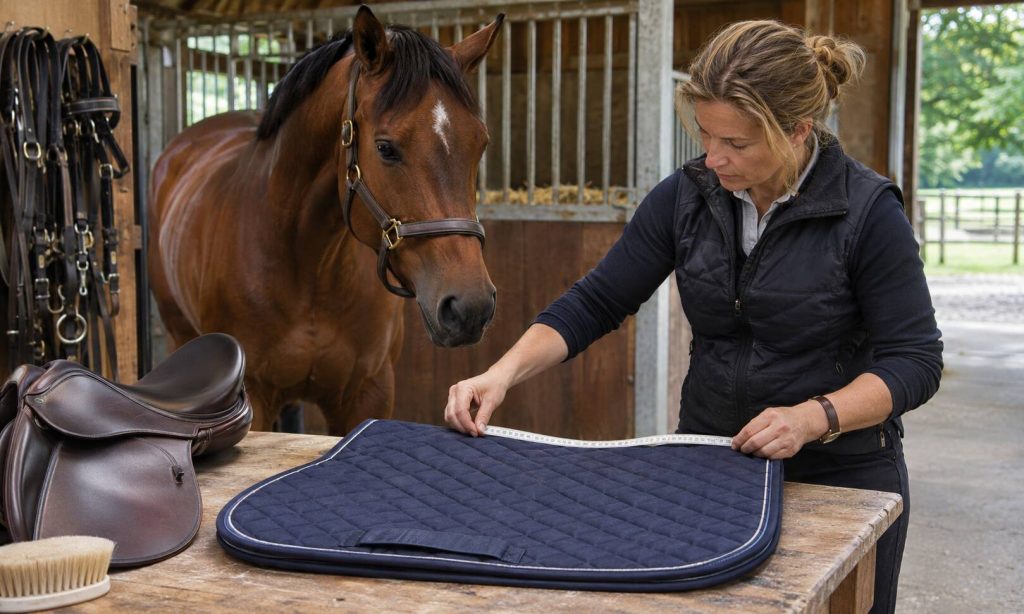
A horse that flinches during saddling, resists moving forward, or develops soreness after riding needs careful assessment. A saddle pad for a horse with a sore back may change cushioning and friction, but it cannot diagnose pain or repair a poorly fitting saddle. The most important features are therefore not softness alone. They include correct size, clear spinal space, stable placement, suitable thickness, and compatibility with a properly assessed saddle.
This guide explains those features and the signs that require veterinary and professional saddle-fitting help. Back discomfort can have causes beyond equipment, including muscle, joint, and other health problems. Do not ride through pain while testing pads. For a broader comparison of construction and fit, see our saddle-pad fit and use guide. The first priority is the horse’s comfort and a sound diagnosis, not an extra layer of fabric.
Start With Veterinary Assessment Rather Than a Pad Change
A painful back deserves evaluation before you purchase or alter equipment. Signs can include sensitivity when grooming the back, repeated ear pinning during saddling, reluctance to bend, bucking, a shorter stride, or a change in performance. These behaviors are not exclusive to saddle problems. A veterinarian can examine the horse and decide whether additional investigation is needed. Sudden severe pain, inability to move normally, neurologic signs, or marked distress warrant prompt care.
Pause ridden work until the cause of significant soreness has been assessed and your veterinarian advises that riding is appropriate. A qualified saddle fitter can then evaluate the saddle and pad combination, ideally with the horse standing and moving under appropriate conditions. University extension guidance emphasizes wither and spinal clearance, even panel contact, and front-to-back saddle balance. Adding a thick pad to a poor fit may alter pressure in an unhelpful way. Treat equipment as one part of the clinical picture.
Prioritize Spine and Wither Clearance
The central channel of a pad should follow the saddle and avoid being pulled tight onto the spine or withers. Material bunched across the withers can create focal pressure. Check the saddle itself for adequate clearance; a pad cannot make an ill-fitting tree suddenly suitable. When a horse has a prominent wither or uneven topline, pad contours and saddle placement need careful assessment. Avoid choosing a pad only because the outline looks attractive on a store image.
Assess the combination with the saddle correctly positioned, without relying on a single static glance. Observe whether the pad stays lifted into the gullet rather than collapsing down. Look for compressed edges that contact sensitive areas or stitching that sits under the loaded saddle panel. A professional can help identify whether the issue comes from saddle shape, girthing, rider balance, or the pad. Our high-withered saddle-pad replacement guide covers related wear and clearance checks.
Check Length, Shape, and Panel Coverage
A saddle pad should extend sufficiently beyond the saddle’s contact area so the border and thick seams are not trapped under loaded panels. Pad size must correspond to the saddle’s actual footprint, not simply the horse’s height or breed. Too-small pads can place binding or piping in pressure areas. Oversized pads can shift or fold, especially when straps are poorly positioned. A shaped pad may work for one saddle model yet sit awkwardly under another.
Test for smooth contact after the girth is fastened appropriately. Check both sides for asymmetry, rolled corners, and wrinkles. When the horse walks, the pad should not creep backward, twist, or bunch up. Watch for rubbing after an appropriately approved short session, but do not use riding as a pain experiment. Unusual hair disturbance, swelling, or repeat soreness calls for renewed evaluation. A properly sized pad is important, yet it is only useful under a saddle that fits the horse.
Evaluate Material, Thickness, and Pressure Distribution
Different pad materials vary in compression, heat retention, moisture handling, and ability to maintain their shape. A very soft material may flatten rapidly, while a dense one may alter how the saddle sits. Thickness is not a direct measure of pain relief. Research on equine saddle pads has found variable effects on pressure depending on the material and context. Do not assume a gel, foam, fleece, or wool layer will distribute load evenly without evaluating it as part of the complete system.
Examine whether the pad is uniform or has inserts intended for specific fit corrections. Shims and specialized half pads require particular care because they can change front-to-back saddle balance. These adjustments should address an identified fitting problem, not a guessed cause of soreness. Our horse half-pad sizing guide explains related fit measurements. A trained fitter may find that changing the saddle, adjusting panels, or avoiding a particular pad is more appropriate than adding more padding.
Consider Heat, Sweat, and Skin Condition
Pads collect sweat, hair, dust, and friction. A dirty or damp pad can irritate the skin and make existing soreness more difficult to assess. Choose a material that can be cleaned according to its care instructions and dried thoroughly between uses. Look at the lining and contact surface for rough stitching, hard patches, or accumulated debris. If the horse develops skin lesions, swelling, or persistent rub marks, stop using the setup and consult the veterinarian.
Heat and sweat patterns may offer clues, but they do not provide a reliable diagnosis by themselves. A dry patch or disturbed hair can raise suspicion about pressure or contact, yet a full examination is still needed. Avoid declaring a pad successful based only on the absence of a visible mark. Evaluate comfort, movement, saddle position, and clinical findings together. Regular cleaning also helps the pad retain its shape and prevents avoidable changes to its contact surface.
Look for Stable Attachment and Repeatable Fit Checks
Girth loops or attachment straps should help keep a pad positioned without creating new tension points. Inspect hook-and-loop closures, elastic, stitching, and edges for wear. A pad that repeatedly slides sideways may signal unsuitable shape, saddle instability, or uneven movement. Do not solve the problem simply by pulling straps tighter. The saddle and pad should remain balanced with normal, comfortable motion under professional assessment.
Keep notes on changes in body condition, muscle development, workload, and tack. A saddle that fitted months ago can become less suitable when the horse gains or loses topline muscle. Recheck fit after those changes, and follow veterinary recommendations about return to exercise. If pain recurs, resist stacking new pads as a substitute for examination. A clear baseline and consistent follow-up make meaningful adjustments easier to identify.
Frequently Asked Questions
Back pain and saddle-padding questions often overlap, but they are not interchangeable. The answers below explain what equipment can and cannot do for a sore-backed horse.
General fit advice does not replace examination of an individual horse. A veterinarian should guide pain assessment, and a qualified saddle fitter should assess the actual saddle and pad combination.
Can a thicker saddle pad fix a sore back?
No. Extra thickness does not diagnose the problem and can alter saddle fit or concentrate pressure. Have the horse evaluated before experimenting with padding.
Which material is best for a horse with back soreness?
There is no universally best material. Pressure response varies with the saddle, horse, pad construction, and rider. Choose only after the underlying cause and saddle fit have been assessed.
Should I keep riding to see whether a new pad helps?
Do not use riding through pain as a test. Pause ridden work when soreness is significant and ask a veterinarian when exercise is appropriate.
Can a saddle pad cause rubbing or pressure?
Yes. Bunched fabric, rough seams, trapped borders, unstable placement, or excessive thickness can contribute to problems. Inspect pad positioning and the complete saddle fit.
When should I replace an existing pad?
Replace pads with compressed, misshapen, rough, torn, or uneven contact surfaces. A replacement is not a substitute for veterinary assessment if the horse is already sore.
Final Words
The most important features in a saddle pad for a horse with a sore back are appropriate clearance, full panel coverage, stable shape, manageable thickness, and clean contact surfaces. But those features matter only within a correctly evaluated saddle setup. Pain requires attention to the horse, not just to the equipment. An extra pad is not a diagnosis or a cure.
Work with a veterinarian to investigate soreness and a skilled fitter to assess tack. Revisit pad and saddle fit as the horse’s body changes. A comfortable horse and sound clinical evaluation should guide every decision.
Reference
The following veterinary and university sources informed the discussion of equine back soreness, saddle fit, and the limits of adding padding. They offer background on why equipment should be evaluated as a complete system.
These references support general educational guidance, not a diagnosis for an individual horse. Ask your treating veterinarian which findings and treatment steps apply to your situation.
- American Association of Equine Practitioners. How to Evaluate a Saddle as a Potential Cause of Back Pain (2016 convention proceedings).
- University of Minnesota Extension. Caring for Horses on a Budget (tack and saddle fit section).
- Equine Veterinary Education. Clinical Progress in the Diagnosis of Thoracolumbar Problems in Horses (2018).









