
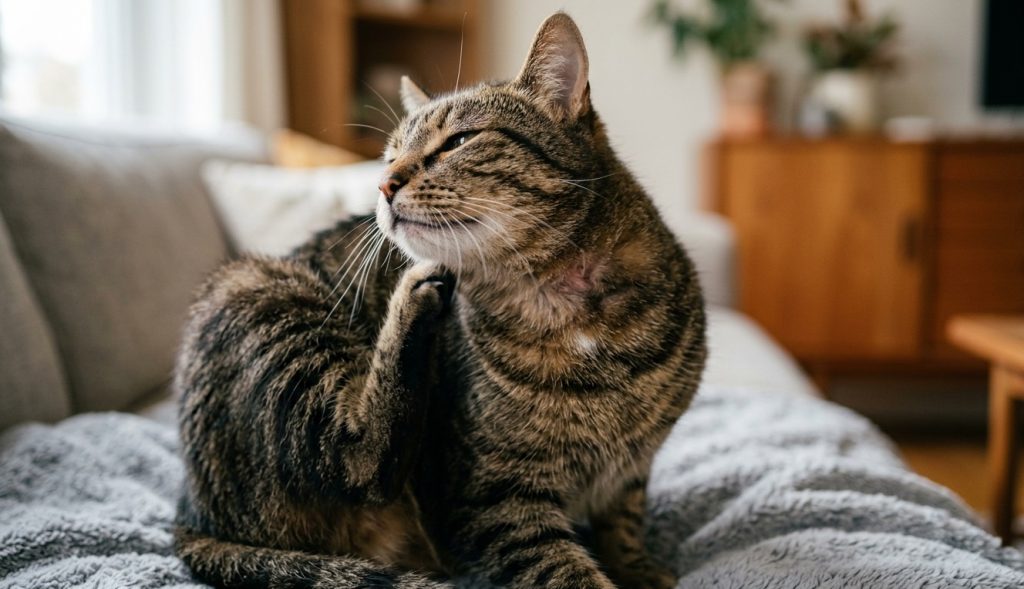
A cat that suddenly starts scratching, licking, or pulling out fur is hard to ignore. If you are searching for cat skin allergy symptoms, you may already have noticed scabs, hair loss, irritated skin, or an unusual amount of grooming. Unfortunately, cats are remarkably good at hiding discomfort until a skin problem becomes difficult to overlook.
Cat skin allergies are one possible reason for these changes, but they are not the only explanation. Fleas, parasites, infections, food reactions, and other skin disorders can cause similar signs. That is why recognizing the pattern of symptoms is useful, but figuring out the underlying cause may require a veterinarian’s help.
What Are Cat Skin Allergies?
A skin allergy occurs when a cat’s immune system reacts excessively to a substance that would normally be harmless. Depending on the individual cat, the trigger may be related to flea bites, food, or environmental allergens such as pollen, dust mites, or mold.
The resulting inflammation can make the skin intensely itchy. The cat scratches, bites, rubs, or licks the irritated areas, which can damage the skin even further. That creates an unpleasant itch-scratch cycle: irritation leads to itching, itching leads to self-trauma, and self-trauma creates more inflammation.
Veterinary dermatology sources describe feline atopic skin syndrome as an allergic skin disease associated with environmental allergens. Diagnosis requires consideration of the cat’s history and clinical signs while ruling out other causes of itching.

Source: Royal Canin Academy — Atopic Dermatitis in Cats
Cat Skin Allergy Symptoms to Watch For
The most important cat skin allergy symptoms are usually related to itching and self-trauma.
Watch for:
- Persistent scratching
- Excessive licking or grooming
- Chewing or biting at the skin
- Hair loss or bald patches
- Small crusty bumps or scabs
- Red or inflamed skin
- Head and neck itching
- Skin lesions or plaques
- Irritated ears
- Changes in coat quality
- Repeated skin infections
Not every allergic cat will develop all of these signs. In fact, feline allergies can look surprisingly different from one cat to another.
Persistent Scratching and Grooming
One of the clearest clues is a sudden or persistent increase in grooming. Cats naturally groom themselves, of course. They are basically tiny, furry perfectionists. But constant licking, chewing, or scratching is different.
A cat that repeatedly focuses on one area, wakes up to scratch, or seems unable to leave its skin alone may be experiencing significant itchiness.
Hair Loss
Allergic cats may remove their own fur through repeated licking, chewing, or scratching. The hair loss can be patchy or widespread.
Sometimes the skin underneath looks relatively normal. In other cases, there may be redness, scabs, crusts, or inflammation.
Scabs and Small Bumps
Small crusted bumps are particularly important. Cats with flea allergy dermatitis may develop a pattern known as miliary dermatitis, which produces numerous small crusty lesions.
Flea allergy dermatitis can also cause itching, overgrooming, and hair loss, particularly around the face, neck, back, tailhead, and other areas.
What Does Cat Allergy Skin Look Like?
There is no single appearance that proves a cat has an allergy.
Depending on the trigger and severity, allergic skin may appear red, irritated, crusty, swollen, or covered with small bumps. A cat may also develop areas of hair loss or moist, inflamed lesions caused by excessive licking and scratching.
Food allergies, for example, commonly cause itching around the face, ears, and neck, although the feet, underside of the body, and other areas may also be affected. Cats with food-related skin disease can develop hair loss, excoriations, miliary dermatitis, and eosinophilic lesions.
The appearance can provide clues, but it cannot reliably identify the allergen. Several unrelated skin conditions can look remarkably similar.

Source: ŌKAMI — Allergies in Cats
Common Causes of Cat Skin Allergies
1. Flea Allergy Dermatitis
Flea allergy dermatitis is one of the first possibilities veterinarians consider when a cat develops itchy allergic skin disease. The problem is not simply the physical presence of fleas. Some cats are hypersensitive to proteins in flea saliva. Even a relatively small number of flea bites can therefore cause a significant reaction.
This is especially frustrating for indoor-cat owners who think, “My cat never goes outside, so fleas can’t be the problem.” Unfortunately, indoor living does not make a cat automatically flea-proof. Fleas can enter homes through other pets, people, clothing, or the environment.
Merck Veterinary Manual identifies flea allergy dermatitis as the most common type of allergic dermatitis in cats and recommends appropriate flea control when evaluating an itchy cat.
2. Food Allergies
Food allergies can cause some of the same cat skin allergy symptoms as flea and environmental allergies.
A cat may develop persistent itching, particularly around the head and neck, along with hair loss, crusting, or skin lesions. Some cats can also experience gastrointestinal problems such as vomiting or diarrhea.
Commonly reported food allergens in cats include beef, fish, and chicken, although virtually any dietary ingredient can potentially be involved in an individual animal.
One confusing detail is that food allergies can develop even when a cat has eaten the same food for a long time. A familiar diet does not automatically rule out a food allergy.
3. Environmental Allergies
Cats can also react to environmental allergens, including pollen, dust mites, and mold spores.
This type of allergy is often described within the broader category of feline atopic skin disease. Symptoms may be seasonal in some cats, while others experience problems throughout the year.
Cornell University notes that allergies to airborne materials, food, and flea or mosquito bites are among causes of feline skin disease seen in veterinary dermatology.
4. Other Possible Triggers and Look-Alikes
Not every itchy cat has an allergy.
Parasites, fungal infections such as ringworm, bacterial or yeast-associated skin problems, medication reactions, and other dermatological conditions can produce similar symptoms. This is one reason treating the skin without determining the underlying cause can lead to frustration.
If the problem keeps returning, the question should not simply be, “What can stop the itching?” It should also be, “Why is my cat itching in the first place?”
Cat Dermatitis and Allergies: What’s the Connection?
Cat dermatitis simply refers to inflammation of the skin. An allergy can cause dermatitis, but dermatitis itself does not automatically mean an allergy. This distinction matters.
When a cat’s skin becomes inflamed, itching may follow. The cat scratches or grooms excessively, causing additional damage. That damage can make the skin even more inflamed and potentially vulnerable to secondary infections.
Cornell describes this as a cycle involving inflammation, itching, self-trauma, and additional inflammation. Breaking that cycle is an important part of managing many feline skin disorders.
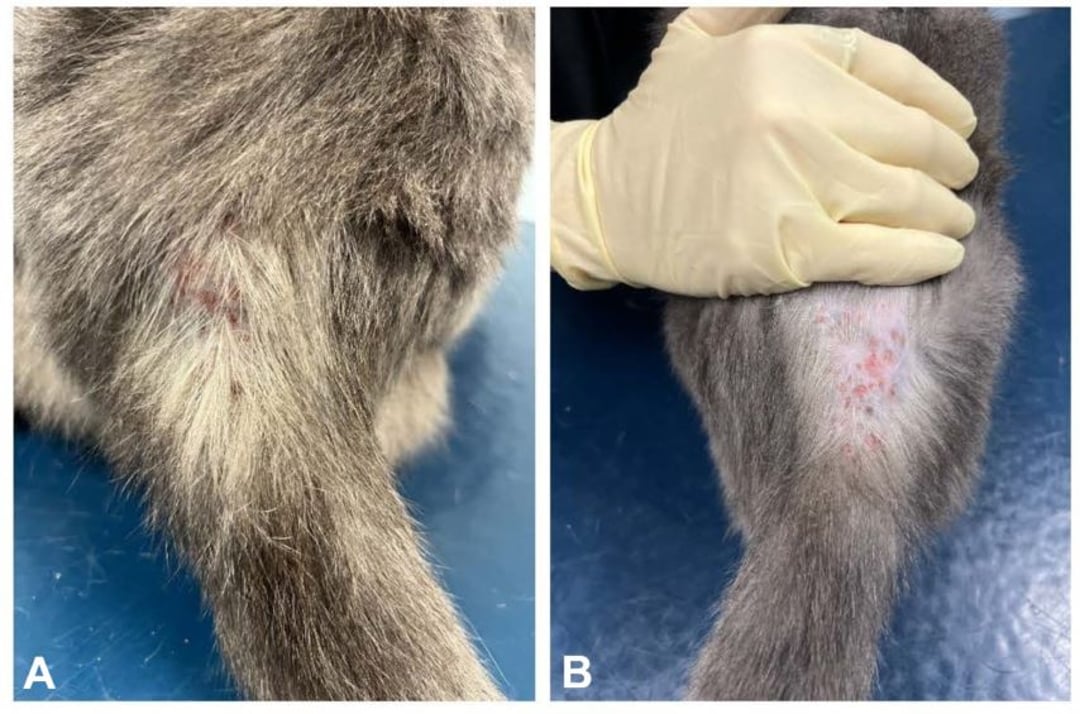
Source: MSD Veterinary Manual — Flea Allergy Dermatitis, Caudal Dorsum, Cat
Cat Dry Skin vs. Cat Skin Allergy Symptoms
Cat dry skin can cause flaking, mild irritation, or a dull-looking coat, but dry skin alone does not necessarily indicate an allergy.
For example, occasional mild flaking may have a much simpler explanation than a cat that is repeatedly scratching its neck, removing fur, and developing scabs.
More concerning cat skin allergy symptoms include persistent itching, significant hair loss, crusts, recurring lesions, and obvious skin inflammation.
If your cat has dry skin accompanied by substantial itching or other skin changes, it is better not to assume that the problem is simply dryness. Parasites, allergies, infections, grooming difficulties, nutrition-related issues, and other conditions may need consideration.
How Veterinarians Diagnose Cat Skin Allergies
Diagnosing feline allergies can involve some detective work.
A veterinarian may begin with a detailed history and physical examination. Depending on the situation, the evaluation may include:
- Flea combing
- Examination for parasites
- Skin cytology
- Skin scrapings
- Fungal testing
- Assessment for secondary infections
- Dietary elimination trials
- Allergy testing in selected cases
Merck Veterinary Manual emphasizes that feline atopic skin syndrome is diagnosed by considering history and clinical signs while excluding other causes of itching. Allergy testing alone does not necessarily establish the diagnosis because it may simply indicate exposure to an allergen.
Food allergies are another good example of why diagnosis can take time. A properly controlled elimination diet followed by a dietary challenge is considered the reliable approach for confirming a food allergy.
How Are Cat Skin Allergies Treated?
Treatment depends on the cause.
Flea Control
If flea allergy is involved, consistent flea control is essential. Treatment may need to include the affected cat, other household pets, and the environment.
A veterinarian can recommend a flea-control program appropriate for your cat’s age, health, lifestyle, and household.
Dietary Management
If a food allergy is suspected or confirmed, your veterinarian may recommend a controlled elimination diet using a suitable novel-protein or hydrolyzed-protein diet.
This is not the same as casually switching between several commercial foods and hoping something works. Extra treats, flavored medications, table food, and other dietary exposures can interfere with a properly conducted trial.
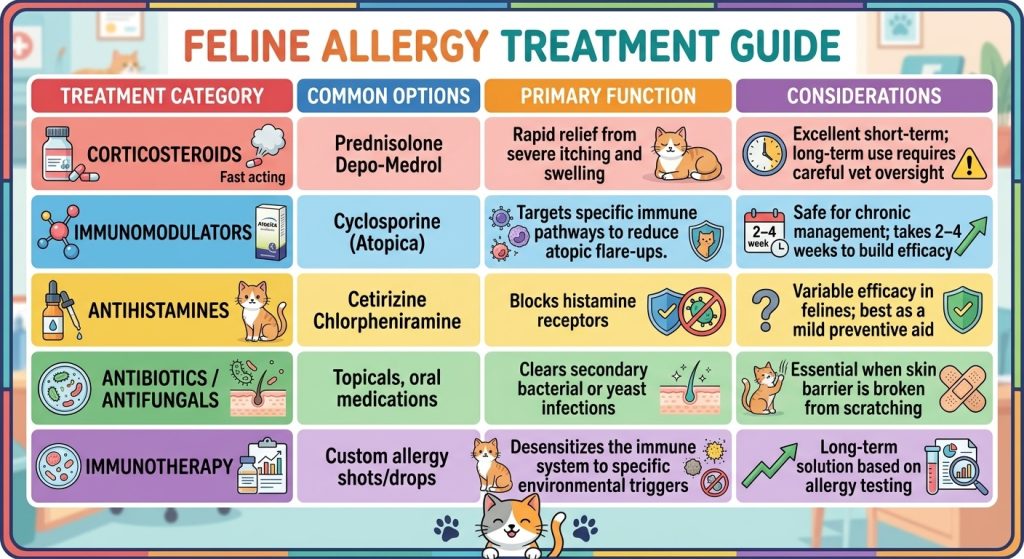
Controlling Itching and Inflammation
Veterinarians may prescribe medications to control itching and inflammation when appropriate. The choice depends on the individual cat and the underlying condition.
If a secondary bacterial or yeast infection develops, that infection may require separate treatment.
Allergy-Specific Management
Some cats with environmental allergies may benefit from longer-term management strategies, including allergen avoidance where practical and allergen-specific immunotherapy.
The goal is generally management rather than a magical one-time cure. Allergic skin disease can be chronic and may require adjustments over time.
What Can You Do at Home?
There are several sensible steps cat owners can take while working with a veterinarian.
Keep flea prevention current according to your veterinarian’s recommendations. Wash bedding regularly and keep the living environment reasonably clean. If you know of a particular environmental trigger, reduce exposure where realistically possible.
Keep a simple record of flare-ups. Note when the itching started, where it appears, what the skin looks like, what food the cat is eating, and whether anything changed recently.
Taking clear photographs can also be surprisingly useful. A skin lesion that disappears before the veterinary appointment is much easier to discuss when you have a dated photo of what it looked like.
Avoid applying human creams, essential oils, or other home remedies unless your veterinarian specifically recommends them. Cats groom themselves, meaning anything applied to their fur or skin may eventually be swallowed.
And IMO, avoiding a frantic cycle of changing food every few days is one of the most useful things an owner can do. A controlled approach produces much better information.
When Should You Take Your Cat to the Vet?
Mild, occasional scratching is not necessarily an emergency. Persistent or worsening skin problems deserve more attention.
Arrange a veterinary examination if your cat has:
- Persistent or severe itching
- Significant hair loss
- Numerous scabs or crusts
- Open sores
- Bleeding skin
- Pus or unusual discharge
- Painful lesions
- Repeated skin infections
- Rapidly worsening skin changes
- Poor appetite or lethargy accompanying the skin problem
Facial swelling or difficulty breathing can indicate a serious allergic reaction and should be treated as an emergency.
Remember that cats can conceal illness surprisingly well. A cat that looks “mostly fine” may still be uncomfortable.
Frequently Asked Questions About Cat Skin Allergy Symptoms
What are the most common cat skin allergy symptoms?
Common cat skin allergy symptoms include persistent itching, excessive grooming, hair loss, scabs, small bumps, redness, and skin inflammation. The face, ears, neck, back, and other areas may be affected depending on the underlying cause.
How can I tell if my cat has a flea allergy?
Flea allergy dermatitis commonly causes intense itching, overgrooming, hair loss, and small crusty bumps. Cats may groom away visible fleas, so the absence of obvious fleas does not completely rule out flea allergy dermatitis.
Can food allergies cause skin problems in cats?
Yes. Food allergies can cause persistent itching, especially around the face, ears, and neck, along with hair loss, crusting, and other skin lesions. Some cats also develop gastrointestinal signs. A veterinarian-supervised elimination diet can help determine whether food is responsible.
Can cat dry skin look like an allergy?
Mild cat dry skin may cause flakes or minor irritation, but significant itching, hair loss, scabs, or recurring lesions suggest that something more may be happening. A veterinarian can help distinguish simple dryness from allergy, parasites, infection, or another skin condition.
Will cat skin allergies go away on their own?
Some mild skin problems may resolve, but persistent allergic disease often requires management. Cornell notes that allergic skin conditions can fluctuate in severity rather than simply disappearing permanently. Identifying and controlling the underlying trigger is therefore important.
Final Words
Recognizing cat skin allergy symptoms early can help you get your cat comfortable sooner. Persistent scratching, excessive grooming, hair loss, scabs, redness, and recurring skin lesions should not simply be dismissed as normal feline behavior.
The difficult part is that allergies are only one possible cause. Fleas, food reactions, environmental allergens, parasites, infections, and other skin disorders can produce overlapping signs.
Watch for patterns, avoid experimenting with potentially harmful home treatments, and work with your veterinarian if symptoms persist or worsen. With the right diagnosis and a sensible management plan, many cats with allergic skin disease can enjoy a much more comfortable daily life.