
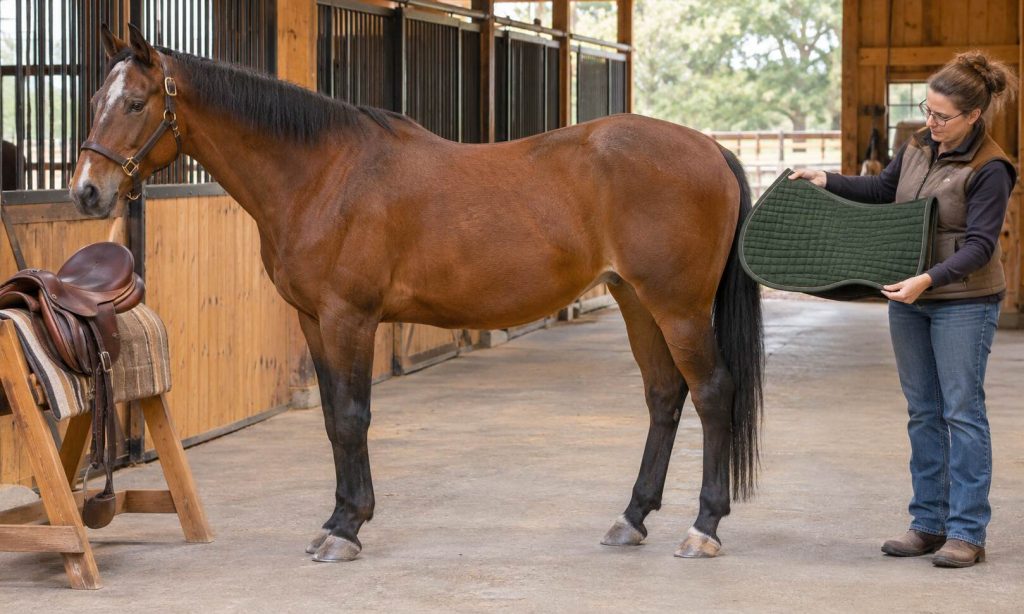
A swayback horse has a more pronounced downward curve through the back than many other horses. That shape can complicate saddle contact, but padding alone does not make a saddle safe or comfortable. When comparing a saddle pad for a swayback horse, examine the whole system: the horse’s topline, saddle tree and panels, pad thickness, insert placement, and the riding work involved. A pad that fills a visible gap can still create undesirable pressure elsewhere.
This guide explains how to compare pad styles by fit and use without ranking individual products. It also identifies signs that call for veterinary or professional saddle-fitting assessment. You can review broader category context in our saddle pad for swayback horse overview. The central principle is straightforward: adapt equipment to the animal’s assessed needs rather than expecting an extra layer to correct structural saddle mismatch.
Understand the Horse’s Actual Back Shape
Not every dipped-looking topline represents the same condition. Age, muscle condition, posture, weight changes, and individual conformation can affect the outline. Some horses have marked lordosis, while others simply have less topline muscle. A veterinarian can distinguish structural or medical concerns from routine conditioning changes. If the horse shows pain, reluctance, lameness, or changes in movement, seek assessment before riding. Fit choices should not be used as a substitute for diagnosis.
Assess the back with the horse standing square, then have a qualified saddle fitter examine the unpadded saddle and the fit under appropriate dynamic conditions. Photographing the topline may help track changes, but a photo cannot reveal the complete pressure pattern. Consider shoulder motion, wither clearance, saddle balance, panel length, and the rider’s position. Our general horse saddle-pad comparison guide explains baseline pad construction, while this guide focuses on atypical curvature.
Compare Full-Length Pads With Targeted Half Pads
A full saddle pad provides a continuous surface under the saddle and helps manage sweat and friction. It may be shaped, quilted, contoured, or made with different lining materials. On a swayback horse, the key question is whether it lies smooth without pulling down over the spine or bunching beneath the panels. A thick full pad may change the saddle’s balance; do not assume more material automatically produces more even contact.
A half pad covers a more limited area and may add cushioning or accommodate carefully planned adjustments. Some offer inserts or shims that change panel contact in selected regions. These systems can also make a mismatch worse when used without fitting expertise. Compare their intended purpose, stability, coverage, and ease of inspection. Our half-pad sizing guide helps with dimensions, but a fitting professional should determine whether inserts are appropriate and where they belong.
Evaluate Bridging, Rocking, and Panel Contact
Bridging describes a situation in which saddle contact is less even across the back, potentially concentrating load toward the front and rear. Rocking refers to movement that shifts pressure as the horse walks or the rider changes position. Both patterns may occur for reasons more complex than the visible curve. Do not diagnose them by sliding a hand under a saddle only once. A professional assessment considers fit in motion and the horse’s response, not merely a static gap.
Changing pad material or adding shims can alter contact, but no home adjustment guarantees a safe pressure distribution. A fitting professional may recommend panel work, a different saddle shape, or another management choice. Research on changing back shape during movement reinforces why static fitting is only part of the story. If the saddle repeatedly tips, bounces, shifts sideways, or presses on the spine, stop the riding session and arrange reassessment rather than adding another layer at random.
Match Pad Construction to the Riding Job
The suitable pad arrangement can depend on whether the horse is used for light pleasure riding, long trail sessions, arena schooling, or a discipline with frequent changes of gait. These activities involve different durations, rider positions, and movement demands. A pad that remains stable during a short walk may migrate during more active work. Examine the full saddle and pad combination while accounting for the actual riding task approved by the horse’s veterinarian.
Pay attention to the pad’s length, edge finish, girth attachments, and whether it maintains shape after use. A long pad can put a raised border beneath the saddle’s back edge; a short one may leave a panel on an unprotected seam. Evaluate breathability and cleaning needs without assuming one fabric solves a conformation issue. The goal is repeatable, comfortable fit across the planned activity, not merely a pad that looks matched while the horse stands still.
Use a Practical Fit-Assessment Checklist
Start by examining the horse’s back for tenderness, swelling, rubbing, or an altered hair pattern. A sore or lame horse needs veterinary advice. With guidance from a qualified fitter, inspect saddle position, wither and spinal clearance, panel contact, and balance. Then add the pad and check that it does not create folds, trap piping, or collapse into the channel. Note whether straps pull the pad in an unnatural direction. Compare one controlled change at a time.
Next, assess movement only when the horse is comfortable and cleared to work. Observe for saddle bounce, pad migration, tail swishing, resistance, uneven movement, and new rub marks. Photograph or record findings for the fitter, but do not interpret any single sign as proof of a particular diagnosis. Recheck as the horse builds or loses muscle. If fit cannot be made stable and comfortable, a different saddle or work plan may be more suitable than more padding.
Inspect Wear and Reassess as the Horse Changes
Over time, foam may compress, wool or fiber may mat, and stitched channels may become uneven. Check both surfaces for hard areas, tears, trapped grit, and changed shape. A pad that used to sit evenly may become distorted. Wash or clean according to the care label and dry it completely before storage. A clean pad makes new rub marks easier to detect and reduces avoidable irritation. Do not use equipment with exposed seams or damaged attachment straps.
Your horse’s topline can change through age, nutrition, health, and exercise. That means even a carefully fitted setup deserves regular reassessment. If you suspect a new fit problem, our guide to worn saddle-pad warning signs covers related inspection principles. The exact conformation differs, but the logic is the same: worn materials should be replaced, while a painful or unstable saddle setup needs evaluation rather than cosmetic repair.
Frequently Asked Questions
These answers address common misunderstandings about pad selection for a dipped-backed horse. They are intended to support, not replace, hands-on fitting and veterinary care.
Because each horse’s curvature and movement differ, avoid copying another animal’s shim arrangement or assuming that one pad type is universally safe.
Can a pad alone fix saddle bridging on a swayback horse?
Not reliably. Some adjustments can change contact, but an improperly shaped saddle may still produce pressure problems. Have a qualified saddle fitter evaluate the complete setup.
Is a thick pad better for pronounced swayback?
Not necessarily. Extra thickness can lift or tilt a saddle and reduce clearance. Material and thickness should be chosen only after actual fit assessment.
Should I use shims without a saddle fitter?
Avoid guessing shim placement. Incorrectly placed inserts can concentrate pressure or alter the saddle’s balance. Seek professional guidance.
Does a horse with lordosis always have back pain?
No. Conformation alone does not establish pain. However, tenderness, abnormal movement, or behavior changes deserve veterinary examination before riding.
How often should the saddle and pad be reassessed?
Recheck after noticeable changes in weight, muscle, workload, comfort, or pad shape. Regular professional reviews are valuable, with timing adapted to the horse.
Final Words
Comparing a saddle pad for swayback horse use requires more than checking the advertised contour. Look for stable positioning, appropriate clearance, smooth panel coverage, practical care, and compatibility with an independently assessed saddle. Consider full pads and half pads as parts of a fitting system, not as cures for back pain or conformation.
Your best safeguard is a qualified evaluation of the horse and saddle in motion, followed by careful monitoring as the horse changes. Our saddle pad for swayback horse resource provides general category context. Keep comfort, fit evidence, and the horse’s welfare ahead of assumptions about cushioning.
Reference
The following veterinary and university sources informed the discussion of saddle pressure, movement, and fitting considerations for horses with atypical toplines. Their findings support a careful, individualized approach.
These references do not determine the correct pad for any specific animal. Use veterinary and professional fitting advice for pain, structural concerns, and ridden work.
- American Association of Equine Practitioners. How to Evaluate a Saddle as a Potential Cause of Back Pain.
- Royal Veterinary College and University of Southampton. Shape Change in the Saddle Region of the Equine Back During Trot and Walk (2024).
- University of Minnesota Extension. Caring for Horses on a Budget (tack fit guidance).









