

A horse with a dipped or swayback topline may show a gap between the middle of its back and the saddle. Finding the best saddle pad for swayback horse fit is therefore not about buying the thickest cushion. The goal is to understand where the saddle contacts and where it bridges, then choose an appropriate support arrangement. This guide compares seven Amazon-verified saddle pads using shaped center fill, movable foam shims, felt, or specialized shoulder support. Some suit English saddles and others are designed for western tack. They are not interchangeable. A qualified saddle fitter should check the tree and pad combination, particularly if your horse has changed muscle condition or seems sore. Product features are taken from current listings, not invented riding tests. Use the comparison to identify which pad design merits a closer fitting appointment before placing an order.
Quick Picks
| Product | Best For | Key Advantage | Buy | |
|---|---|---|---|---|
| Reinsman Swayback Contour Square Pad | Western saddles with center bridging | a fixed center build-up, a Tacky Too underside, and spine channel | View on Amazon | Jump to Review |
| ECP Contoured Correction Dressage Pad | Adjustable dressage-saddle contact | a quilted dressage design with removable foam shims in four pockets | View on Amazon | Jump to Review |
| ECP Memory-Foam Adjustable Half Pad | English saddles needing localized support | twelve removable foam pieces and four adjustment pockets | View on Amazon | Jump to Review |
| Southwestern Equine OrthoRide Half Pad | Graduated English saddle shimming | twelve graduated foam shims, four pockets, and a vented spine | View on Amazon | Jump to Review |
| Tough 1 Western Shim Saddle Pad | Single-pad western shim arrangements | a western shim-pad format with a neoprene underside | View on Amazon | Jump to Review |
| Billy Royal Correct Fit Shoulder Felt Pad | Western horses with shoulder hollowing | one-inch wool felt and flexible shoulder correction shims | View on Amazon | Jump to Review |
| Diamond Wool Western Shim Saddle Pad | Contoured western felt correction | a contoured felt body and shim-oriented western pad design | View on Amazon | Jump to Review |
1. Reinsman Swayback Contour Square Pad

- Center-thickened foam profile
- Tacky Too underside material
- Contoured spinal channel
- Western square pad outline
- Fixed thickness may overfill a horse whose saddle already contacts evenly
Reinsman Swayback Contour Square Pad addresses a particular western-saddle fitting problem: a middle section that does not contact the horse the way a fitter expects. The listing describes extra build-up through the center, a Tacky Too underside, and a contoured spine channel. Unlike a pocketed correction pad, the center profile is built into the product. That can simplify set-up when the missing contact is exactly where the pad adds material, but it leaves little room for small adjustments if the horse’s back changes over a season.
Before buying Reinsman, establish whether the saddle is genuinely bridging or merely looks high above a dipped topline. A thickened middle can fill one gap while creating excess pressure elsewhere, especially if the saddle already sits tight over the withers or rear panels. The underside material is intended to influence grip, but additional traction does not repair a tree with the wrong shape. I would compare the contour against the horse’s actual saddle footprint and have a fitter evaluate the horse both standing and moving.
This pad suits a western setup only when the fixed correction has been judged appropriate. Its square outline and center construction are materially different from an adjustable English half pad; do not buy on the assumption that every swayback needs the same amount of lift. After fitting, inspect sweat patterns cautiously and watch for shortened strides, head tossing, shifting equipment, or rub marks. Clean the contact surface according to its instructions, and request a veterinary assessment if the horse shows persistent back pain or marked asymmetry.
My Recommendation
For a western saddle that shows genuine center bridging, I would ask a qualified fitter whether Reinsman’s fixed center build-up matches the missing contact. Its integrated shape is simpler than managing removable shims, but that simplicity is a drawback if the horse requires only a subtle or changing correction. The Tacky Too underside and spine channel are useful construction details, not proof of pressure relief. I would choose it only after checking the actual saddle under movement and would reassess as the horse’s topline changes. If the contact pattern does not match, a configurable design is preferable.
2. ECP Contoured Correction Dressage Pad

- Four separate shim pockets
- Removable memory foam inserts
- Diamond-quilted polycotton top
- Brushed underside construction
- Shim locations must be mapped carefully and the dressage cut will not suit western tack
ECP Contoured Correction Dressage Pad pairs a full dressage-style quilted saddle cloth with removable foam shims in four pockets. Its dressage cut makes it a practical comparison for riders who prefer not to add a separate half pad on top of a normal cloth. The listing identifies a quilted polycotton top and a brushed underside. The main advantage is that placement can be changed in distinct regions. That flexibility is valuable only when the person arranging the shims understands the saddle’s current contact pattern.
Adjustability does not mean more shims are always better. The front, center, and rear of a dressage saddle affect each other, so changing one pocket can alter balance and load distribution elsewhere. A fitter can identify whether the horse needs temporary compensation for muscle loss or whether the saddle itself requires modification. Compare this design with the compact ECP half pad if your current saddle cloth already fits well. Riders using western tack should look elsewhere; this shape is not a universal corrective layer.
For a swayback horse in dressage work, I would start with the fewest inserts the fitter recommends and document their exact locations. Recheck the fit after weight changes or a period of conditioning because a formerly useful shim arrangement can become excessive. Make sure the pad lies flat, the center remains free from spine pressure, and the edges do not create new seams beneath the rider. Remove and inspect inserts during cleaning. If the horse reacts to saddling, investigate discomfort rather than adding still more padding.
My Recommendation
The ECP dressage correction pad appeals to me when a rider wants removable shims within a complete dressage cloth. Four pockets provide meaningful regional choices, though adjusting them without a fitting plan could make the saddle less balanced. I would have the fitter specify pocket locations and the minimum required foam before buying. This is a more logical candidate for dressage tack than western gear, and it may replace a separate everyday pad in the setup. Check how the edges, saddle panels, and spine channel behave together rather than judging the inserts by thickness alone.
3. ECP Memory-Foam Adjustable Half Pad
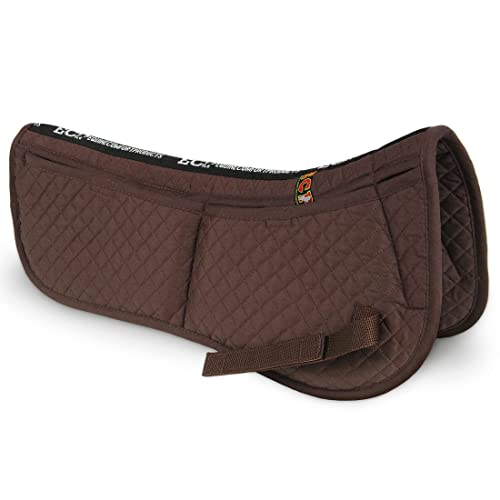
- Twelve supplied foam inserts
- Four targeted shim pockets
- Compact English half-pad format
- Quilted polycotton finish
- Stacking extra foam beneath a close saddle can remove necessary clearance
ECP Memory-Foam Adjustable Half Pad focuses on localized change rather than replacing the entire saddle cloth. The verified listing describes twelve removable foam pieces organized across four pockets in an English half-pad shape. That arrangement provides several possible combinations for a fitter to use with an existing pad. The compact format matters: a rider who likes a current dressage or general-purpose cloth may prefer a correction layer that does not require changing the full base pad. Each extra layer still takes up saddle clearance.
With a swayback horse, the interesting question is which part of the saddle bridges and whether shimming that area improves the overall contact. Filling every pocket would defeat the purpose of targeted correction and could make the saddle perch higher than before. Compare the ECP half pad with the full ECP dressage correction cloth: the former adds another layer, while the latter combines normal cloth coverage and pockets. Neither solves the problem of a saddle tree that is fundamentally too narrow or the wrong curve.
I would use this as a fitter-guided temporary adjustment when the horse’s muscle shape is changing or a modest difference needs compensation. Keep a record of which foam pieces were used, since the supply of twelve inserts makes it easy to forget a working combination. Check the horse at the walk and during normal ridden movement, not just after tightening the girth. Stop if there is rubbing or unusual resistance. An ill-fitting saddle can remain painful even when its outward profile looks more even.
My Recommendation
I would compare ECP’s adjustable half pad when the existing English saddle cloth fits well but a separate targeted correction is warranted. Twelve inserts and four pockets give the fitter options, yet adding foam everywhere would undermine that advantage. The compact format is the reason to choose it over the full dressage correction cloth. Ask whether the added layer leaves enough room beneath the saddle and document the exact working combination. I would avoid this solution if the saddle tree is fundamentally unsuitable or the horse is already showing uninvestigated back pain.
4. Southwestern Equine OrthoRide Half Pad

- Graduated foam inserts
- Vented spine design
- Four adjustment pockets
- Quilted English pad construction
- Many insert combinations are difficult to select without expert saddle-fitting advice
Southwestern Equine OrthoRide Half Pad offers a more graduated approach to English-saddle shimming. According to the listing, it includes twelve graduated foam inserts, four adjustment pockets, a vented spine area, and a quilted top. The word graduated matters because differently sized inserts may let a fitter make smaller changes than a single thick block. This is still a half pad, which means it must be assessed with the horse’s existing saddle cloth and the saddle together rather than as a stand-alone piece.
The large number of combinations is both a benefit and the main complication. Adding foam to the wrong pocket can shift weight to a new region, especially on a horse with a pronounced dip behind the withers or through the back. Ventilation details are useful for comparing construction but do not prove a cooler or pressure-free fit. If you are deciding between OrthoRide and a simpler fixed-contour pad, favor the design that matches the fitter’s plan rather than the product offering the most possible settings.
A sensible trial starts with the fitter marking a baseline and testing one change at a time. Note whether the rider remains centered and whether the saddle moves forward, back, or side to side during movement. Reassess the setting after changes in topline condition; the ability to remove shims can be valuable as the horse builds muscle. Clean and dry the quilted layer thoroughly so sweat and grit do not create friction. For persistent soreness or refusal under saddle, arrange a qualified veterinary check.
My Recommendation
OrthoRide is appealing for fine-tuning because its graduated foam inserts provide several potential adjustments rather than one fixed lump of padding. For that reason, I would treat it as fitter-guided equipment and not a quick purchase based on a swayback photograph. The vented spine and quilted surface help identify the construction, but they do not prove a pressure-free ride. It is most useful when a specific English-saddle contact problem has been mapped and can be reassessed as the horse develops. Keep a written record of insert thickness and placement.
5. Tough 1 Western Shim Saddle Pad

- Western saddle pad outline
- Listed neoprene bottom
- Specifically marketed shim style
- Single western pad construction
- The available listing offers very limited details on pocket layout and insert dimensions
Tough 1 Western Shim Saddle Pad is a simpler western-format option whose current listing describes a shim-oriented pad and neoprene underside. The key attraction is compatibility with a western saddle silhouette rather than the dressage or compact English shapes elsewhere in this guide. However, the available listing gives relatively little information about exact pocket positions, insert sizes, or adjustment range. That evidence gap matters more than a promotional label when a buyer is trying to correct an identified pressure pattern on a swayback horse.
Before ordering, I would confirm the specific SKU and ask the seller or maker for measurements, a diagram of any shim spaces, and details about what is supplied. A neoprene underside can affect contact and cleaning, but the material does not guarantee that the saddle will be stable on every horse. Compare the thickness and overall footprint against the actual western saddle. If the horse needs a fine-tuned correction at a very specific location, a pad with well-documented pocket geometry may be easier to configure.
This product makes most sense for riders already committed to a western saddle and prepared to verify missing details before purchase. Use the horse’s body and the saddle fit assessment to determine whether shims belong under the shoulder, through the middle, or not at all. Do not treat a generic shim label as evidence that it accommodates every swayback shape. Watch for heat, sweat accumulation, dirt, and sliding during ordinary rides. If the exact construction cannot be established, I would delay buying rather than guess.
My Recommendation
Tough 1’s western shim pad belongs on a shortlist only if the retailer can confirm the exact pockets, included inserts, dimensions, and neoprene underside details. I appreciate the western-oriented concept, but the limited product information is a serious buying limitation for an item intended to change saddle pressure. If the layout cannot be verified before purchase, I would favor a better-documented alternative. Any correction should be based on the horse’s actual saddle fit, not on an assumption that more padding helps a dipped back. Check for rubbing and movement during supervised use.
6. Billy Royal Correct Fit Shoulder Felt Pad

- One-inch wool felt base
- Flexible shoulder shim panels
- Contoured western silhouette
- Reinforced leather wear sections
- Shoulder-focused correction may not address a dip under the middle of the saddle
Billy Royal Correct Fit Shoulder Felt Pad is not a general-purpose answer to every dipped topline. The listing identifies a one-inch wool felt body with flexible shoulder correction panels, a western contour, and leather wear areas. Those characteristics make it most relevant when the fit problem is concentrated near the shoulder or behind the wither. A horse whose western saddle bridges primarily through the center might need a different location of support. The location of added material, not its premium look, determines its usefulness.
Wool felt and reinforced wear sections help distinguish this from the neoprene-bottom Tough 1 design, but material differences alone do not establish that either will distribute pressure correctly. Shoulder shims can influence the front of the saddle and change how the rear bears weight. A competent saddle fitter should determine whether the horse has asymmetry, muscle loss, or a tree mismatch before anyone inserts compensation. Confirm overall pad size and girth placement so the western contour does not fold or shift under tack.
I would place this on a shortlist for a horse with verified shoulder hollowing rather than simply one described as swaybacked. Its focused correction could be useful for a particular contact pattern, but it should not become an excuse to leave an unsuitable saddle in service. Revisit the fit as the horse gains condition or changes workload. Keep the felt free of compacted dirt and let it dry completely. If discomfort remains after correct fitting, the next step is assessment, not automatically thicker padding.
My Recommendation
I would choose Billy Royal’s shoulder-focused felt pad only when the fitter identifies hollowing near the shoulder as the problem to address. The one-inch felt base and flexible correction sections make it a different solution from pads aimed at center bridging. That distinction can save an owner from buying the wrong type of shim. I would verify the western saddle footprint and whether the correction shifts too much weight to the rear. If the horse’s dip is primarily beneath the rider rather than behind the withers, this may not be the right design.
7. Diamond Wool Western Shim Saddle Pad

- Contoured western felt body
- Shim-oriented adjustment design
- 32-by-32-inch listed footprint
- Half-inch listed pad thickness
- The precise shim setup and measured saddle footprint still need checking
Diamond Wool Western Shim Saddle Pad combines a contoured felt body with a design intended for western saddle adjustments. The verified listing identifies a 32-by-32-inch footprint and approximately half-inch base pad thickness. Those dimensions give shoppers a concrete starting point, especially when comparing this pad with a shorter English half pad or a larger square western cloth. But the external measurements do not describe where corrective material should sit on a horse’s back; they must be related to the saddle and actual contact areas.
For swayback fitting, a wider pad footprint is not always helpful. Too much material can interfere with the saddle’s intended angle, while inadequate coverage can leave edges or seams in a pressure-bearing area. Ask for the exact shim configuration and verify that the product variation includes what your fitter needs. A felt-based system differs from a fixed center build-up like Reinsman’s because it may support a different adjustment strategy. I would not assume their pressure effects are identical simply because both products have western styling.
This option is most useful for someone who knows the saddle dimensions and can evaluate the pad on the actual horse. Confirm the listed 32-inch length and width are suitable rather than relying on the label western. A fitter should test the relevant correction before long rides. Look for shifting, uneven bearing, rub marks, and changes in willingness to move. Regular brushing and drying of the felt can keep grit from becoming another source of friction. Serious back pain always warrants veterinary involvement.
My Recommendation
Diamond Wool is worth evaluating for a western horse whose fitter wants a contoured felt pad with a specific shim arrangement. The listed 32-by-32-inch footprint and half-inch base thickness provide more concrete sizing information than some alternatives, but the exact inserts still need confirmation. I would compare it with Reinsman by asking whether an adjustable correction or a fixed center profile fits the horse’s needs. Avoid choosing purely by felt thickness or brand. Recheck saddle balance and comfort periodically, and keep the contact surface clear of grit.
How to choose best saddle pad for swayback horse
The best pad is the one that complements a correctly fitted saddle, not the one with the thickest padding. Before comparing western contours, dressage pads, and adjustable half pads, identify the pressure pattern and confirm the adjustment with a qualified saddle fitter.
Identify the actual area that needs support
A dipped back can look dramatic while the contact problem is located closer to the shoulder or farther behind the rider. Ask a qualified fitter to check the bare saddle first and observe its balance with a rider. A pad should not be used to compensate for a tree that is too narrow, badly twisted, or simply the wrong shape. Check whether bridging is central, whether the front tips down, and whether the saddle moves sideways. If pain, resistance, or unusual gait accompanies saddling, ask a veterinarian to assess the horse as well. Clear diagnosis of the fitting problem narrows your choices more reliably than a product label.
Match shim placement to your saddle type
Western saddle pads cover a larger footprint, while dressage and English half pads follow a different panel shape. Compare measured dimensions, wither clearance, and spine-channel design. A fixed swayback contour may make sense for a stable central gap, whereas removable foam shims allow a fitter to adjust localized support as the horse develops muscle. Adding too much thickness can worsen a tight fit, especially around the withers. Check whether inserts can be removed, positioned independently, and washed according to manufacturer instructions. Do not guess which pockets should be filled from photographs alone. Keep a record of the chosen arrangement for future comparison.
Test carefully and monitor changes over time
Once the pad has been fitted, check the horse at a standstill and then during short, controlled movement. Watch for shifting, rocking, fresh rub marks, unexpected heat, or behavior suggesting discomfort. Sweat patterns are not reliable on their own for diagnosing saddle pressure. Reassess the arrangement after weight loss, conditioning, changes in workload, or a new rider. Clean the underside so grit cannot cause extra friction, and make sure any shim stays flat in its pocket. A product that appears comfortable today may need adjustment several months later. If you see persistent soreness, stop and arrange a professional evaluation rather than adding more material.
Finally, ask the fitter to explain how to recognize an incorrect correction. A shim should stay flat rather than roll or bunch, and it should not force the saddle to sit above the horse at the wrong angle. Keep clear notes about which pockets were filled and why. This small step can prevent well-intentioned adjustments from becoming a source of pressure later.
Related Horse Tack Guides
Compare adjustable half pads for English saddles and everyday saddle pad styles before buying. Checking horse equipment fit and rubbing is also useful before riding.
Frequently Asked Questions
Can a saddle pad correct a swayback horse?
A pad may improve a particular fit pattern under guidance, but it cannot change the horse’s spine or fix a fundamentally unsuitable saddle tree.
Should I choose a thick pad or adjustable shims?
Choose according to where contact is missing. Adjustable shims can target specific gaps. Uniform thickness may make an already snug saddle tighter.
Can western swayback pads be used with English saddles?
Generally these formats are designed for different saddle footprints. Match the pad to the actual tack and verify the dimensions.
When should I check saddle fit again?
Recheck whenever the horse changes muscle or weight, the saddle shifts, new soreness appears, or a fitter recommends reassessment.
Are swayback horses always uncomfortable to ride?
No. Conformation alone does not prove discomfort, but pain or abnormal movement deserves veterinary and saddle-fitting assessment.
Final Verdict
The Reinsman Swayback Contour Square Pad is the most specifically shaped western option for a confirmed central gap. For adjustable English-saddle support, the ECP half pad and OrthoRide half pad offer shims. If the hollow lies behind the shoulder, Billy Royal’s specialized western design merits separate consideration. None can replace a proper saddle-fitting assessment.
Affiliate disclosure: This article contains Amazon affiliate links. If you purchase through them, PetAdvisorPro may earn a commission. As an Amazon Associate I earn from qualifying purchases.