
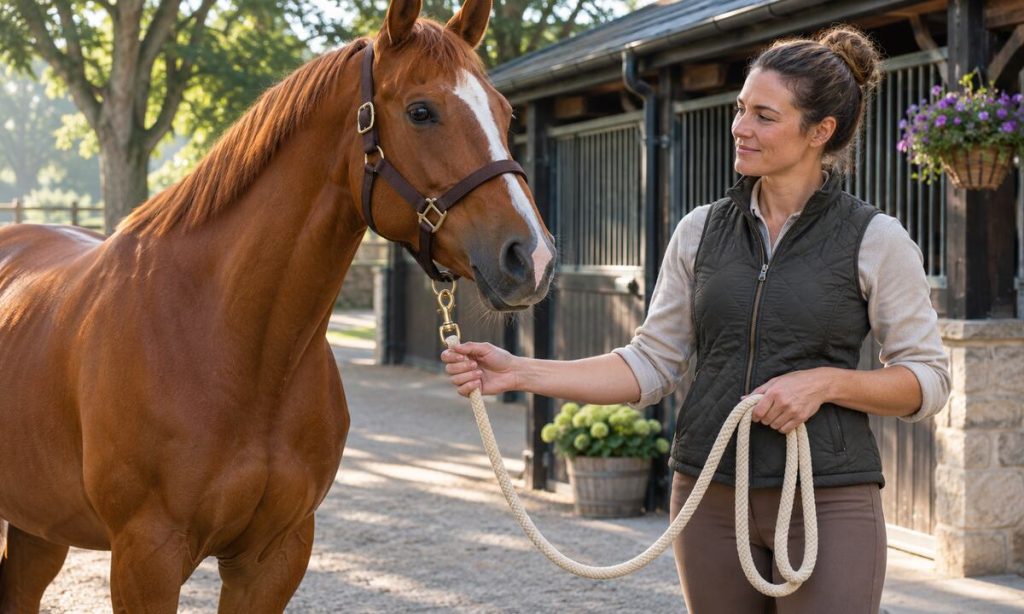
Sizing a lead rope for horses involves more than choosing a rope that looks strong. Length, diameter, weight, grip, clip size, and the way the extra line is carried all influence safe everyday handling. A rope that is too short for the activity may feel restrictive, while unmanaged extra length can trail near hooves or become tangled around a person. A heavy clip may also be uncomfortable on a small or sensitive horse.
The right dimensions depend on whether you are leading through a barn, loading a trailer, working on the ground, or handling a young or reactive horse under professional supervision. This guide shows how to measure rope length, assess thickness and hand feel, match hardware to a properly fitted halter, and check for damage. It also explains why safe handling technique matters more than a claimed universal rope size.
Choose the Intended Handling Task First
For ordinary barn leading, the goal is comfortable separation between handler and horse plus enough spare line to adjust position without dragging on the ground. Training and groundwork may require longer equipment and an experienced handler; a trailer task has different clearance hazards. Do not purchase an extra-long rope solely because it seems more versatile if it will be used in tight aisles every day. For the broad range of available lead designs, lead rope comparisons cover everyday barn and training categories.
Make a short list of the actual situations in which the rope will be used: turning out, crossing a busy yard, grooming at a designated safe spot, or loading. A novice handler may benefit from a simple manageable lead rather than a specialized groundwork line. Separate ropes for separate activities can make safer routines easier, provided each item is stored and used appropriately.
Measure Usable Length Including the Hardware
Retail length may refer to the entire rope or to the cord without its clip, so check the seller’s measuring method. Lay a candidate rope straight on clean ground and measure from the attachment point to the end. Consider the portion held near the halter, the necessary slack for the horse’s natural head carriage, and the extra length that must be safely folded in the free hand.
A common everyday lead length is often described in a range around eight to twelve feet, but this is context rather than a mandatory standard. Horse size alone does not determine length. A larger horse may be led with a similar rope to a smaller horse if the job and handler control are comparable. If the rope routinely drags, tangles, or forces an unsafe grip, reconsider length and technique.
Evaluate Diameter, Texture, and Hand Grip
Thickness influences how securely the rope can be held. Very thin cord can concentrate pressure on hands, while an oversized heavy rope may be awkward for a child or a handler wearing gloves. Test the grip with your normal work gloves: the rope should be comfortable to fold without becoming a rigid bundle or slipping uncontrollably. Wet conditions may change how some fibers feel.
Cotton, synthetic blends, and braided constructions differ in weight, drying, and abrasion behavior. Do not assume that softness means the rope is safe once frayed, or that a very stiff rope provides better control. The intended use, material condition, and handler experience are more relevant than a fashionable color or decorative finish. Choose a design that can be cleaned and inspected easily.
Match the Clip and Halter Connection
Check that the snap or other approved attachment fits the halter ring without jamming, twisting, or creating sharp contact. Hardware should open and close reliably, have smooth edges, and be proportionate to the horse and task. A large heavy clip can swing against a small horse, while a damaged clip may release unexpectedly. Inspect the stitching or knot where the hardware meets the rope. For complementary equipment fit, review breakaway halter options with the stable’s safety protocol.
The lead rope does not correct a poorly fitted halter. Check the halter first for appropriate adjustment and sound buckles. Any quick-release or breakaway design should be chosen for its specific handling environment and understood by the handler. Do not improvise knots that compromise the manufacturer’s hardware or tie directly around a horse’s neck as an alternative attachment method.
Handle Spare Length Without Loops Around the Body
Safe ground-handling guidance recommends holding the line near the halter while managing the excess in loose folds or a figure-eight pattern. Never wrap the rope around a wrist, hand, waist, or any part of the body. A sudden pull from a startled horse can tighten loops rapidly. Keep the end from trailing under the horse’s feet, and maintain a position where you are not directly in its path.
Use enough slack for the horse to carry its head naturally, without allowing a large loose loop to contact legs or obstacles. Extension horsemanship guidance describes leading position and safe excess-rope management. Practice with a calm horse and a qualified instructor before handling a difficult or unfamiliar animal, and wear appropriate footwear and protective equipment.
Check the Fit in the Actual Environment
Try the rope in a clear, controlled area with a calm horse. Note whether the clip hangs sensibly, the handler can maintain an appropriate position, and the remaining length stays manageable. Walk around common turns and gates only as appropriate to the handler’s skill. Do not use the first trial for difficult trailer loading, a busy event, or a horse known to rear or bolt.
Storage facilities also affect size choice. Ropes that routinely snag on door hardware, hooks, or hay racks may be too long for that environment or poorly managed. A specialized long line belongs with groundwork equipment and should not be confused with an ordinary stall-to-paddock lead. If unsure, ask a competent horse trainer to evaluate both size and handling method.
Inspect, Clean, and Retire Damaged Rope
Before each use, run your eyes along the rope for broken strands, deep abrasion, heat damage, severe stiffness, loose knots, weak stitching, and corrosion or malfunction at the snap. Follow material-specific cleaning instructions and dry it fully before putting it away. Salt, mud, manure, and harsh cleaners can shorten the working life of some materials or hardware.
Store the rope neatly on a suitable hook away from horses’ reach, water, and sharp tools. Never keep a lead where a loose end may become entangled with a leg. Replace a rope with compromised fibers or hardware rather than attempting an untested repair in a load-bearing section. The most suitable rope becomes unsafe if the connection fails at a critical moment.
Frequently Asked Questions
These answers address the most common confusion about length, diameter, clips, and handling extra rope. There is no single size that is safe for every horse and activity.
Consult a qualified instructor for specialized handling and do not rely on general gear advice for a dangerous behavior problem. Equipment and training should be considered together.
Is a longer lead rope always safer?
No. Extra length can offer flexibility but creates a tripping or entanglement risk if handled badly. Match length to the job and the handler’s skill.
How thick should a horse lead rope be?
Choose a diameter that feels secure and comfortable with normal gloves, without excessive weight or a cutting cord-like feel. There is no single ideal thickness.
Can I wrap excess lead rope around my wrist?
Never. Keep spare line in loose, controlled folds rather than wrapping it around any body part. A horse can pull suddenly and tighten a loop.
Should a pony use a smaller snap?
Consider the halter ring, animal size, and clip weight. Hardware must operate reliably without uncomfortable bulk or insecure engagement.
When should I replace a lead rope?
Replace it if fibers are frayed or damaged, seams or knots fail, or hardware is bent, sharp, corroded, or unreliable. Do not wait for complete breakage.
Final Words
When sizing a lead rope for horses, start with its task, then assess usable length, comfortable diameter, clip compatibility, and safe management of extra line. The best fit lets the handler work calmly without dragging rope or tightening loops around the body. Quality material and intact hardware are as important as measurements.
Choose a manageable everyday setup and reserve longer training lines for their intended context. Inspect before each use, clean and dry the rope properly, and replace damaged equipment promptly. A good rope supports skilled handling; it cannot substitute for safe positioning, a suitable halter, or appropriate training.









