
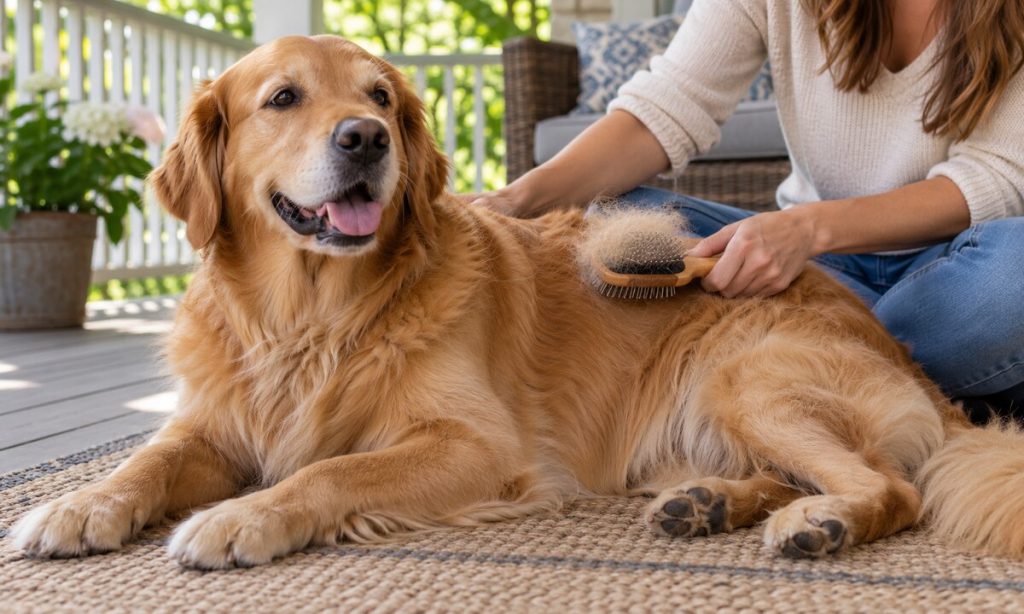
When a dog is moulting, brushing can lift loose coat and keep it from settling across furniture, but the wrong brush can snag hair or irritate skin. The best choice depends on coat type, length, density, and how your dog responds to grooming. A short-coated dog, a double-coated retriever, and a long-haired herding breed do not need identical tools. Before choosing a brush for regular dog coat care, look at the coat you are managing and the way the brush contacts skin. The phrase “brush for moulting dog” can describe several tools, so focus on gentle control, safe use, and a routine your dog can tolerate rather than assuming one brush removes all shedding. A brief check before brushing can prevent avoidable discomfort.
Start with the coat, not the shedding label
Identify whether your dog has a smooth coat, a dense undercoat, long feathering, curls, or a mix. A soft bristle brush may help smooth short coats and distribute loose surface hair, while a pin brush or wide-tooth comb may suit longer coats when used gently. Dogs with an undercoat may need a tool designed to lift loose undercoat without cutting or scraping healthy topcoat. These categories overlap, so a groomer can demonstrate what is appropriate for your dog’s particular coat.
Check the manufacturer’s description for the coat lengths and types the tool is intended for. Avoid assuming that “deshedding” means a brush is safe for every breed. A blade-like edge or tightly spaced teeth can pull at tangles or irritate skin if used with too much pressure or in the wrong direction. If the label is vague, choose a gentler tool or ask a professional groomer before using it on a dense or sensitive coat.
Choose bristles and teeth that move through the coat gently
Inspect the working surface. Rounded tips or flexible pins can feel gentler than sharp, rigid points, but design alone does not guarantee comfort. Look for smooth edges, even spacing, and a construction that does not snag when drawn through a small section of coat. Run the tool over your own forearm with very light pressure as a basic check; if it scratches, catches, or feels sharp, do not press it against your dog’s skin.
For a long coat, a pin brush with enough length to reach through the coat may be useful for surface grooming, while a comb can help check for small tangles. For a short coat, a rubber curry-style tool may collect loose hair without a hard scraping action. A double-coated dog may need staged grooming: first loosen the outer coat, then work carefully through the undercoat. Do not rake repeatedly over the same area to chase every loose hair.
Consider handle comfort and control
A comfortable, nonslip handle can help you use steady, light strokes rather than gripping too tightly. The brush should be easy to hold while you work around shoulders, chest, hindquarters, and tail. If the tool is heavy or awkward, you may use uneven pressure or tire before finishing. A handle that fits your hand matters more than decorative features.
Look for a design you can clean safely. Hair that remains packed between teeth makes the next grooming session less effective and can collect oils and debris. A removable cleaning surface or open design may help, but check that moving parts are secure and do not pinch fingers or fur. Wash and dry the tool according to its care instructions, and store it where children and pets cannot chew it.
Match the tool to your dog’s tolerance
A brush can be technically suited to the coat and still be a poor choice if the dog finds it frightening or uncomfortable. Begin with a brief introduction: let the dog sniff the tool, reward calm behavior, and make one or two gentle strokes on an easy area. Stop before the dog becomes tense. Over several short sessions, gradually work toward the areas that need more grooming.
Watch for turning away, lip licking, repeated yawning, freezing, growling, skin twitching, or attempts to escape. These can signal discomfort or stress. Do not pin the dog down to finish a routine brush-out. If handling the coat is difficult, seek help from a qualified groomer or veterinary professional. Positive, short sessions are safer than a long struggle that teaches the dog to fear grooming.
Use the brush safely during a moult
Brush in the direction of hair growth unless a professional has shown you a technique for the coat. Separate thick fur into small sections and use short, light strokes. Keep the tool away from eyes, ears, genital areas, skin folds, and bony points unless the design and instructions specifically allow it. Never press hard enough to scrape skin or cause redness. A brush is for loose coat and manageable tangles, not for cutting out mats.
If you find a tight mat, do not yank it or repeatedly saw at it with a comb. Mats can pull painfully on skin and hide irritation. A groomer can assess whether safe detangling or clipping is needed. If you notice wounds, scabs, unusual bald patches, parasites, a sudden change in shedding, or skin that is red and itchy, pause grooming and contact your veterinarian. Coat changes can reflect more than seasonal moulting.
The length and frequency of sessions should fit the dog. A few minutes at a time may be enough for a puppy or a dog unfamiliar with brushing. During heavier seasonal shedding, short regular sessions can collect loose hair without overworking one patch. Brushing does not stop the normal hair cycle, and no tool can remove all shedding. It can make routine coat care more manageable when the technique is gentle.
Brushes to avoid or use cautiously
Avoid tools with broken pins, sharp burrs, rust, loose handles, or teeth that bend unpredictably. Do not use a blade-style deshedding tool on thin, damaged, curly, or sensitive coats unless a professional has confirmed it is suitable. A tool that removes large amounts of hair immediately is not necessarily doing a better job; it may be cutting healthy coat or irritating skin. Follow use limits on the label and stop if the dog shows discomfort.
Do not use human hairbrushes as a default grooming solution. Their spacing and tips may not suit a dog’s coat, and they may snag or break hair. Choose a dog grooming tool matched to the coat and task. If you are uncertain, ask a groomer to show the safest direction, pressure, and frequency for your dog rather than trying multiple aggressive tools at home.
Frequently Asked Questions
What kind of brush is best for a moulting dog?
It depends on coat length and undercoat. Match the tool to your dog’s coat type and choose a design that moves through hair without scratching or pulling.
Can brushing stop my dog from shedding?
No. Shedding is a normal hair-growth process. Brushing can collect loose hair and help with coat maintenance, but it cannot stop the cycle.
How often should I brush a moulting dog?
Frequency depends on coat and tolerance. Begin with short sessions and ask a groomer or veterinarian if the coat mats or shedding changes suddenly.
Can a deshedding brush hurt my dog?
Yes, if it is unsuitable for the coat or used with excessive pressure. Stop if the skin reddens, the dog reacts, or hair appears to be cut or broken.
Should I brush out a mat at home?
Only if it is loose and can be worked through gently without pulling the skin. Tight mats should be assessed by a professional groomer.
Final Words
Choose a tool for the coat your dog actually has, with smooth working surfaces, a comfortable handle, and a safe cleaning method. Introduce it slowly, use light strokes, and stop when the skin or dog signals discomfort. For more general dog grooming guidance, see the related guide; if shedding looks abnormal or the skin is irritated, consult your veterinarian.









