
GPS trackers for cats can help locate a wandering pet, but location dots alone do not make a tracker useful. The features that matter most are safe collar attachment, dependable coverage in your neighborhood, manageable weight, battery life, and alerts you can understand quickly. A tracker is a supplement to identification, not a substitute for it. Before adding one, think about where your cat goes and whether the device can work there.
If you are assessing gps trackers for cats, start with the animal rather than an app’s feature list. A lightweight indoor escape artist has different needs from a confident outdoor explorer. This guide separates true location tracking from proximity finding, explains practical tradeoffs, and provides a safety-first checklist for everyday use. The best decision is the one your cat can comfortably live with.
Start With the Tracking Method
Many devices get described as trackers even though they answer different questions. Satellite positioning can estimate an outdoor location, but a collar device still needs a way to send that information to your phone. Some use a cellular network and a paid service. Others use radio signals, Bluetooth proximity, or nearby participating phones. The technologies differ in range, coverage, and how fast an updated location arrives. A map screen by itself does not prove independent real-time tracking.
Match the method to the question you need answered. If your cat slips into a neighbor’s garage, a short-range finding signal may help nearby. If your cat travels beyond your block, network-based location may be more useful where supported. Dense buildings, basements, thick vegetation, and weak service can all affect performance. Ask what happens when the tracker loses signal: does it show a clearly dated last known position, or an apparently current dot that could mislead you?
Safety Features Come Before App Features
Check how the tracker attaches before considering maps or notifications. Cats climb, squeeze through gaps, and brush against branches. A rigid attachment can alter how a collar releases if snagged. Cats Protection advises quick-release collars and raises concerns about tracker weight and interference with the release mechanism. Choose attachment hardware that does not defeat the safety release. A device that keeps perfect records but catches on a fence is the wrong tradeoff.
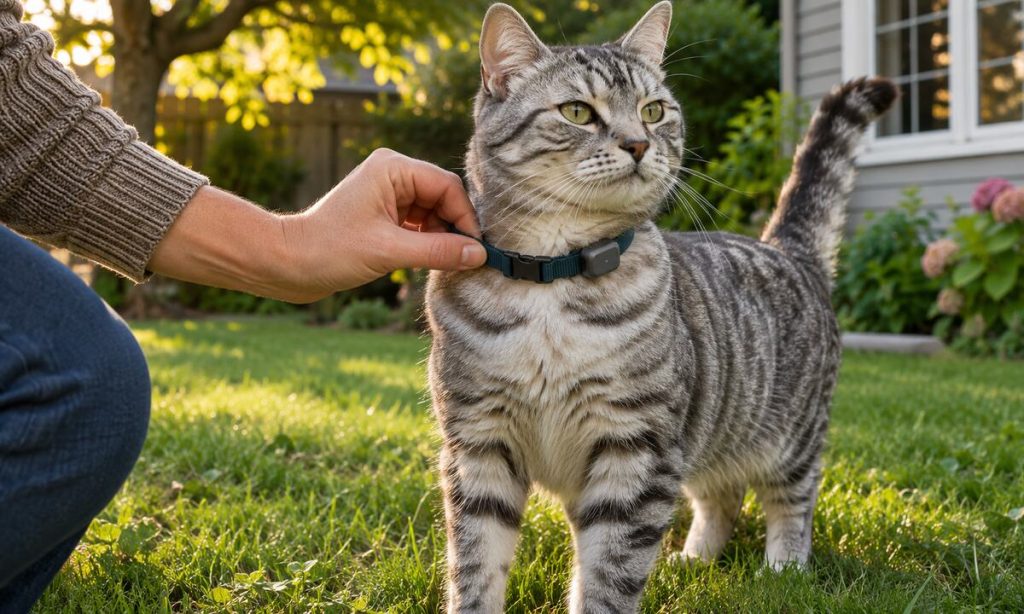
Inspect the collar fit with your cat standing naturally. Two fingers should fit snugly beneath a correctly adjusted collar, although neck shape and the manufacturer’s directions still matter. Watch for rubbing, trapped fur, skin redness, or a cat repeatedly trying to remove it. Try any new equipment at home under supervision, beginning with brief sessions. If the tracker shifts toward the throat or the release mechanism jams, remove it and reconsider the setup.
Weight, Shape, and Water Resistance
A tracker that seems tiny in an adult’s hand can feel bulky on a small cat. Look at its weight and dimensions, not just its marketing photograph. Consider whether the device swings under the chin, catches during grooming, or changes the collar’s balance. The smallest possible unit is not automatically safest if it requires a heavy case or stiff mounting band. Examine the complete worn assembly, including the collar and attachments.
Water resistance deserves a careful reading. A device intended for splashes may not tolerate prolonged immersion, frequent puddles, or rough cleaning. The rating concerns the specified conditions for the whole unit, including seals and charging ports. Check the manufacturer’s cleaning directions; do not soak electronics unless they are expressly designed for it. A damaged casing, swollen battery, exposed wire, or cracked closure means the device should be removed until a safe replacement is available.
Location Updates, Alerts, and Recovery
An effective locator makes uncertainty visible. Look for an update timestamp, a readable map, and clear indicators for lost service or low power. Frequent updates can help during an active search, but they often consume more battery. Check whether an owner can switch between ordinary monitoring and a more demanding search mode. Geofence alerts may notify you when your cat crosses a saved boundary; they can be delayed or inaccurate at the edge of a signal area.
Practice using the controls before an emergency. Save a nearby location, walk with the tracker outdoors, and compare its reported position with where you actually stand. Test notifications with the phone locked and check whether sound, vibration, and permissions work. Keep a backup search plan: recent photos, neighbors, shelters, and your cat’s microchip registration. A location history can narrow a search, but it does not guarantee that your cat is still at the last reported spot.
Coverage, Battery, and Ongoing Costs
Coverage is often the deciding feature for a roaming cat. A satellite receiver can calculate a position where conditions allow, yet a cellular tracker also depends on the service network used to transmit it. Verify coverage around your home and common travel routes. Check whether the device works while traveling to another state, and whether a service plan, roaming conditions, or data subscription applies. A technically capable unit can be disappointing in a coverage gap.
Battery duration should reflect the settings you actually intend to use. More frequent fixes, stronger alerts, weak networks, and colder weather can shorten operating time. Pick a charging routine that fits your household. A battery that lasts a week on a marketing chart may need much more frequent charging under active tracking. Consider replacement battery availability, charging-port wear, and how your cat will remain identified while the device is off the collar for charging.
Privacy, App Reliability, and Household Access
Location tracking creates information about your home and routine. Read the privacy controls before activating an account. Check who can see live locations, whether household access can be revoked, and how location history may be deleted. Enable available account protections and avoid sharing live tracking links publicly. A map is useful to family members searching for a lost pet, but access should not be wider than necessary.
App quality matters as much as sensor quality. Test login recovery, push alerts, map loading on a weak connection, and compatibility with every phone the household plans to use. Look for plain-language labels on signal loss and battery state. Ask what happens if the service closes or the subscription lapses. You should still have a current ID tag and registration details. The ASPCA supports microchips together with visible identification; a tracker does not replace either.
Set Up and Maintain a Tracker Safely
Begin with the cat’s comfort. Attach the tracker to a properly fitted quick-release collar only if the assembly remains safe. Let the cat explore the equipment indoors, then offer a distraction such as food or play. Supervise initial wear and check after movement, jumping, and grooming. If the collar irritates the skin, changes posture, or interferes with normal behavior, take it off. Never use a non-release collar merely to prevent the tracker from falling off.
Make maintenance predictable. Clean the outside according to the device instructions, inspect the collar’s buckle and seams, and recharge before battery alerts become urgent. After software updates, test permissions and notification behavior. Our separate guidance on cleaning and maintaining a pet tracker covers practical upkeep. Also review how an outdoor cat collar should balance visibility, fit, and safe release.
Frequently Asked Questions
These quick answers cover the most common uncertainties after you choose a tracking method. They focus on what can be established before an emergency rather than promising that a device will always work. Recheck the manufacturer’s current operating conditions whenever you change the device, service plan, or phone.
Use the questions as a short preflight before letting your cat wear the equipment for long periods. A careful setup can improve everyday usefulness, but no tracker eliminates outdoor hazards. Always consider your cat’s individual behavior and the risks of the environment.
Can a GPS tracker replace a microchip?
No. A tracker may lose power, signal, or its collar. A registered microchip provides permanent identification when scanned, while an ID tag gives a finder immediate contact information. Keep both records current.
Will the device show my cat’s exact location indoors?
Not necessarily. Satellite positioning often weakens indoors, and cellular or proximity methods have their own limits. Check the last-update time and signal status before assuming a map pin is exact.
How often should I recharge a cat tracker?
Follow the device’s actual usage pattern rather than its maximum advertised battery life. Check the battery daily at first. Set reminders and allow extra margin during travel or an active search.
Are all tracking collars breakaway?
No. A tracker can be attached to a collar that does not release, or its mount can interfere with a release buckle. Test the full assembly as directed and prioritize cat-safe hardware.
Should indoor cats wear trackers?
Some households find them helpful when doors are opened frequently, but every cat’s tolerance varies. Indoor cats still benefit from a microchip, an ID tag where tolerated, secure doors, and up-to-date photos.
Final Words
The most valuable features in GPS trackers for cats are a safe quick-release setup, comfortable weight, coverage that works where your cat travels, clear last-location timestamps, and a practical charging routine. Treat extra graphs and novelty alerts as optional until those basics are satisfied. If a device compromises collar safety or cannot reliably communicate in your area, a long specification list will not fix the central problem.
Use gps trackers for cats as one layer of a broader lost-pet plan. Keep identification current, maintain a recent photograph, and rehearse the app before you need it. For the physical setup, our guide to GPS collar fit and safety expands on the comfort checks. A calm, well-practiced search routine can matter more than one flashy feature.









