
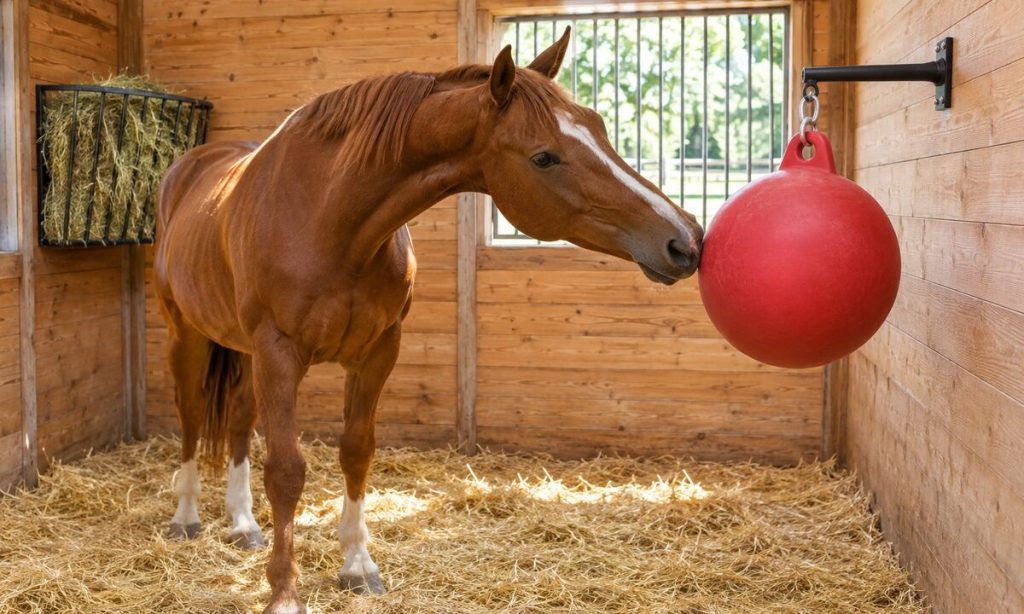
A horse confined to a stall may have fewer opportunities to forage, investigate, and interact with its surroundings. That can make a quiet day seem long, especially during temporary stall rest. The best stall toys for horses offer appropriate novelty without introducing loose hardware, dangerous ropes, excessive treats, or objects the horse can swallow. The right choice depends on temperament and the actual stall setup.
We compared seven stable-oriented products spanning hanging treat holders, a mirror, bar-mounted activity rings, and food-search toys. These are not substitutes for forage, turnout when allowed, social contact, or professional care. Many require direct supervision, particularly during introduction. Before placing any product in a stall, check the horse’s veterinary restrictions, eating needs, mounting height, and tendency to chew or pull equipment.
Quick Picks
These seven stable-oriented products support different activities. Some depend on treat refills; others offer nonfood exploration. Supervision requirements vary.
| Product | Best For | Key Advantage | Buy | |
|---|---|---|---|---|
| Likit Boredom Breaker Aqua Stable Toy | Rotating treat-based activity | Stable-hanging interactive format | View on Amazon | Jump to Review |
| Likit Holder Stable Toy | Introductory treat holder | Simple moving refill holder | View on Amazon | Jump to Review |
| Sukh Acrylic Horse Stall Mirror | Nonfood visual enrichment | Lightweight acrylic reflective panel | View on Amazon | Jump to Review |
| Rockstar Health Stall-Bar Fidget Rings | Short supervised nose play | Eight removable bar-mounted rings | View on Amazon | Jump to Review |
| QHP Snackcounter Hanging Horse Stall Toy | Novel fabric hanging enrichment | Suede, coconut fiber, and rope design | View on Amazon | Jump to Review |
| Unittype 3D Treat Feeder Horse Ball | Carrot-slot puzzle interaction | Six-inch treat-holding ball | View on Amazon | Jump to Review |
| PetKORE Clover Horse Treat Puzzle Ball | Rubber treat-and-hay puzzle | Rubber clover with removable suspension | View on Amazon | Jump to Review |
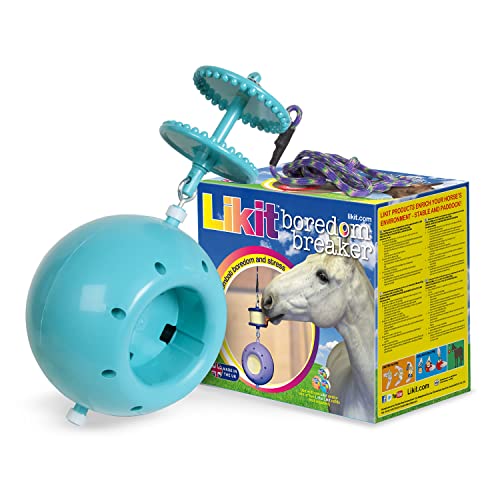
Likit Boredom Breaker Aqua Stable Toy
- Designed for stable use
- Encourages treat searching
- More complex than simple holder
- Recognizable refill ecosystem
- Compact hanging footprint
- Requires compatible treats
- Hanging setup needs checks
The Likit Boredom Breaker Aqua is a stable-hanging activity toy intended to occupy a horse as it works to reach a treat. Its design adds movement and challenge compared with a fixed feed bucket, which may interest a food-motivated horse during supervised stall time. The product is sold as an enrichment accessory rather than a complete feed source. Check which refill formats are compatible with the exact model and whether they fit the horse’s diet before purchasing. A sugar-based lick is not suitable for every horse.
Placement matters more than the bright color. The toy should hang from an approved secure point at a height the horse can reach safely without pawing, rearing, or becoming entangled. Watch the first sessions to see whether the movement encourages gentle interaction or aggressive striking. Remove the toy if the horse attempts to bite off parts or pulls hard on the suspension. Use only the manufacturer’s specified mounting method, and avoid creating loose loops or accessible knots. Ask stable management to inspect the installation.
Clean the holder and remove old treats according to the maker’s instructions. Check plastic components and hanging fittings each time you refill them. A horse accustomed to treat puzzles may find this product engaging, but you should not leave it available continuously without first establishing how the animal behaves. Avoid allowing treat intake to interfere with forage or prescribed diet restrictions. This is a targeted stall activity for supervised enrichment, not a remedy for stereotypic behavior or insufficient turnout.
My Recommendation
I would consider the Likit Boredom Breaker for a treat-motivated horse that already interacts gently with simpler hanging toys. It offers a more challenging activity, but only if the refill is diet-appropriate. Check suspension height and supervise initial use. I would avoid it for a horse that paws or bites hanging equipment aggressively.
Likit Holder Stable Toy

- Beginner-friendly interaction
- Uses compatible Likit refills
- Easy to assemble
- Washable holder
- Gentle starting challenge
- Refills sold separately
- Suspension rope poses risk
The standard Likit Holder is a simpler stable toy designed to suspend a compatible treat refill. Compared with the Boredom Breaker, it offers a lower-level challenge that may suit a horse unfamiliar with food puzzles. When the horse nudges the holder, it moves and makes the reward slightly more difficult to reach. This can encourage exploratory behavior during supervised periods. The listing specifies compatible refills sold separately, so compare the true cost of the holder and consumable treats.
The included rope and any overhead mounting point must be examined carefully. Although the product description discusses creating improvised suspension points, a horse-safe installation should use an approved fixed location and eliminate loose loops or knots that could snag a halter or limb. Do not hang it low enough for pawing or high enough to provoke rearing. Introduce the object slowly and remove it if the horse pulls at the rope instead of interacting with the holder. Follow any barn restrictions on hanging equipment.
The holder can be washed with soap and water, which helps prevent old sticky residue accumulating around the treat. Inspect the plastic for cracks and check the attachment point each time it is reinstalled. Use the appropriate refill type and count its sugars or calories within the feeding plan. For a calm, food-curious horse, this may be an accessible introduction to a stable toy. It is not appropriate for an animal that consumes ropes or requires a strict low-sugar diet unless an approved compatible option exists.
My Recommendation
The Likit Holder is my beginner-oriented treat toy because it offers an understandable moving reward without a complicated mechanism. I would start with a short supervised session and a veterinarian-approved refill. Secure mounting is essential; never rely on improvised twine or a loose hanging loop that a horse could catch.
Sukh Acrylic Horse Stall Mirror

- No treat refills needed
- Acrylic rather than glass
- Stall-wall placement
- Visual investigation activity
- Simple wipe-down care
- Some horses react anxiously
- Secure edge mounting essential
The Sukh Acrylic Horse Mirror is a lightweight reflective sheet marketed for use in horse stalls and stable areas. The listing gives dimensions of approximately seventeen by thirteen inches and describes an acrylic construction instead of ordinary glass. This makes it a nonfood enrichment candidate for an owner who wants to avoid adding treat calories. Some horses may investigate the reflection calmly, but another horse may become startled, territorial, or agitated. A mirror is not equivalent to actual equine social contact.
Secure mounting and safe edges are critical. The seller mentions several possible installation methods, but use only a setup approved by the barn and appropriate for a horse that can rub, lean, or strike the wall. An exposed screw, loose adhesive, flexible sheet edge, or hanging cord can become hazardous. Place the panel outside the reach of direct biting and at a height where it is visible without encouraging rearing. Watch the horse’s behavior carefully during introduction and remove the mirror if it produces anxiety.
Acrylic surfaces should be cleaned gently with a soft cloth and mild soapy water according to the product guidance; abrasive cleaners can scratch them. Inspect the panel for cracks and the mount for movement before each use. The mirror may add visual interest during quiet stall hours, but its behavioral effects differ among individuals, and marketing claims about reducing stable vices should not be taken as guaranteed. This is most appropriate when supervised observation confirms the horse tolerates its reflection comfortably.
My Recommendation
I like the Sukh mirror as a nonfood enrichment option for a calm horse, provided a stable professional approves a fully secure, horse-safe installation. Observe the first several sessions because reflections can also upset horses. It should complement real social contact and permitted turnout, not replace them.
Rockstar Health Stall-Bar Fidget Rings

- Tool-free stall-bar fit
- No treat calories
- Eight small activity rings
- Easy wipe-down surface
- Clear supervised-use warning
- Small parts if detached
- Not suitable for chewers
Rockstar Health’s Horse Therapy Toy consists of small fidget rings that attach to compatible round stall bars. The listing specifies eight rings and bar sizes of roughly three-quarters, seven-eighths, or one inch. A horse can nudge or spin them with its nose, offering a simple nonfood activity at the stall front. Unlike hanging treat balls, the rings do not need a rope suspension. Their compact size, however, creates an important risk if an enthusiastic horse bites, breaks, or pulls one off.
The manufacturer explicitly describes supervised use only and says the rings are not chew toys. That warning should govern the decision. Install them only on an approved stall-bar style and remain present to observe every session. Remove them immediately if the horse bites, tugs forcefully, or dislodges an attachment. Check whether the rings could fall into bedding or feed where they might be swallowed. A mouthy horse or one that chews plastic fixtures is a poor candidate regardless of the toy’s novelty.
Inspection is quick: look for cracks, rough edges, or loose components before putting a ring on the bar. Wipe clean and remove the pieces after the session ends. These are not durable objects for unsupervised all-day chewing or stall rest without an attendant. They may work as brief guided enrichment for an especially gentle horse that likes manipulating small fixed objects. Their main advantage is no food reward and minimal hardware, but the small detachable format makes vigilance non-negotiable.
My Recommendation
I would use Rockstar fidget rings only for an attentive handler’s short supervised enrichment session. Their nonfood activity and tool-free mounting are interesting, but small detachable parts make them inappropriate for a horse that bites or pulls on fixtures. Remove every ring afterward and check for any missing pieces.
QHP Snackcounter Hanging Horse Stall Toy

- Novel soft-toy texture
- Several playful designs
- Designed for stable hanging
- Encourages gentle investigation
- No specific treat needed
- Rope and stuffing hazards
- Supervision strongly advised
The QHP Snackcounter is a fabric-based hanging stable toy with a suede exterior, coconut-fiber filling, and a cotton-and-jute rope. It comes in novelty designs that may interest a horse inclined to investigate textures and swinging objects. This is quite different from a solid rubber feeder or acrylic mirror. However, fabric, stuffing, and ropes are potential ingestion and entanglement hazards if the horse bites, shreds, or pulls aggressively. Its cute appearance should never override those practical risks.
Choose a mounting point only after considering the horse’s head movement, stall door clearance, and access from neighboring stalls. Avoid long hanging lengths and loose loops; ask barn management or a qualified professional to approve the attachment. Introduce the toy under direct observation and remove it if the horse chews seams, unravels rope, or tears the exterior. The listing describes natural materials, but natural does not mean safe to ingest. A horse with a habit of shredding blankets or chewing ropes is not a suitable user.
After a supervised session, inspect stitching, filling, and every knot. Clean or replace according to the manufacturer’s directions, and discard the toy if fibers loosen or pieces go missing. This product is best viewed as an occasional supervised sensory novelty rather than a leave-in stall accessory. It does not supply forage or social contact, and it should not be used to treat behavioral problems. The novel texture is its strength, while the soft materials make safety screening especially important.
My Recommendation
I would reserve QHP Snackcounter for a calm horse that explores objects gently while someone remains nearby. The suede-and-rope construction adds sensory variety, but it also introduces chew and entanglement risks. Remove the toy immediately if the horse mouths seams or fibers, and do not leave it hanging unattended.
Unittype 3D Treat Feeder Horse Ball

- Multiple treat insertion points
- Hanging or ground-play listing
- Compact six-inch format
- Encourages gentle foraging
- Distinct textured design
- Fabric filling needs checks
- Rope attachment may snag
The Unittype 3D Treat Feeder is a compact six-inch ball advertised with carrot slots, a textured outer layer, and options for hanging or ground interaction. It aims to turn food discovery into a small puzzle, making it a different activity from a stationary feed tub. The listing describes suede, burlap, polyester filling, and a hanging rope. Those materials require more caution than a solid, one-piece rubber object because pieces could detach or be chewed. Do not assume promotional claims about durability establish safe unattended use.
Assess the horse’s chewing habits and diet before loading the slots with carrots or other permitted treats. Small rewards should be counted within the normal ration and may be inappropriate for some metabolic conditions. If hung, the rope needs a secure manufacturer-approved mount with no accessible loop; alternatively, any floor use should be supervised so it cannot be trampled into fragments. Watch for biting, pulling, and attempts to swallow the outer material. Remove it immediately if seams loosen or the horse becomes frustrated.
Clean out uneaten food after the session and inspect every fabric and rope component. Food residue hidden in seams can spoil, especially in warm weather. This is best treated as a supervised novelty for a gentle, treat-motivated horse, not a permanent stall fixture. Its carrot-slot idea provides a different challenge from lick-based toys, but the soft materials and small dimensions limit how confidently it can be recommended. Prioritize the animal’s actual behavior over the listing’s broad safety assurances.
My Recommendation
I would consider the Unittype ball only for a gentle horse under active supervision, with a few diet-appropriate carrot pieces. Inspect its filled construction and rope before every use. If the horse shreds fabrics, pulls hard, or swallows nonfood objects, choose a sturdier, simpler option instead.
PetKORE Clover Horse Treat Puzzle Ball

- Rubber puzzle construction
- Carrot and hay openings
- Hanging or ground options
- Different reward configurations
- Suitable for stable-focused comparison
- Treat intake needs monitoring
- Suspension kit must be secured
PetKORE Clover is a rubber puzzle ball with openings for carrots, treats, and hay, marketed for both stalls and paddocks. Its removable suspension kit gives caregivers a choice between hanging and ground-based activity depending on the space and horse. The clover-style openings invite a horse to investigate how food can be reached. This is a distinct material approach from the fabric-filled Unittype toy, although neither should be assumed safe for every horse without observation and careful inspection.
The option to use hay or carrots can make the puzzle flexible, but it must not replace the horse’s normal forage provision. Choose only veterinarian-approved treats and portion them appropriately, especially for horses with dietary restrictions. A horse may try to bite or pull the entire object; watch the first session closely and remove it if chunks loosen. If using the suspension kit, follow the manufacturer’s mounting instructions and eliminate long hanging loops or hardware within reach of the legs. Ground play also requires supervision.
Wash food-contact surfaces after use and discard any remaining damp produce. Inspect rubber for cracks, missing pieces, or areas that become sharp as the material ages. This is a useful candidate for a horse that already enjoys simple treat puzzles and needs a new way to investigate its ration. It appears in a broader horse-toy comparison as well, but here the focus is stall-specific use and mounting. Treat it as enrichment alongside normal feeding and companionship, not a cure for boredom-related behavior.
My Recommendation
PetKORE Clover is my first product to discuss when you want a rubber-based stall puzzle and can manage treats carefully. Its suspended and ground options add flexibility, but both require inspection and sensible supervision. I would prefer it over fabric-filled toys for a horse that gently manipulates rubber without chewing pieces off.
How to choose best stall toys for horses
To choose the best stall toys for horses, first identify a safe activity that matches the individual horse and the space available. A fun-looking toy is not useful if it risks entanglement, ingestion, or excessive feeding.
Assess temperament and supervise first introductions
Some horses enjoy gently nudging an object, while others bite, strike, paw, or become frightened by movement. Introduce each toy during a supervised period when you can remove it immediately if the horse reacts poorly. Check that parts cannot detach into swallowable pieces and that ropes, straps, chains, or mounts cannot catch a hoof, halter, mane, or jaw. Never leave a halter on solely to make a stall toy easier to use. A mirror should be safely mounted, with no accessible sharp corners or breakable fittings; observe whether the reflection appears calming or upsetting. Small plastic fidget accessories may be unsuitable for horses that bite or pull at fixtures. Products described as boredom relievers are not evidence that they treat cribbing, weaving, or other stereotypic behavior. Discuss persistent changes in behavior with a veterinarian or equine behavior professional.
Protect forage access, nutrition, and stall routines
A treat puzzle can provide a rewarding activity, but it must not reduce essential forage or encourage uncontrolled intake of sugary refills. Count carrots, apples, commercial lick treats, and other rewards within the horse’s feeding plan. Horses with insulin dysregulation, obesity, laminitis history, or other dietary restrictions may need nonfood options or veterinary-approved substitutes. Do not fill a toy with unfamiliar foods or leave spoiled produce in a stall. Regular hay access, clean water, appropriate movement, and social interaction remain fundamental. A toy should add variety to a welfare plan, not replace turnout or companionship. If the horse is on prescribed stall rest, confirm that nudging, reaching, or moving to retrieve a toy will not violate the veterinarian’s activity limits. Rotate items only if they are safe and the horse shows interest.
Mount securely and inspect every component
Install toys only where the stable operator permits and where the horse cannot become trapped against walls, doors, or feeders. Avoid dangling loops, long cords, exposed nails, and fittings that protrude into the stall. Use manufacturer-approved hardware and appropriate height for the specific horse, keeping an adequate distance from feed and water areas. A hanging toy should not swing into the horse’s eyes or collide with the legs when struck. Inspect rope fibers, plastic edges, brackets, screw heads, and treat-holder cracks before every use. Remove anything damaged immediately; do not repair a load-bearing mount with improvised twine. Clean food-contact surfaces regularly and let them dry before refilling. Ask barn management or a professional to check any wall-mounted system you are unsure about. Supervised short sessions are the safest way to learn a toy’s real behavior in your stall.
Frequently Asked Questions
Here are practical answers to the questions owners often ask before choosing.
Can stall toys prevent cribbing or weaving?
They may provide additional enrichment, but they are not proven cures for stereotypic behavior. Review forage, social contact, turnout opportunities, and veterinary or behavior advice.
Are hanging horse toys safe overnight?
Do not assume so. Safety depends on the exact toy, mounting, horse behavior, and manufacturer directions. Rope, fabric, or detachable parts may require active supervision.
Can I use treat toys for a horse with laminitis?
Only within a veterinarian-approved diet. Sugary lick refills and unrestricted treats may be inappropriate; consider nonfood enrichment.
Are acrylic stall mirrors safe?
Only when securely mounted with horse-safe edges and appropriate materials, and only if the horse tolerates its reflection. Inspect for scratches, cracks, and loose fittings.
What should I do if my horse chews pieces off a toy?
Remove it immediately and inspect for missing material. Contact a veterinarian if ingestion or injury is suspected, and choose a safer enrichment style.
Final Verdict
The best stall toys for horses should suit the stall, the individual horse’s habits, and an achievable supervision plan. Likit Boredom Breaker and Likit Holder offer two levels of treat-based activity, while the Sukh acrylic mirror provides a nonfood visual option. Rockstar Health rings are explicitly supervised, and QHP Snackcounter offers a fabric hanging toy that needs chewing and rope checks.
Unittype’s treat ball and PetKORE Clover offer alternative foraging challenges with different constructions. Avoid leaving rope or detachable parts within reach when unsupervised. Enrichment works best alongside forage, equine social contact, and permitted movement; consult your veterinarian about activities during injury-related stall rest.
Affiliate disclosure: This article contains Amazon affiliate links. If you purchase through them, PetAdvisorPro may earn a commission. As an Amazon Associate I earn from qualifying purchases.









