
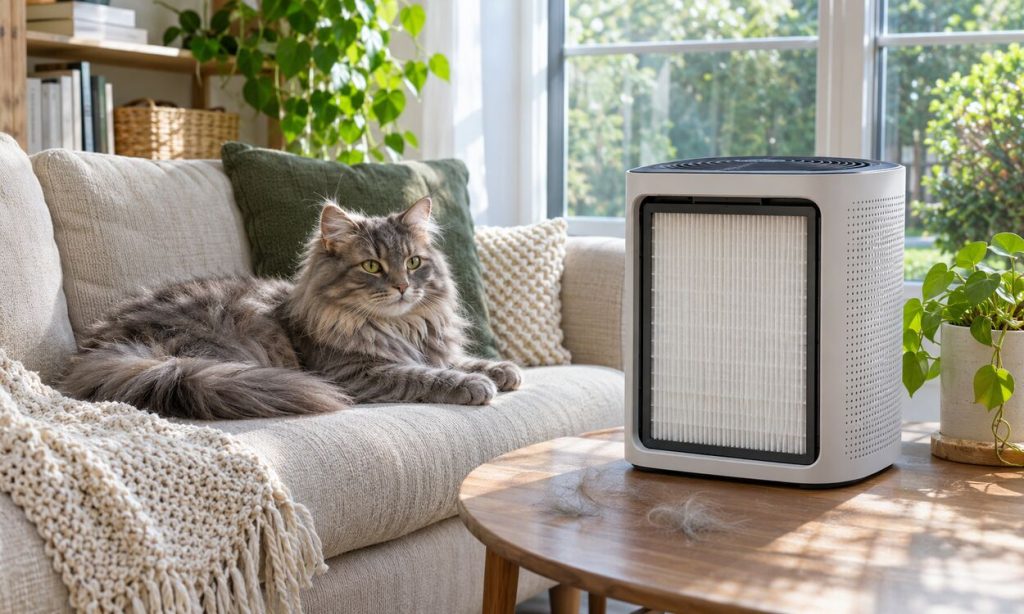
People with cat allergies sometimes hope that a better air filter will make a shared home comfortable. Filtration can capture some airborne particles, but it cannot remove every cat allergen from carpets, clothing, furniture, or the animal itself. The most useful question is which filtration system fits the room and how it works within broader allergen management. A label that simply says ‘for pets’ is not enough to judge performance or safety.
This guide explains what to look for in an air filter for cat allergies, including particle filtration, room sizing, airflow, maintenance, and limitations. It distinguishes replacement filters from whole room purifiers and central heating filters. For a related overview, our guide to air purifiers for cat allergies explores broader device features.
Understand Where Cat Allergens Come From
Cat allergy is usually linked to proteins produced by the animal, including allergens carried by saliva and skin particles. These materials can attach to fur, furnishings, and house dust. The National Institute of Environmental Health Sciences explains that cat allergens are not limited to hair and may persist on household surfaces. Even a hairless cat can expose a sensitive person to allergens. Removing only visible fur does not guarantee that an environment has become allergy-free.
Some particles remain airborne and can be captured by an appropriate filter, while others settle and later become airborne again during activity or cleaning. This is why filtration works best alongside regular surface cleaning, appropriate ventilation, and personal medical advice. If symptoms include wheezing, severe breathing difficulty, or worsening asthma, seek health-care guidance. An air filter is an environmental tool, not a substitute for diagnosis or treatment.
Look for Meaningful Particle Filtration
A high-efficiency particulate air, or HEPA, filter is designed to capture very small particles when correctly constructed and installed. Look for clear, verifiable information about the filter standard and its compatibility with the unit. A marketing phrase such as ‘HEPA-type’ is not necessarily equivalent to a certified performance claim. A well-sealed system matters because air that leaks around the filter is not cleaned through the intended media.
For central HVAC systems, check the manufacturer’s allowable filter ratings and airflow requirements. A dense filter that restricts airflow can cause equipment problems if the system is not designed for it. Ask a qualified HVAC professional when uncertain. In a portable air cleaner, the filter is only one part of overall performance: fan speed, airflow path, and clean air delivery also matter. More layers are not automatically better if air cannot move through them effectively.
Match Filtration Capacity to the Room
The US Environmental Protection Agency recommends considering clean air delivery rate, or CADR, when evaluating portable air cleaners. CADR describes how much filtered air the unit can provide under specified test conditions. A small filter paired with a weak fan may be insufficient in a large open-plan room, regardless of its advertised efficiency. Consider the space where the allergic household member spends the most time, such as a bedroom or living room.
Measure the room and consider ceiling height, open doorways, and the appliance’s operating speed. Filtration may perform differently on the quietest fan setting than on a high setting, so realistic everyday use matters. Avoid blocking intake or exhaust openings with curtains, furniture, or pet beds. A cat should not be able to tip the cleaner over or chew its power cord. The best device is one that can safely run as needed in the actual room.
Avoid Ozone Generation and Unsupported Promises
The EPA advises avoiding air cleaners that intentionally generate ozone. Ozone can irritate lungs and is not an appropriate home allergy-management strategy. Read technical information about ionizers, plasma features, and optional modes rather than assuming they are harmless. Mechanical filtration has a clearer purpose: moving air through material that captures particles. If a device can only function through an ozone-producing process, that is a reason to reconsider.
Be cautious about promises to eliminate all cat allergens or guarantee relief from allergies. Research shows that filtration can reduce airborne allergens, but clinical symptom improvement varies between studies and households. People differ in sensitivity, room conditions, exposure, and medical needs. IMO, a carefully sized filter with honest performance information is more valuable than dramatic claims about completely transforming the air overnight.
Plan for Replacement and Routine Maintenance
Check the cost, availability, and recommended replacement interval of compatible filters before relying on an appliance. A clogged or incorrectly seated filter can reduce performance. Follow the instruction manual for safe removal, bagging, and disposal, particularly when a household member has strong allergies. Unplug the device before opening it and never wash a filter unless the manufacturer expressly identifies it as washable. Many HEPA media filters are not designed for rinsing.
Maintain clear airflow and clean accessible exterior surfaces gently according to instructions. If a filter monitor uses operating hours, check whether heavy dust exposure calls for earlier inspection. A new filter cannot fix a fan that has stopped, a leaking seal, or an obstructed intake. Keep a simple maintenance record. For related household cleaning, our cat-hair vacuum care guide offers practical context for equipment cleanliness.
Combine Filtration With Realistic Allergen Reduction
Frequent cleaning of surfaces, washable bedding, and pet-contact areas reduces reservoirs that a room filter cannot reach directly. Use appropriate vacuum filtration and clean without deliberately stirring up settled dust. A person with allergies may benefit from discussing bedroom access rules and exposure reduction with an allergist. Consider what is realistic for the household and the cat’s welfare. Do not make abrupt animal-care decisions solely from an equipment advertisement.
Where asthma or strong allergic reactions are present, environmental measures may be only one part of a broader clinical plan. A health-care professional can evaluate medications, triggers, and appropriate testing. Monitor symptoms over time rather than attributing every improvement or setback to a filter change. FYI, even excellent filtration cannot make an allergen-producing animal ‘hypoallergenic,’ but it may contribute to a more manageable environment.
Frequently Asked Questions
Air-filter choices can be confusing because filter media, complete appliances, and HVAC systems use overlapping terms. Focus on evidence, compatibility, and room airflow.
Do not make medical promises based on laboratory particle-capture figures alone. Real household benefit depends on exposure patterns and the affected person’s health.
Will a HEPA air filter remove all cat allergens?
No. It can capture airborne particles, but allergens remain on surfaces and may be continually produced. Combine filtration with cleaning and appropriate medical advice.
Is an HVAC filter the same as a portable air purifier?
No. An HVAC filter works within a central system, while a portable cleaner serves a room. Both require compatible filters and adequate airflow.
Does a higher filter rating always help?
Not if the system cannot maintain proper airflow. Check appliance specifications and seek HVAC guidance before installing a restrictive central filter.
Should I buy an ozone air cleaner for pet odor and allergies?
Avoid units that intentionally generate ozone. The EPA cautions against ozone-generating air-cleaning devices.
How often should the filter be replaced?
Follow the actual model’s instructions and inspect sooner when conditions warrant. Do not wash a non-washable HEPA cartridge or reuse a damaged filter.
Final Words
When choosing an air filter for cat allergies, examine particle capture, system sealing, airflow capacity, compatible replacements, and safe operation. HEPA filtration can help reduce airborne particles, but it cannot remove every allergen source. Choose equipment that fits the room and can be maintained consistently.
Pair filtration with sensible cleaning and medical guidance when symptoms warrant it. Avoid ozone-producing features and absolute relief claims. Our guide to common air-purifier mistakes around cats describes additional placement and maintenance considerations.
Reference
These public-health and research sources informed the distinctions between airborne particle removal, allergen exposure, and health outcomes.
Household filtration can supplement exposure management but does not replace professional care for allergic asthma or other significant respiratory symptoms.
- US Environmental Protection Agency, “Guide to Air Cleaners in the Home.”
- US Environmental Protection Agency, “Will Air Cleaners Reduce Health Risks?”
- National Institute of Environmental Health Sciences, “Pet Allergens.”
- US National Library of Medicine, clinical trial evidence on HEPA filtration and cat allergy (PubMed).









