

Cross-country courses put horse legs through mud, water, brushing contact, and sudden changes of terrain. That makes breathable, secure leg protection a practical consideration, although no boot can prevent every injury. The best XC boots for horses should suit the correct leg. They should resist water absorption and stay secure without rubbing. A protective-looking boot that slips during a gallop creates another problem. Fit and regular checks matter more than flashy features.
We compared seven actual Amazon-listed cross-country boot options, including different front and hind designs. This guide explores each model’s eventing use and stated construction. We also examine purchase tradeoffs. Check current sizing details with an experienced coach or fitter. Take extra care with unusual leg proportions or prior tendon problems.
Quick Picks
These seven XC boots differ in protection, ventilation, and leg-specific fit. For fitting guidance, see fitting horse boots without rubbing.
| Product | Best For | Key Advantage | Buy | |
|---|---|---|---|---|
| Shires ARMA Cross Country Boots Full Front | Budget front-leg protection | Straightforward dedicated XC front design | View on Amazon | Jump to Review |
| LeMieux Carbon Air XC Front Boots | Ventilated front-leg protection | Vented design and flexible strike guard | View on Amazon | Jump to Review |
| LeMieux Carbon Air XC Hind Boots | Matching hind-leg coverage | Rear-leg-specific vented construction | View on Amazon | Jump to Review |
| Professional’s Choice Pro Performance Elite XC Front Boots | Non-waterlogging front design | Perforated lining and flexible strike guard | View on Amazon | Jump to Review |
| Equilibrium Tri-Zone Impact Sports Front XC Boots | Specialist high-impact front option | Purpose-built front XC impact design | View on Amazon | Jump to Review |
| Shires ARMA Carbon XC Front Boots | Layered front-leg coverage | Carbon-effect shell with EVA foam | View on Amazon | Jump to Review |
| Professional’s Choice Pro Performance Elite XC Hind Boots | Water-resistant hind-leg setup | Breathable rear pair with strike protection | View on Amazon | Jump to Review |
Shires ARMA Cross Country Boots Full Front
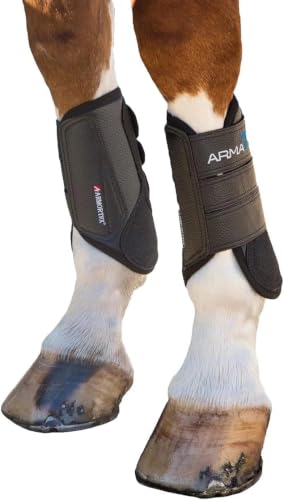
- XC-specific front model
- Accessible entry price
- Simple front-leg option
- Recognizable Shires range
- Check leg fit closely
- Limited feature details listed
The Shires ARMA Cross Country Boots Full Front offer a dedicated eventing option. They cost less than some premium choices. Amazon identifies this as a front-leg product. Hind boots have different contours and are not interchangeable. This option suits introductory cross-country schooling. Its price may leave room for other essential tack. It should not be confused with Shires’ more elaborate Carbon XC collection.
The main appeal here is purpose rather than a long list of technical claims. A boot designed and sold as a cross-country front model is a more targeted choice than an ordinary stable wrap. However, the available listing provides limited material and impact-test detail. Do not assume that a simple label guarantees heat control, strike resistance, or compatibility with every horse. Compare the actual dimensions and fastening arrangement shown on the current product page with your horse’s cannon length and circumference.
Before a lesson, practice fitting both front boots on clean, dry legs and walking the horse to look for movement or pressure points. Then inspect the inside surface after a short schooling session, especially around the fetlock and tendons. Mud trapped under any leg boot can irritate skin, so remove and clean boots promptly. Riders needing more detailed ventilation or shell construction may prefer the Carbon XC or LeMieux alternatives further down this list. The value of this choice is a simple dedicated front XC listing, not a promise of protection against all impacts.
My Recommendation
Choose the Shires ARMA front boot if your priority is a recognizable, relatively affordable XC-specific option and you are prepared to measure carefully. It is best for riders who prefer uncomplicated equipment over extensive technical specifications. Check the actual product dimensions, fastening security, and fit after movement before using it on a full course.
LeMieux Carbon Air XC Front Boots

- Dedicated front pair
- Vented construction
- Flexible strike guard
- Soft non-slip lining
- Washable as directed
- Premium over basic models
- Must shape guards to fit
The LeMieux Carbon Air XC front boots take a more engineered approach to the demands of cross-country riding. The manufacturer describes fully vented construction that encourages airflow. A flexible polycarbonate strike guard adds coverage over vulnerable areas. The boots use perforated EVA lining intended to sit closely and resist slipping. This gives eventers specific features to compare with a basic fabric boot. The advertised protection is a design feature, however, not a guarantee that an injury will be prevented.
One notable detail is the central elasticated locking strap. Security matters when a horse gallops through water or uneven footing, and a boot that shifts can interfere with comfort. LeMieux specifically warns that its strike guards can arrive flattened in packaging and should be shaped before fitting. That small preparation step is easy to overlook. The listing is for front legs, so do not order it expecting a full four-leg set. The product has a companion hind version, but its size and anatomy need a separate fit check.
Care instructions also make this option practical for muddy schooling. LeMieux describes low-temperature machine washing with fastenings closed and air drying away from direct heat. Follow the current care label rather than improvising with a tumble dryer. Once clean, check the lining, guard, and closures for wear. For wet courses, prioritize low water retention and secure straps. Remove boots promptly after work to inspect the skin and cool the legs.
My Recommendation
LeMieux Carbon Air suits riders seeking XC-specific ventilation and a shaped strike guard. Its care instructions are also clear. Budget for the hind pair separately if needed. Carefully form the guards before first use, confirm the fit in motion, and avoid leaving the boots on after strenuous exercise.
LeMieux Carbon Air XC Hind Boots

- Hind-specific shape
- Vented XC construction
- Protective strike guard
- Pair sold together
- Coordinated LeMieux setup
- Front boots sold separately
- Precise rear fit essential
The LeMieux Carbon Air XC hind boots are the rear-leg companion to the front model above, but they fulfill a different buying need. Hind cannon and fetlock proportions differ from the front legs. Four-leg coverage requires a correctly shaped hind design. The listing calls these fully vented cross-country boots and highlights shock-absorbing materials alongside a flexible polycarbonate strike guard. Those details help compare the product on construction, though they cannot establish that one horse will avoid injury.
For active eventing horses, the practical attraction is a coordinated set of leg-specific boots. When front and hind equipment use a similar system, cleaning and maintenance can be easier to remember. Still, matching branding does not mean every pair will fit the horse in the same size. LeMieux advises fitting its XC guards carefully and shaping any guards that have flattened in packaging. The rear version must be positioned according to the hind-leg instructions, and riders should check that fastening edges sit flat.
The hind boots are especially worth considering if the front version already fits comfortably and remains secure over small training obstacles. Introduce the rear pair during a short, controlled session. Check for rubbing before changing all four boots at once. Follow the brand’s washing and air-drying directions after a muddy course. For horses with previous soft-tissue issues, ask a veterinarian about appropriate exercise and protection rather than relying on a boot’s support language as medical evidence.
My Recommendation
Choose these hind boots when you want the rear-specific LeMieux Carbon Air design, especially alongside compatible front boots. They offer a coordinated ventilated option for eventing, but they are not interchangeable with the front pair. Start with a short fit trial, examine the skin afterward, and confirm every strap remains secure while moving.
Professional’s Choice Pro Performance Elite XC Front Boots

- Front-leg pair
- Neoprene-free lining
- Breathable mesh exterior
- Pebax strike guard
- Designed to resist waterlogging
- Check medium size carefully
- White color shows dirt
The Professional’s Choice Pro Performance Elite XC front boots stand out for their approach to airflow and wet conditions. The lining uses perforated polyolefin foam instead of conventional neoprene. A TPU-reinforced mesh forms the exterior. It also identifies a flexible Pebax strike guard, designed to conform to the leg while providing a durable barrier against knocks. The front model has a shaped fetlock area for additional coverage in that zone.
That combination is relevant to courses with water complexes. Water retention adds weight and discomfort. The manufacturer says these materials resist waterlogging. Treat such statements as product construction claims and check real fit on your own horse. This is the white, medium front pair on the verified listing, not a generic one-size-fits-all item. Use the current size chart. Even advanced boots may slip when too short or too wide.
Use these boots first during flatwork, then build toward short cross-country schooling if they remain stable. Check the top and lower edges for marks, and clean the lining so grit does not accumulate. A lighter-colored boot can make dirt easier to spot but will also show stains quickly. The Elite XC range includes hind-leg options, which are a separate purchase. Riders comparing technology should weigh breathable construction and strike-guard coverage against the higher cost of a specialist front pair. After water obstacles, check whether the boot feels heavier and whether straps still lie flat against the leg.
My Recommendation
These front boots are a strong shortlist choice when water retention and airflow are high priorities. Their neoprene-free, perforated lining and Pebax strike guard are distinctive features. Verify the specific medium-size dimensions, test movement and closures, and inspect the leg after training before relying on them for an entire event.
Equilibrium Tri-Zone Impact Sports Front XC Boots

- Cross-country-specific front boot
- High-impact design intent
- Lightweight construction claim
- Airflow-focused construction
- Suitable for eventing comparison
- Higher listed price
- Independent test data not in listing
The Equilibrium Tri-Zone Impact Sports front boot is a dedicated front-leg option. Its stated uses include cross-country and racing. The verified Amazon description emphasizes impact protection while seeking to keep the legs cool and allow normal movement. A boot’s stiffness alone does not prove good protection; for eventing, material weight, ventilation, coverage, and secure positioning all deserve consideration. The Tri-Zone approach makes those practical design priorities clear, although shoppers should not treat the listing as a substitute for published laboratory test results.
The listing is for a medium black front model. Measure your horse instead of relying on familiar tack sizes. A boot reaching too high may catch or compress. A low-riding boot can expose the intended protection zone. Pay attention to any visible fastener instructions and inspect the boot edges by hand before strapping it on. Riders should also make sure a matching rear product, if chosen, is designed for the correct leg.
Give this option a gradual trial on familiar ground. Watch for rotation after trotting and cantering, then examine the skin for warmth, rubbing, or trapped dirt after removing the boot. Clean and dry the pair as the manufacturer directs, checking the protective structure after contact with logs or brush. The premium asking price makes sense only if its particular cut, construction, and security suit your horse better than lower-priced alternatives. No commercial boot can remove the underlying risks of cross-country jumping.
My Recommendation
Consider the Equilibrium Tri-Zone front boot if you want a specialist XC option and have the budget to prioritize fit and construction over price. The manufacturer emphasizes impact coverage and reduced bulk. Before buying, verify the medium sizing and fastening details; before competing, confirm the boots stay fixed during galloping and jumping.
Shires ARMA Carbon XC Front Boots

- Three-layer structure
- Shock-absorbing EVA layer
- Breathable soft-grip lining
- XC-specific front build
- Midrange price point
- Carbon-effect is not solid carbon fiber
- Sizing is model-specific
Shires ARMA Carbon XC adds features beyond the simpler ARMA Cross Country boots. Both appear in this guide. Amazon describes a carbon-effect outer shell and an EVA foam middle layer. A soft-grip lining is intended to breathe against the leg. These layers distinguish Carbon XC from the basic range. Carbon-effect is not a verified solid carbon-fiber safety certification.
For riders facing brush contact or muddy schooling, layered leg coverage can be appealing. The outer layer provides a designated contact surface, while the intermediate foam and lining address impact and comfort in different ways. Nevertheless, an expensive shell is not useful if its edges press into the horse’s tendons or the straps loosen when wet. This verified listing is for the full-size black front model. Riders with finer legs should compare it against other sizes in the same range instead of guessing that Full always fits.
Fit these boots on a clean, standing horse before moving to a walk and then a short trot. Make sure the guard is aligned over the intended area and that all fastening surfaces close smoothly without bunching. After training, remove the boots and wash away grit before it hardens at the seams. Check that the foam and shell have not separated after a heavy knock. The ARMA Carbon front pair is worth considering if you want visible construction detail at a price below some specialist competitors.
My Recommendation
The Shires ARMA Carbon XC front boots are a good comparison point for riders interested in a layered shell-and-foam approach. They offer more stated construction detail than the basic ARMA listing. Choose by measurement and actual horse movement, and remember that a carbon-effect finish alone does not establish impact-test performance.
Professional’s Choice Pro Performance Elite XC Hind Boots

- Designed for hind legs
- Perforated foam lining
- Mesh for ventilation
- Materials resist waterlogging
- Flexible strike-guard feature
- Large rear size only in this listing
- Must fit separately from front
The Professional’s Choice Pro Performance Elite XC hind pair extends that product family’s focus on ventilation to the horse’s rear legs. The listing describes a perforated foam lining, breathable mesh structure, and flexible protective strike area. It also emphasizes materials that resist becoming waterlogged, a relevant point when a course includes streams or water jumps. The hind version is a separate design. Do not assume it matches front-boot shape, strap length, or size.
This verified product is listed as charcoal in large, so it may not be appropriate for a small or fine-boned horse. Measure the hind-leg circumference and length, then compare them with the product’s current sizing guidance. Look for contact with the lower fetlock or back of the cannon during walking and trotting. A snug boot should remain steady without restricting natural joint flexion. Specialist materials cannot guarantee comfort for every horse. Heat buildup remains possible during hard work.
The rear pair can be paired with a compatible Professional’s Choice front model to create a four-leg system, but fit each part independently. After a water or mud session, remove the boots promptly, inspect the horse’s skin, and clean the inside surfaces thoroughly. Let equipment dry before storage to reduce odor and material wear. For riders seeking hind-leg protection with attention to weight and moisture, this model offers useful construction claims. Its value depends on the actual shape and stability on your horse.
My Recommendation
Choose the Professional’s Choice hind pair when your horse fits the listed large size and you want a rear-specific XC design emphasizing airflow and minimal water retention. It pairs logically with the front Elite model, but each needs its own sizing check. Confirm closures and remove the boots promptly after the ride.
How to choose best xc boots for horses
Choosing the best XC boots for horses means balancing protection, comfort, and correct use. Boots must suit the horse and the correct leg. Marketing cannot establish security through water obstacles or a long gallop.
Prioritize front-versus-hind fit and full-range movement
Start with the horse, not the brand. Measure the leg where the manufacturer requests and check the cannon length, fetlock clearance, and fastening reach. Front and hind legs differ in shape, and some ranges sell the pairs separately. A close fit should be secure without pinching or preventing normal joint flexion. Put boots on clean legs and walk the horse in hand before riding. During the first schooling ride, stop after a few minutes to check for twisting or sliding. If a boot rotates, bunches at the edge, or causes visible rub marks, do not tighten it blindly and continue; revisit size or design. For sensitive horses, ask a knowledgeable fitter or veterinarian about suitability. No boot compensates for inappropriate training or poor footing.
Evaluate strike coverage, ventilation, and water behavior
Compare the materials that a manufacturer actually names: breathable mesh, perforated foam, a flexible strike guard, or a layered shell. Protective coverage should line up with the relevant part of the leg while leaving enough clearance for movement. Ventilation matters because boots can trap heat next to tendons, especially in hot conditions. Water-retaining materials may feel substantially heavier after streams or muddy footing. Look for specific product information on water absorption, but recognize that advertised claims are not a universal injury-prevention rating. Higher price does not automatically mean superior fit or scientifically demonstrated protection. Assess each design by where the guard sits and how it behaves on your horse. For a practical boot-care routine, see the linked guidance in this section. For more context, see how to clean and inspect horse boots.
Test closures, clean thoroughly, and reassess often
Secure straps according to the maker’s sequence, keeping them flat and away from grit. Start with familiar flatwork, then repeat fit checks after cantering or small schooling obstacles. Boots that migrate on the leg, pinch behind the fetlock, or fill with debris should be changed before the next intensive session. Remove them promptly after exercise; look for unusual heat, soreness, rubbing, or skin damage. Clean off mud and sand, close hook-and-loop fastenings before washing when instructed, and dry thoroughly before storing. Inspect shells, foam, and stitching after impacts and replace compromised pieces. Eventing coaches can match leg protection to the course. Ask a veterinarian about horses with previous tendon or ligament injuries. Correct preparation is part of a safe setup, not an optional detail.
Frequently Asked Questions
These questions cover everyday use and safety considerations. Get individual veterinary guidance for a diagnosed medical condition.
What does XC mean in horse boots?
XC stands for cross-country, an eventing phase with natural-style obstacles and varied terrain. XC boots are designed for leg protection during this kind of work, but the appropriate product depends on a horse’s fit, workload, and rider’s needs.
Do horses need both front and hind cross-country boots?
Not every horse needs four boots. Some riders use front boots only; others choose leg-specific protection for all four. The decision depends on individual contact risks, course demands, fit, and advice from an experienced trainer.
Can ordinary brushing boots replace XC boots?
Brushing boots may protect against light contact, but they are not necessarily designed for cross-country impacts, prolonged galloping, or water complexes. Compare stated materials, fit, breathability, and intended use before substituting them.
Should XC boots be tight?
They should fit firmly enough to stay in place without restricting movement or leaving pressure marks. Follow the manufacturer’s size and fastening instructions, check the boot after movement, and remove it if rubbing or slipping occurs.
How do I care for XC boots after a muddy ride?
Remove boots promptly, clean off grit and mud, check for damage, and dry them fully. Follow each manufacturer’s washing guidance, particularly when a boot has a molded strike guard, foam layers, or hook-and-loop closures.
Final Verdict
The best XC boots for horses are the ones that remain secure, comfortable, and appropriately positioned on your particular horse. For technical front coverage, compare LeMieux Carbon Air and Professional’s Choice Elite XC; for a lower-cost start, consider Shires ARMA. The Shires Carbon XC adds a layered design, while Equilibrium offers another purpose-built front option. Select the matching hind model only when its own fit checks succeed. Replace damaged boots, take them off after work, and remember that boots reduce some exposure to knocks without making cross-country risk-free. Related guidance: cleaning muddy horse boots.
Affiliate disclosure: This article contains Amazon affiliate links. If you purchase through them, PetAdvisorPro may earn a commission. As an Amazon Associate I earn from qualifying purchases.









