
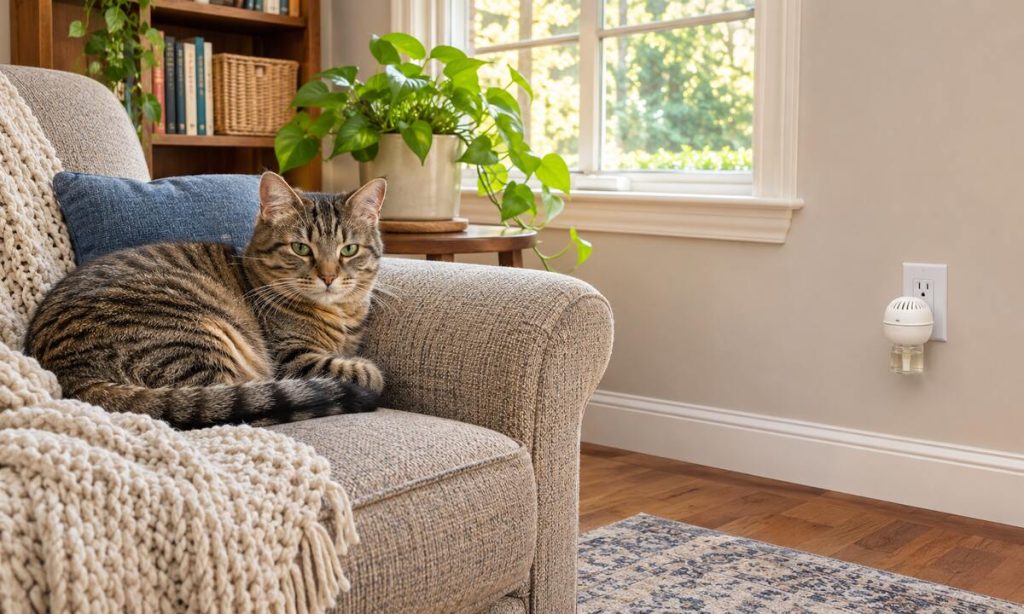
A pheromone diffuser for cats may help some households manage stressful transitions, intercat tension, or changes in routine. But the best fit depends on what the cat is experiencing, where the diffuser will operate, and the limits of the evidence. When learning how to compare pheromone diffuser for cats options by fit and use, begin with a clear behavior goal instead of assuming any pleasant scent is useful.
This guide explains the difference between synthetic feline signals and ordinary fragrances, plus safe placement, monitoring, and environmental support. It does not rank products or promise that a plug-in will resolve anxiety. Cats can respond differently, and stress-like behavior sometimes signals pain or illness. Practical improvements in resource access, predictable routines, and veterinary advice may matter more than a device alone.
Understand the Signal, Not Just the Scent
Cats communicate through chemical signals called pheromones. Synthetic feline pheromone products aim to mimic certain naturally occurring signals, such as those associated with familiar territories or social interactions. These are not interchangeable with essential oils, room perfumes, or other household fragrances. Some scent products can irritate sensitive cats, and certain essential oils pose toxicity concerns. Never substitute scented household products for a feline-specific plan.
The American Veterinary Society of Animal Behavior describes different pheromone analogs used for different behavioral goals. Studies show mixed outcomes across settings and behaviors, so it is reasonable to discuss what evidence applies to your cat’s problem. A diffuser is one possible component of care, not a universal “calm switch.” When comparing a pheromone diffuser for cats, look for a clear statement of the specific intended feline signal without assuming every claimed benefit is equally supported.
Decide Which Behavior You Are Addressing
A new kitten, a resident cat hiding after a house move, and two cats blocking each other’s paths present different challenges. For intercat tension, watch for staring, guarding doorways, chasing, ambushing, or one cat avoiding shared areas. For general stress, changes in hiding, grooming, food intake, and social behavior may be relevant. Document the pattern and possible trigger before introducing a new management tool.
Urinary accidents, sudden aggression, reduced eating, and persistent hiding should never automatically be labeled anxiety. A veterinary examination can rule out illness or pain, including urinary disease and arthritis. Behavioral care works best when the problem is defined precisely. If medications are prescribed, the guide to monitoring veterinary anxiety treatment in cats can help organize observations without replacing veterinary supervision. The clearer the goal, the easier it is to judge whether a diffuser is making a meaningful difference.
Match Placement to a Cat’s Daily Routes
A plug-in may be most useful in a room where the cat actually rests or spends time. Pheromone distribution can be affected by airflow, blocked outlets, furniture, doors, and the size of the space. Do not place an electrical device where bedding, curtains, water bowls, or curious paws create a hazard. Follow its electrical and clearance instructions, and keep the room adequately ventilated without using strong fragrance products.
In a multi-cat home, identify each cat’s preferred resting areas and travel routes before changing the environment. The 2024 feline practice guidelines emphasize giving cats access to separate resources and reducing bottlenecks. See the site’s discussion of litter box locations in a multi-cat home for one practical example. A diffuser placed near a single shared resource cannot fix competition for it. Improving access and exit routes may help more than trying to cover the whole house with scent.
Compare Powered and Unpowered Formats Carefully
Some systems use a wall outlet to disperse a formulation over time; others rely on an unpowered gel or a different release method. The format affects placement flexibility, refill handling, and how consistently the active substance reaches the intended area. Electrical devices require a suitable open outlet. Unpowered units still need stable, safe placement away from children, pets, food surfaces, and heat sources.
Check the instructions for the approved setting, refill schedule, room area, storage, and safe disposal. Verify whether a refill and its dispenser are meant to work together. Never modify heating elements, cover the unit, use it near splashing water, or combine components from unrelated systems. How to compare pheromone diffuser for cats options by fit and use should include practical household constraints and safe operation, not price or a list of unverified promises.
Keep the Environment Doing Its Share
Feline practice guidelines describe environmental management as essential for addressing tension between cats. Provide enough separate food and water locations, litter boxes, resting places, scratching surfaces, elevated escapes, and predictable interaction. A cat that must pass an intimidating housemate to reach a litter box may remain stressed despite a diffuser. The physical setup needs to support choice and safe movement.
Gentle routines also reduce avoidable stress. Establish calm feeding locations, avoid forced contact between cats, and allow hiding spaces during transitions. Our guide to calmer cat mealtimes explains how ordinary mealtime adjustments can help. Brushing that ignores a cat’s body language may add another trigger, so consider low-stress grooming routines when grooming is part of the concern. These changes can be documented separately to understand what actually helps.
Set a Realistic Observation Plan
Before starting a pheromone diffuser for cats, write down the behaviors you want to improve. Note frequency, setting, severity, and possible triggers. Choose specific observations, such as whether two cats can pass a hallway calmly or whether one cat spends more time resting in an open area. Keep the rest of the routine stable where possible, while continuing necessary welfare improvements.
Watch for improvements, no change, or worsening without treating a single peaceful afternoon as proof of effectiveness. Controlled trials have found benefits for certain behaviors, while others reported little or no difference. Results in a shelter or laboratory may not predict an individual home. If signs persist, ask a veterinarian or credentialed veterinary behavior professional to review the plan. Do not postpone professional care because the diffuser has not reached a supposed waiting period.
Recognize Safety and Medical Red Flags
Cats that stop eating, strain to urinate, suddenly become aggressive, seem painful, or stop normal activities need prompt veterinary assessment. Straining with little or no urine is an emergency, especially in male cats. A diffuser does not treat urinary obstruction, dental pain, arthritis, or another medical cause. Even when behavior seems tied to a new environment, medical illness can be present at the same time.
Check the device periodically for excessive heat, leaking material, damaged plugs, or access by a pet. Keep it away from damp locations and never attempt household electrical repairs. If a cat chews or ingests diffuser contents, seek veterinary advice and provide the label information. The right comparison of pheromone diffuser for cats options always includes safety of the household and prompt attention to changes in the cat’s health.
Frequently Asked Questions
Owners often ask whether pheromones are a substitute for training or medication. The short answer is that they may be an adjunct within a broader plan, and the evidence varies by problem. Start with the cat’s actual behavior and a safe environment.
These answers summarize common practical concerns. For ongoing aggression, persistent hiding, elimination changes, or a sudden decline in appetite, ask a veterinarian for an individual assessment rather than relying on general diffuser guidance.
Do all cats respond to a pheromone diffuser?
No. Cats and households vary, and scientific trials have not shown consistent benefits for every situation.
Can I use a regular air freshener instead?
No. Fragrances and essential oils are not feline pheromones, and some scented substances can irritate or harm cats.
Where should a diffuser be placed?
Follow the device’s clearance directions and choose a safe area the cat uses. Avoid blocked outlets, water, curtains, and unsafe electrical arrangements.
Will it stop fighting between two cats?
Not on its own. Address access to resources, safe routes, gradual introductions, and veterinary or behavior-professional advice.
How can I tell if the approach is helping?
Track specific behaviors over time and review the pattern with the care team. A single calm day is not reliable evidence.
Final Words
Learning how to compare pheromone diffuser for cats options by fit and use starts with the cat’s needs. Clarify the behavior, understand the evidence, place any device safely, and measure meaningful changes. A pheromone diffuser for cats may be useful in some homes, but resource access and low-stress handling remain fundamental.
When stress appears suddenly, intensifies, or changes basic behaviors, speak with a veterinarian. Think of synthetic pheromones as a possible supporting tool, not the center of the plan. A home that offers choices, separate resources, and predictable routines gives cats a much stronger foundation for feeling secure.
Reference
The following veterinary behavior and research resources inform this discussion of synthetic pheromones, intercat tension, and mixed treatment evidence. They are cited for clinical context, not as endorsements of a commercial diffuser.
Consider the publication setting and the behavior studied when applying results to a particular cat. A licensed veterinarian can recommend the appropriate next step if a pet is distressed.









